The Deal WithSpreads

Find a layout.
Make it yours.

Start with what your audience needs to understand. Find the right composition, then make it yours with AI.

98 layouts · 143 variations · 8 colours

New here? Start with the AI guide

AI instructions and repository map · Machine-readable catalogue · GitHub repository

Your content, your brand, a better starting point.

Choose the composition that answers your audience’s question. Its public files and adaptation prompt give AI a concrete starting point.

  1. Find the right shape. Search by message, format or code. Read the question on each card before choosing a layout.
  2. Inspect it. Open the preview to see it at full size. Expand “Colour & variations” to try another treatment and check any motion.
  3. Add your brief. Open “Use with AI” and fill in your project, brand and verified content. Then copy the prompt into your AI.
  4. Review what AI makes. Ask for an editable copy in your own project. Check the arrangement, facts, image rights, reading order and target size.

The instructions travel with your prompt

The full prompt keeps the selected layout, content requirements, motion and source credits. You can inspect it under “See the full instructions sent to AI”. Missing facts remain marked; the sample content does not become your evidence.

Your brief stays in this page while you browse; reloading clears it. Without JavaScript, add those three inputs directly to the written prompt. An AI that cannot read the public files will need you to attach the layout and its referenced styles, scripts and images. Source credits remain under “Details & source”; original screenshots and native deck evidence stay in the private reference library.

98 of 98 layouts

Openers and endings

Set the scene. Open, pause or close a story.

16 layouts
Cover adapted layout previewPreview layout

Cover

S01

What subject am I entering, and what does this piece promise?

Colour & variationsPlum · Default
Use with AI

Copy this prompt. Add your content, brand and output format. The public layout files are linked below.

Layout HTML / live preview
Content slots and credits

How to use this prompt
Details & source

Use when
Opening an article or a deck.

Meaning & narrative

Reader question
What subject am I entering, and what does this piece promise?

Reasoning relationship
orientation and reading promise

Meaning and reuse: reviewed · layout interpretation; author intent unverified.

The point
The opening promises a specific argument worth the reader’s attention.

Communication job
Orient the reader to the subject, point of view and scope before evidence begins.

What the audience gains
Orientation: what this is about, why it matters and who is responsible for it.

How to read it
Identify format and subject from the stamp and eyebrow.
Read the large title as the promised point, then the dek as the scope of that promise.
Use byline/date to identify responsibility and currency; treat the artwork as identity, not data.

How to adapt it

Inputs needed
One clear argument or question.
A bounded promise the following story can fulfil.
Author and date; approved identity assets.

What belongs in each slot
stamp: Content format, not the topic.

eyebrow: Topic or dossier that places the piece.

title: The central argument or question; avoid a vague category label.

dek: Explain what the reader will gain and the angle taken.

byline: Author and publication or proposal date.

art: Preserved decorative brand art; not a graph of success.

mark: Preserved TDW wordmark, not evidence or an endorsement.

What can change
Topic, argument, format label and author/date.
Accent word within the title without changing its meaning.

What must survive
Title and dek promise the same story.
Do not turn proposed outcomes into achieved results.
Artwork has no numeric meaning.

Before this page
The invitation or meeting context should identify the audience and purpose.

What it prepares next
Establish the repair decision problem and evidence for the proposed pilot.

Good uses
Pitch openings
Editorial covers
A new visual story

Poor fits
Detailed evidence
A promise the body cannot support

Fictional worked example

Fictional worked example
A fictional repair cooperative is preparing a pilot proposal; all people, events and data are teaching examples.

Example slot fills
stamp: Pilot proposal

eyebrow: Local repair services

title: Make repair easier to choose than replacement

dek: A parts-ready pilot will test whether clearer estimates and reliable appointments can make local repair a practical first choice.

byline: Ari Vale · fictional project lead · 13 October 2026

art: Retain TDW ridgeline artwork as decoration.

mark: Retain the existing TDW wordmark.

Why the example works
The title gives the direction; the dek qualifies it as a test and tells readers what will be examined.

Example qualification
Fictional teaching example. Replace with authorised facts, evidence and destinations before delivery; no results or audience effect are claimed.

Evidence and review limits

Observed in the inspected material
Viewed source: a large two-line proposition, short subtitle, engagement/date metadata and decorative rising line.
Current markup and the named slot contract were inspected.

Interpretation for reuse
Communication job, audience value and adaptation advice are layout-contract interpretations. They are not verified statements of source-author intent.

Not verified
Source-author intent, surrounding source sequence, sample factual claims and audience effect were not independently verified.

References inspected
02_product/spreads/S01-cover/source.webp
dist/S01-cover/spread.html
dist/S01-cover/spread.json
https://github.com/neekchan/hoffman-agency-design-system/blob/main/templates/deck/Deck.dc.html

Review basis
reviewed: Viewed base source capture, inspected current markup/slots and reviewed the example for reasoning fit; no source-intent or empirical validation claim.

Relationship to the default
base

Read the semantic guide · Review coverage

title · airy · 1 column · deck / page

Original reference · Hoffman

Hoffman L01 Cover
Visit original source

Slot reference · all variations

stamp
format label1-2 words
eyebrow
vertical / dossier2-5 words
title
headline, one word may take the lime accentunder 14 words
dek
one-line promiseunder 25 words
byline
author and datemono meta
art
TDW generated ridgeline art, right and bottomgenerated, no photo
mark
TDW wordmark, bottom leftfixed
avatar
opt-photo: round author illustration beside the bylineillustration

Variations

  • Bar Colour bar down the left edge instead of the ridgeline art
  • Photo Cover set over a full-bleed illustration, title block left with an avatar byline

Open live preview
Divider adapted layout previewPreview layout

Divider

S08

Which part begins here, and what question will it answer?

Colour & variationsBeet · Default
Use with AI

Copy this prompt. Add your content, brand and output format. The public layout files are linked below.

Layout HTML / live preview
Content slots and credits

How to use this prompt
Details & source

Use when
Between parts of a long piece; rotate the surface each time.

Meaning & narrative

Reader question
Which part begins here, and what question will it answer?

Reasoning relationship
section navigation

Meaning and reuse: reviewed · layout interpretation; author intent unverified.

The point
The argument is moving into a named new part.

Communication job
Reorient the audience at a chapter boundary.

What the audience gains
Orientation and pacing: tells readers where they are and what question comes next.

How to read it
Read the part marker for location.
Read the title as the next subject or question.
Use the pause to connect the preceding conclusion to the next section.

How to adapt it

Inputs needed
An intentional section boundary.
A title that accurately represents the pages following it.

What belongs in each slot
number: Position in the authored sequence, not priority or importance.

title: The upcoming section’s subject or governing question.

emoji: Deck-only orientation cue; never the only indication of topic.

What can change
Part number and title.
Bar or scene option when it serves the same orientation job.

What must survive
Section title matches what follows.
Numbering matches the actual sequence.

Before this page
Close the current section with a clear takeaway.

What it prepares next
Answer the named question promptly on the following page.

Good uses
Long-form chapter breaks
A pitch moving from problem to response

Poor fits
Evidence pages
Short sequences where another divider adds friction

Fictional worked example

Fictional worked example
A fictional repair cooperative is preparing a pilot proposal; all people, events and data are teaching examples.

Example slot fills
number: Part II

title: What makes a booking dependable?

emoji: Deck-only tool symbol; decorative.

Why the example works
The divider shifts from diagnosing delay to defining dependable service, without pretending to prove anything itself.

Example qualification
Fictional teaching example. Replace with authorised facts, evidence and destinations before delivery; no results or audience effect are claimed.

Evidence and review limits

Observed in the inspected material
Viewed source: numbered part label and large section title with one decorative symbol; no evidence panel.
Current markup and the named slot contract were inspected.

Interpretation for reuse
Communication job, audience value and adaptation advice are layout-contract interpretations. They are not verified statements of source-author intent.

Not verified
Source-author intent, surrounding source sequence, sample factual claims and audience effect were not independently verified.

References inspected
02_product/spreads/S08-divider/source.webp
dist/S08-divider/spread.html
dist/S08-divider/spread.json
https://github.com/neekchan/hoffman-agency-design-system/blob/main/templates/deck/Deck.dc.html

Review basis
reviewed: Viewed base source capture, inspected current markup/slots and reviewed the example for reasoning fit; no source-intent or empirical validation claim.

Relationship to the default
base

Read the semantic guide · Review coverage

section-break · airy · 1 column · deck / page

Original reference · Hoffman

Hoffman L02 Section
Visit original source

Slot reference · all variations

number
part label1-2 words
title
part titleunder 8 words
emoji
one Noto emoji, top right (decks only)1

Variations

  • Bar Colour bar down the left edge
  • Scene Section cover with scene: part title in the top third, a wide scene picture filling the lower two thirds
Open live preview
Close adapted layout previewPreview layout

Close

S14

What final thought closes this argument, and who stands behind it?

Colour & variationsPlum · Default
Use with AI

Copy this prompt. Add your content, brand and output format. The public layout files are linked below.

Layout HTML / live preview
Content slots and credits

How to use this prompt
Details & source

Use when
Ending an article or a deck.

Meaning & narrative

Reader question
What final thought closes this argument, and who stands behind it?

Reasoning relationship
resolution and sign-off

Meaning and reuse: reviewed · layout interpretation; author intent unverified.

The point
The final line leaves the audience with the implication the story has earned.

Communication job
Close with a destination: takeaway, invitation or next step.

What the audience gains
Perspective and resolution: makes clear what to remember or do after the argument.

How to read it
Read the closing sentence as the conclusion.
Read the echo for the practical implication or next action.
Let the identity mark sign off; do not use the ending to introduce new evidence.

How to adapt it

Inputs needed
A conclusion supported by the preceding story.
One appropriate echo or action.
Approved identity artwork.

What belongs in each slot
last-line: The final conclusion or invitation.

echo: The consequence, next step or contact route that follows it.

art: Decorative brand art, retained without numeric meaning.

mark: Preserved identity/sign-off.

What can change
Conclusion and echo.
Contact route if supplied and authorised.

What must survive
Ending follows from the argument.
One next step rather than several competing asks.

Before this page
Resolve evidence, cost and limitations before arriving here.

What it prepares next
A decision, conversation or explicitly scoped next step.

Good uses
Pitch endings
An editorial final insight
A clear call to discuss

Poor fits
New evidence
An appendix index
A promise broader than the proposal

Fictional worked example

Fictional worked example
A fictional repair cooperative is preparing a pilot proposal; all people, events and data are teaching examples.

Example slot fills
last-line: Make fewer promises we cannot keep.

echo: Approve a small parts-readiness pilot, then review its failures as closely as its successes.

art: Retain the decorative TDW ridgeline.

mark: Retain the TDW wordmark.

Why the example works
The close returns to reliability and asks for a bounded test rather than claiming the service already works.

Example qualification
Fictional teaching example. Replace with authorised facts, evidence and destinations before delivery; no results or audience effect are claimed.

Evidence and review limits

Observed in the inspected material
Viewed source: a large invitation, a short contact line and identity artwork; current markup adapts the same ending to a takeaway plus echo.
Current markup and the named slot contract were inspected.

Interpretation for reuse
Communication job, audience value and adaptation advice are layout-contract interpretations. They are not verified statements of source-author intent.

Not verified
Source-author intent, surrounding source sequence, sample factual claims and audience effect were not independently verified.

References inspected
02_product/spreads/S14-close/source.webp
dist/S14-close/spread.html
dist/S14-close/spread.json
https://github.com/neekchan/hoffman-agency-design-system/blob/main/templates/deck/Deck.dc.html

Review basis
reviewed: Viewed base source capture, inspected current markup/slots and reviewed the example for reasoning fit; no source-intent or empirical validation claim.

Relationship to the default
base

Read the semantic guide · Review coverage

close · airy · 1 column · deck / page

Original reference · Hoffman

Hoffman L30 Closing
Visit original source

Slot reference · all variations

last-line
the closing sentence; its last phrase may take the lime accentunder 16 words
echo
one line afterunder 20 words
art
TDW generated ridgeline artgenerated
mark
TDW wordmark, bottom leftfixed
Open live preview
Contents adapted layout previewPreview layout

Contents

S21

Which sections will I read, and in what order?

Colour & variationsPaper · Default
Use with AI

Copy this prompt. Add your content, brand and output format. The public layout files are linked below.

Layout HTML / live preview
Content slots and credits

How to use this prompt
Details & source

Use when
Showing the shape of the journey near the start: a short, scannable table of contents with titles only.

Meaning & narrative

Reader question
Which sections will I read, and in what order?

Reasoning relationship
contents and narrative order

Meaning and reuse: reviewed · layout interpretation; author intent unverified.

The point
The audience can see the route through the story before taking it.

Communication job
Provide a short map of the authored sequence.

What the audience gains
Orientation: reduces uncertainty about scope and helps readers locate a later section.

How to read it
Read the list label and large organising word.
Scan numbered section titles in the order the argument will follow.
Use titles to anticipate questions, without treating the agenda as evidence.

How to adapt it

Inputs needed
Three to five actual major sections.
Accurate ordering and concise titles.

What belongs in each slot
eyebrow: Name the scope of this contents list.

items: Three to five ordered section names; optional decorative deck symbols do not carry essential information.

word: One organising label for the list.

What can change
Section names and three-to-five count.
The supported contents option when page references matter.

What must survive
Titles correspond to actual sections.
Order matches the real argument.

Before this page
Introduce the proposal’s central promise.

What it prepares next
Begin the first section with the question the agenda names.

Good uses
A substantial pitch
A long visual story
A document needing way-finding

Poor fits
A short self-explanatory sequence
A list of benefits masquerading as an agenda

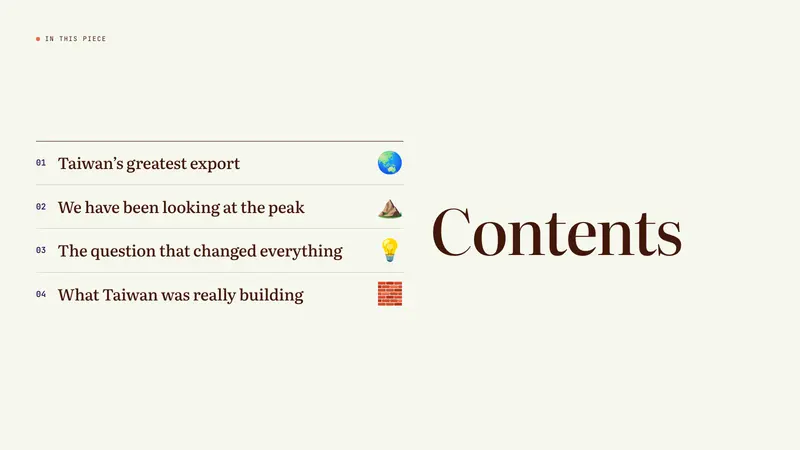
Fictional worked example

Fictional worked example
Fictional repair cooperative proposal; all events, people and evidence are invented teaching material.

Example slot fills
eyebrow: In this proposal

items: 01 Why bookings fail
02 What readiness means
03 How the pilot works
04 What we will measure

word: Contents

Why the example works
The map moves from diagnosis to definition, method and evaluation, so each later section has a clear role.

Example qualification
Fictional teaching example only. Proposed benefits and results are not verified; replace with authorised material for a real use.

Evidence and review limits

Observed in the inspected material
Viewed source: four numbered agenda rows under a small label, with one oversized organising word beside them.
Current HTML and active slot contract were inspected.

Interpretation for reuse
The guidance interprets the layout’s communication affordances; it does not assert source-author intent.

Not verified
Original author intent, surrounding source sequence, sample factual claims and persuasion effects are not independently verified.

References inspected
02_product/spreads/S21-agenda/source.webp
dist/S21-agenda/spread.html
dist/S21-agenda/spread.json
https://github.com/neekchan/hoffman-agency-design-system/blob/main/templates/deck/Deck.dc.html

Review basis
reviewed: Viewed retained source capture and inspected current markup/slot contract; reviewed reasoning and example mapping. This is layout-contract review, not source-intent confirmation.

Relationship to the default
base

Read the semantic guide · Review coverage

contents · airy · 2 columns · deck / page

Original reference · Hoffman

Hoffman L03 Agenda
Visit original source

Slot reference · all variations

eyebrow
what the list is, top left2-4 words
items
3-5 rows on hairlines: mono number, part title, one Noto emoji at the right end (decks only)under 6 words each, no descriptions
word
one huge word on the right naming the list1 word

Variations

  • Toc Table of contents: small title above one centred column, indented sub-entries, hairline leaders to page numbers
Open live preview
Centred motif adapted layout previewPreview layout

Centred motif

S51

What brief idea should this central motif make memorable?

Colour & variationsPlum · Default
Use with AI

Copy this prompt. Add your content, brand and output format. The public layout files are linked below.

Layout HTML / live preview
Content slots and credits

How to use this prompt
Details & source

Use when
Opening a section with warmth, or a rally line before the next part of the argument.

Meaning & narrative

Reader question
What brief idea should this central motif make memorable?

Reasoning relationship
setup, motif and emphatic headline

Meaning and reuse: reviewed · layout interpretation; author intent unverified.

The point
One already-established idea becomes the memorable hinge or closing thought.

Communication job
Answer which short idea the audience should carry into the next section.

What the audience gains
Perspective and pacing: offers a brief pause that names the argument’s destination; it adds no evidence.

How to read it
Read the setup as the bridge from the preceding argument.
Use the central motif as a mnemonic.
Land on the few-word headline as the one idea to retain.

How to adapt it

Inputs needed
One established idea.
A short setup and one legible, appropriate motif.

What belongs in each slot
setup: Connect the preceding evidence to the takeaway.

motif: One mnemonic symbol; it must not carry meaning the words omit.

headline: Name the single idea in fewer than four words.

What can change
Subject, names and wording within the active slot roles.
Illustrations or supporting values where present, with their provenance and limits.

What must survive
One idea, explicitly stated in words.
No invented proof from emotional emphasis.

Before this page
Show how people learn through the program.

What it prepares next
Introduce the capability-building plan or close the talk.

Good uses
A talk hinge or final emphasis.

Poor fits
A standalone evidence claim.
Editorial web content requiring deck-only emoji.

Fictional worked example

Fictional worked example
A fictional repair-cooperative pitch turns from tools to member skills.

Example slot fills
setup: Tools help. Shared skills last.

motif: One sprouting-seed motif, deck-only.

headline: Build capability.

Why the example works
The seed reinforces the idea of skills developing over time; the preceding section must already have established why capability matters.

Example qualification
Every organization, value and assertion in this example is fictional. Replace it with approved, sourced content before use.

Evidence and review limits

Observed in the inspected material
Retained reference is a short setup above one centered emoji and a huge closing phrase.
Current markup supplies those three slots only.

Interpretation for reuse
The communication job and reuse advice are inferred from the current arrangement and slot contract, not independently confirmed source intent.

Not verified
Original author intent, factual accuracy of sample copy and persuasion effects are not verified.
No confidential archive or proposal corpus was used.

References inspected
dist/S51-centered-motif/spread.json
dist/S51-centered-motif/spread.html
02_product/spreads/S51-centered-motif/source.webp (viewed for arrangement)

Review basis
reviewed: Motif inspected current metadata, active markup and the retained source arrangement, then checked the fictional example against the content roles. This is a layout-contract adaptation review.

Relationship to the default
base

Read the semantic guide · Review coverage

section-break · airy · 1 column · deck / page

Original reference · Hoffman

Hoffman L47 Centered motif
Visit original source

Slot reference · all variations

setup
short line above, first phrase in mintunder 7 words
motif
one Noto emoji, centred (decks only)1
headline
huge, centred, limeunder 4 words
Open live preview
Script and acronym adapted layout previewPreview layout

Script and acronym

S54

What does each letter of this named acronym stand for?

Colour & variationsMint · Default
Use with AI

Copy this prompt. Add your content, brand and output format. The public layout files are linked below.

Layout HTML / live preview
Content slots and credits

How to use this prompt
Details & source

Use when
A playful opener for a section, region or programme that has a short name worth decoding.

Meaning & narrative

Reader question
What does each letter of this named acronym stand for?

Reasoning relationship
acronym and definition

Meaning and reuse: reviewed · layout interpretation; author intent unverified.

The point
A short name is decoded into its component meaning.

Communication job
Answer what this acronym stands for and why it is being introduced.

What the audience gains
Orientation and recall: gives the audience a pronounceable label and its expansion, without making a brand name an argument.

How to read it
Read the small greeting or setup.
Identify the acronym.
Read its expansion in the same letter order.

How to adapt it

Inputs needed
A legitimate three-to-five-letter acronym.
An exact expansion and a suitable short setup.

What belongs in each slot
script: A brief greeting or setup; preserve the source’s letter treatment only if appropriate to the delivery context.

acronym: The actual short name, three to five letters.

expansion: One word or phrase per letter group, in exactly the same order.

What can change
Subject, names and wording within the active slot roles.
Illustrations or supporting values where present, with their provenance and limits.

What must survive
Exact letter-to-meaning mapping.
Deck-specific stretched-letter decoration does not become editorial permission.

Before this page
Establish the context in which the named program will be used.

What it prepares next
Explain its promise or operating model.

Good uses
Introducing a new team or program name.

Poor fits
An acronym whose letters do not match its expansion.
A reasoning framework forced into a catchy word.

Fictional worked example

Fictional worked example
A fictional repair cooperative introduces its abbreviated name.

Example slot fills
script: hello

acronym: RHC

expansion: Repair Hub Collective

Why the example works
The expansion makes a new name intelligible immediately; it does not imply that a clever acronym proves the concept.

Example qualification
Every organization, value and assertion in this example is fictional. Replace it with approved, sourced content before use.

Evidence and review limits

Observed in the inspected material
Retained reference centers a short stylized greeting, large acronym and expansion.
Current markup repeats the greeting’s middle letter decoratively.

Interpretation for reuse
The communication job and reuse advice are inferred from the current arrangement and slot contract, not independently confirmed source intent.

Not verified
Original author intent, factual accuracy of sample copy and persuasion effects are not verified.
No confidential archive or proposal corpus was used.

References inspected
dist/S54-script-acronym/spread.json
dist/S54-script-acronym/spread.html
02_product/spreads/S54-script-acronym/source.webp (viewed for arrangement)

Review basis
reviewed: Motif inspected current metadata, active markup and the retained source arrangement, then checked the fictional example against the content roles. This is a layout-contract adaptation review.

Relationship to the default
base

Read the semantic guide · Review coverage

acronym · airy · 1 column · deck / page

Original reference · Hoffman

Hoffman L50 Script + acronym
Visit original source

Slot reference · all variations

script
small italic word, middle letters repeated and multicolouredunder 9 letters
acronym
huge, centred, plum3-5 letters
expansion
one word or phrase per letter group, berry1-3 words each
Open live preview
Questions adapted layout previewPreview layout

Questions

S55

What question should we discuss before moving on?

Colour & variationsBerry · Default
Use with AI

Copy this prompt. Add your content, brand and output format. The public layout files are linked below.

Layout HTML / live preview
Content slots and credits

How to use this prompt
Details & source

Use when
The questions or discussion moment near the end of a talk.

Meaning & narrative

Reader question
What question should we discuss before moving on?

Reasoning relationship
discussion invitation

Meaning and reuse: reviewed · layout interpretation; author intent unverified.

The point
The talk pauses for the audience’s questions.

Communication job
Signal a clear transition from presenting to listening.

What the audience gains
Permission and orientation: invites uncertainty into the discussion without implying that objections have been resolved.

How to read it
Read the large Q&A label.
The raised-hand row reinforces that the audience now has the floor.

How to adapt it

Inputs needed
A real discussion opportunity.
A facilitator ready to handle questions.

What belongs in each slot
label: Name the discussion moment in one to three words.

emoji-row: Five decorative raised-hand figures, deck-only; the label carries the meaning.

What can change
Subject, names and wording within the active slot roles.
Illustrations or supporting values where present, with their provenance and limits.

What must survive
The invitation is real and accessible in text.
Decorative figures do not imply actual participation.

Before this page
Finish the argument and name the decision or uncertainty worth discussing aloud.

What it prepares next
Answer questions, record unresolved points and restate the next action.

Good uses
A facilitated presentation discussion.

Poor fits
An asynchronous page with no way to respond.
A substitute for a clear closing recommendation.

Fictional worked example

Fictional worked example
A fictional workshop proposal pauses for member questions.

Example slot fills
label: Questions welcome

emoji-row: Raised hand 1; Raised hand 2; Raised hand 3; Raised hand 4; Raised hand 5

Why the example works
The page yields attention to the audience. It contains no hidden claim or vote.

Example qualification
Every organization, value and assertion in this example is fictional. Replace it with approved, sourced content before use.

Evidence and review limits

Observed in the inspected material
Retained and current layouts show a large discussion label over a row of raised-hand motifs.

Interpretation for reuse
The communication job and reuse advice are inferred from the current arrangement and slot contract, not independently confirmed source intent.

Not verified
Original author intent, factual accuracy of sample copy and persuasion effects are not verified.
No confidential archive or proposal corpus was used.

References inspected
dist/S55-q-a/spread.json
dist/S55-q-a/spread.html
02_product/spreads/S55-q-a/source.webp (viewed for arrangement)

Review basis
reviewed: Motif inspected current metadata, active markup and the retained source arrangement, then checked the fictional example against the content roles. This is a layout-contract adaptation review.

Relationship to the default
base

Read the semantic guide · Review coverage

close · airy · 1 column · deck / page

Original reference · Hoffman

Hoffman L51 Q&A
Visit original source

Slot reference · all variations

label
huge, centred, bone with one lime character1-3 words
emoji-row
5 overlapping raised-hand Noto emoji along the base (decks only)5
Open live preview
Centred hero adapted layout previewPreview layout

Centred hero

S62

What is promised, what can I do, and what does the product look like?

Colour & variationsDeep · Default
Use with AI

Copy this prompt. Add your content, brand and output format. The public layout files are linked below.

Layout HTML / live preview
Content slots and credits

How to use this prompt
Details & source

Use when
When the reader should see what TDW is and what to do next before anything else, with the product (or one picture) right below.

Meaning & narrative

Reader question
What is promised, what can I do, and what does the product look like?

Reasoning relationship
offer, supporting line and product view

Meaning and reuse: reviewed · layout interpretation; author intent unverified.

The point
An opening promise connects to a concrete product view and two clearly different next actions.

Communication job
Answer what this offer does, why it is relevant and how to begin or inspect it further.

What the audience gains
Orientation: turns an unfamiliar offer into an understandable first step; the product view can illustrate the mechanism but does not prove results.

How to read it
Read the small update label and central promise.
Use the supporting sentence to define the promise’s scope.
Choose the primary or secondary action, with the product view showing what the offer refers to.

How to adapt it

Inputs needed
One honest promise and bounded explanation.
A truthful update label.
Two real destinations with different commitment levels.
A product view labeled as illustrative if it is not the actual product.

What belongs in each slot
pill: A truthful update or category cue; do not invent novelty.

headline: The primary benefit or job the offer performs.

blurb: Explain for whom and how, including a necessary limit.

buttons: Primary start action plus quieter inspect/learn action; each needs a real destination.

screen: Illustrate the relevant product workflow and state; the token-drawn screen is a specimen, not proof of shipped functionality.

What can change
Subject, names and wording within the active slot roles.
Illustrations or supporting values where present, with their provenance and limits.

What must survive
Promise, screen and action describe the same offer.
Demonstration and released capability remain distinct.
No placeholder href or fake field is presented as a completed action.

Before this page
Identify the audience or arrive from a relevant invitation.

What it prepares next
Demonstrate the workflow, show evidence, and explain availability before asking for commitment.

Good uses
Product or pitch opener with an understandable workflow.

Poor fits
An unsupported superlative.
A mock screen passed off as a functioning service.

Fictional worked example

Fictional worked example
A fictional repair-booking workspace introduces its purpose.

Example slot fills
pill: Pilot · Repair bookings in one place

headline: Know where your repair request stands.

blurb: A fictional booking workspace keeps intake notes, appointments and handover status together for volunteer repair teams.

buttons: View sample / Read method

screen: Illustrative workspace: request list at left, selected lamp intake note at right, appointment and handover state clearly labeled.

Why the example works
The promise is made concrete by the request-to-handover workflow. The two actions distinguish seeing an example from understanding the process.

Example qualification
Every organization, value and assertion in this example is fictional. Replace it with approved, sourced content before use.

Evidence and review limits

Observed in the inspected material
Retained source centers a promise and actions above a large product screen.
Current default shows pill, headline, blurb, buttons and token-drawn screen; image branches are hidden.

Interpretation for reuse
The communication job and reuse advice are inferred from the current arrangement and slot contract, not independently confirmed source intent.

Not verified
Original author intent, factual accuracy of sample copy and persuasion effects are not verified.
No confidential archive or proposal corpus was used.

References inspected
dist/S62-centred-hero/spread.json
dist/S62-centred-hero/spread.html
02_product/spreads/S62-centred-hero/source.webp (viewed for arrangement)

Review basis
reviewed: Motif inspected current metadata, active markup and the retained source arrangement, then checked the fictional example against the content roles. This is a layout-contract adaptation review.

Relationship to the default
base

Read the semantic guide · Review coverage

hero · airy · 1 column · deck / page

Original reference · Tailark

Tailark dusk hero 1
Visit original source

Slot reference · all variations

pill
a small label with a highlighted word: what is new1 highlighted word + under 7 words
headline
the promise, centred, two linesunder 9 words
blurb
one sentence that explains the promiseunder 25 words
buttons
a main action and a quieter second action2-3 words each
screen
a product screen drawn from tokens (window bar, sidebar, list, reading pane), full content width, cut off by the frame bottomno copy
illustration
photo option: one wide illustration in place of the screen; picture-first option: one object above the headline16:9

Variations

  • Framed The screen sits inside a coloured gradient frame
  • Photo A full-width illustration instead of the screen
  • Picture first One illustration above the centred headline, no screen
  • Cta Closing call to action: centred title, one line, one button and a small text link; no pill, no picture
  • Signup Centred headline over a full-bleed scene; the buttons become one bar of two fields and a button
Open live preview
Split header hero adapted layout previewPreview layout

Split header hero

S63

How does this product promise connect to the preview and next action?

Colour & variationsDeep · Default
Use with AI

Copy this prompt. Add your content, brand and output format. The public layout files are linked below.

Layout HTML / live preview
Content slots and credits

How to use this prompt
Details & source

Use when
When the headline should read like a title and the action sits beside it rather than under it, with the product or one wide picture taking the rest of the frame.

Meaning & narrative

Reader question
How does this product promise connect to the preview and next action?

Reasoning relationship
split promise and product demonstration

Meaning and reuse: reviewed · layout interpretation; author intent unverified.

The point
A concise promise and next action are connected by one shared product demonstration.

Communication job
Answer what the product offers and what the preview shows about that offer.

What the audience gains
Orientation: keeps proposition and explanation separate enough to read quickly, while the wide preview gives both a common referent.

How to read it
Read the left headline as the offer.
Read the right explanation and action to understand its scope and next step.
Inspect the wide screen below as the example of the same offer.

How to adapt it

Inputs needed
One promise, one short explanation and one destination.
A relevant, honestly labeled product view.

What belongs in each slot
headline: State the job or benefit plainly.

blurb: Clarify audience or mechanism in one line.

button: Name the next action and connect it to a real destination.

screen: Show the relevant workflow; a mock screen needs an illustrative label.

What can change
Subject, names and wording within the active slot roles.
Illustrations or supporting values where present, with their provenance and limits.

What must survive
Headline, supporting line and visual refer to the same capability.
Prototype status stays explicit.

Before this page
Establish the repair team’s coordination problem.

What it prepares next
Demonstrate one request moving through the workflow.

Good uses
A product or solution opener.

Poor fits
A preview unrelated to the promise.
An action with no real destination.

Fictional worked example

Fictional worked example
A fictional repair-booking workspace introduces handover coordination.

Example slot fills
headline: Keep every repair handover in view.

blurb: A fictional workspace joins intake notes to appointment and handover status.

button: View sample

screen: Illustrative list of repair requests and the selected request’s dated handover note.

Why the example works
Both text blocks refer to handover continuity; the screen is an example of that workflow, not evidence of adoption.

Example qualification
Every organization, value and assertion in this example is fictional. Replace it with approved, sourced content before use.

Evidence and review limits

Observed in the inspected material
Retained source splits headline and supporting action across the top, with a wide product screen below.
Current default keeps those parts; photo and row replace the visual region.

Interpretation for reuse
The communication job and reuse advice are inferred from the current arrangement and slot contract, not independently confirmed source intent.

Not verified
Original author intent, factual accuracy of sample copy and persuasion effects are not verified.
No confidential archive or proposal corpus was used.

References inspected
dist/S63-split-header-hero/spread.json
dist/S63-split-header-hero/spread.html
02_product/spreads/S63-split-header-hero/source.webp (viewed for arrangement)

Review basis
reviewed: Motif inspected current metadata, active markup and the retained source arrangement, then checked the fictional example against the content roles. This is a layout-contract adaptation review.

Relationship to the default
base

Read the semantic guide · Review coverage

hero · airy · 1 column · deck / page

Original reference · Tailark

Tailark dusk hero 2
Visit original source

Slot reference · all variations

headline
the promise, top-left, two linesunder 9 words
blurb
one line on the right, level with the headline's last lineunder 15 words
button
the main action under the blurb2-3 words
screen
a product screen drawn from tokens (window bar, sidebar, list, reading pane) in a thin frame, spanning the width, cut off by the frame bottomno copy
illustration
photo option: one wide illustration in place of the screen16:9

Variations

  • Photo A wide illustration instead of the screen
  • Row A row of three small cards (figure, label, one line) under the split header instead of the screen
Open live preview
Logo strip hero adapted layout previewPreview layout

Logo strip hero

S64

What offer is supported by these named relationships?

Colour & variationsPlum · Default
Use with AI

Copy this prompt. Add your content, brand and output format. The public layout files are linked below.

Layout HTML / live preview
Content slots and credits

How to use this prompt
Details & source

Use when
When who stands behind TDW matters as much as the headline, and one picture carries the mood of the page.

Meaning & narrative

Reader question
What offer is supported by these named relationships?

Reasoning relationship
offer and verified affiliations

Meaning and reuse: reviewed · layout interpretation; author intent unverified.

The point
An offer is introduced alongside named, qualified relationships and a view of its use.

Communication job
Answer who is connected to this offer and what those relationships actually mean.

What the audience gains
Reassurance with boundaries: provides identifiable context, while avoiding a false implication that every displayed mark endorses the offer.

How to read it
Read the promise.
Read the relationship label before interpreting the logo row.
Use the large illustration and device as context for the offer, not proof of adoption.

How to adapt it

Inputs needed
A supported promise.
Five or six authorized marks with one explicit relationship definition.
An illustration and device specimen consistent with the offer.

What belongs in each slot
headline: Name the offer without overstating what partner marks establish.

logos: Five or six authorized marks and an explicit relation such as pilot locations; no implied endorsement.

illustration: Show use context; distinguish generative illustration from evidence.

device: A small decorative product specimen; essential claims must also be in accessible text.

What can change
Subject, names and wording within the active slot roles.
Illustrations or supporting values where present, with their provenance and limits.

What must survive
Every mark’s relationship is stated and true.
Proposed, current and past relationships remain distinct.
Decorative device content cannot carry the only essential fact.

Before this page
Explain the service and the status of the relationships.

What it prepares next
Show a confirmed pilot schedule or partnership terms.

Good uses
An accurately qualified partner or host introduction.

Poor fits
Client-logo proof without authorization.
A decorative logo row treated as adoption evidence.

Fictional worked example

Fictional worked example
A fictional repair service illustrates proposed neighborhood hosts.

Example slot fills
headline: Repair support, hosted close to home.

logos: River Library · proposed host
Market Hall · proposed host
East School · proposed host
Cedar Club · proposed host
Canal Center · proposed host
Hill Rooms · proposed host

illustration: Illustrative neighborhood hall before a repair session.

device: Pilot calendar specimen

Why the example works
The marks identify proposed venues, not customers or endorsers. The explicit relationship does the semantic work that logos alone cannot.

Example qualification
All named organizations are fictional proposed hosts. None represents endorsement, a confirmed agreement or an actual user.

Evidence and review limits

Observed in the inspected material
Retained source places a centered promise above logos and a wide scene with a device.
Current device is aria-hidden, so its content must remain nonessential.

Interpretation for reuse
The communication job and reuse advice are inferred from the current arrangement and slot contract, not independently confirmed source intent.

Not verified
Original author intent, factual accuracy of sample copy and persuasion effects are not verified.
No confidential archive or proposal corpus was used.

References inspected
dist/S64-logo-strip-hero/spread.json
dist/S64-logo-strip-hero/spread.html
02_product/spreads/S64-logo-strip-hero/source.webp (viewed for arrangement)

Review basis
reviewed: Motif inspected current metadata, active markup and the retained source arrangement, then checked the fictional example against the content roles. This is a layout-contract adaptation review.

Relationship to the default
base

Read the semantic guide · Review coverage

hero · airy · 1 column · deck / page

Original reference · Tailark

Tailark dusk hero 3
Visit original source

Slot reference · all variations

headline
a short centred headline; the first half quieter, the second half full strengthunder 12 words
logos
a centred row of partner or reader logos (placeholder marks until real ones are agreed)5-6 logos
illustration
one illustration running nearly edge to edge and off the frame bottom16:9
device
a phone drawn from tokens standing in the middle of the picture: a label, a short two-line figure, a small bar chartunder 5 words

Variations

  • Strip Logo strip: title and a small note top-left, a hairline, one row of four logos (the last on a plate), no picture
Open live preview
Object hero adapted layout previewPreview layout

Object hero

S65

What offer does this object introduce, and what can I try next?

Colour & variationsDeep · Default
Use with AI

Copy this prompt. Add your content, brand and output format. The public layout files are linked below.

Layout HTML / live preview
Content slots and credits

How to use this prompt
Details & source

Use when
Opening a product or publication page where one striking object carries the mood and the logo row shows who reads or partners with us.

Meaning & narrative

Reader question
What offer does this object introduce, and what can I try next?

Reasoning relationship
offer, focal object and prompt invitation

Meaning and reuse: reviewed · layout interpretation; author intent unverified.

The point
An unfamiliar offer is made concrete through a memorable object and an example of what a reader could ask.

Communication job
Answer what this offer helps me do and what a first interaction would look like.

What the audience gains
Orientation and perspective: the object creates a recognizable subject; the prompt illustrates a use case but does not prove a working service.

How to read it
Read the promise and explanatory sentence.
Use the object to orient to the subject, then read the sample ask as a concrete starting point.
Choose a real action; interpret the bottom marks only under their stated relationship.

How to adapt it

Inputs needed
One bounded promise.
Two meaningful destinations.
One illustrative object, a representative sample ask and five or six qualified marks.

What belongs in each slot
headline: Name the reader job.

blurb: Explain the scope in plain words.

buttons: Primary action and a lower-commitment alternative; key hints must correspond to real behavior.

illustration: One sculptural cutout as a mnemonic, not documentary proof.

prompt-card: An example ask; the current card is decorative and aria-hidden, so essential instructions belong in visible accessible text.

logos: Five or six authorized marks with explicit relationship status.

What can change
Subject, names and wording within the active slot roles.
Illustrations or supporting values where present, with their provenance and limits.

What must survive
Example ask fits the actual offer.
Decorative object never substitutes for capability evidence.
Prototype and partner status remain explicit.

Before this page
Identify the intake problem and clarify whether this is a concept or working guide.

What it prepares next
Show a complete sample answer, including limits and sources.

Good uses
A concept opener with a representative first task.

Poor fits
A decorative prompt mistaken for a functioning input.
Logos treated as customer proof.

Fictional worked example

Fictional worked example
A fictional repair intake guide introduces a concrete reader question.

Example slot fills
headline: Start with the repair question.

blurb: A fictional guide helps volunteers find the right intake procedure before a session.

buttons: Read sample / See coverage

illustration: A single sculptural lamp assembled from labeled, generic tool forms; clearly illustrative.

prompt-card: How should I record an intermittent lamp fault?

logos: River Library · proposed host
Market Hall · proposed host
East School · proposed host
Cedar Club · proposed host
Canal Center · proposed host
Hill Rooms · proposed host

Why the example works
The sample ask connects the abstract offer to a real reader task. The object and marks cannot certify answer quality or a live assistant.

Example qualification
Every organization, value and assertion in this example is fictional. Replace it with approved, sourced content before use.

Evidence and review limits

Observed in the inspected material
Retained source shows left promise/actions, right object and floating ask, with a bottom logo row.
Current prompt-card is aria-hidden and provides no working input.

Interpretation for reuse
The communication job and reuse advice are inferred from the current arrangement and slot contract, not independently confirmed source intent.

Not verified
Original author intent, factual accuracy of sample copy and persuasion effects are not verified.
No confidential archive or proposal corpus was used.

References inspected
dist/S65-object-hero/spread.json
dist/S65-object-hero/spread.html
02_product/spreads/S65-object-hero/source.webp (viewed for arrangement)

Review basis
reviewed: Motif inspected current metadata, active markup and the retained source arrangement, then checked the fictional example against the content roles. This is a layout-contract adaptation review.

Relationship to the default
base

Read the semantic guide · Review coverage

hero · airy · 2 columns · deck / page

Original reference · Tailark

Tailark dusk hero 4
Visit original source

Slot reference · all variations

headline
the promise, leftunder 9 words
blurb
one plain sentence under the headlineunder 20 words
buttons
primary button and a ghost button with a key hint2-4 words each
illustration
a single sculptural object cut out on a plain background, fills the right column, fades out at the bottom4:3
prompt-card
an ask box floating over the object: placeholder line, two tool icons, send buttonunder 12 words
logos
placeholder logo marks along the bottom edge5-6 names

Variations

  • Plain Object alone, without the prompt card
Open live preview
Orbit hero adapted layout previewPreview layout

Orbit hero

S66

Which topics does this offer help me explore?

Colour & variationsPaper · Default
Use with AI

Copy this prompt. Add your content, brand and output format. The public layout files are linked below.

Layout HTML / live preview
Content slots and credits

How to use this prompt
Details & source

Use when
Opening a landing page or a deck where the breadth of what we cover (topics, sections, sources) is the point, shown as a light constellation rather than a list.

Meaning & narrative

Reader question
Which topics does this offer help me explore?

Reasoning relationship
offer and topic cluster

Meaning and reuse: reviewed · layout interpretation; author intent unverified.

The point
The offer spans a defined set of topics, all gathered under one promise.

Communication job
Answer what kinds of question this offer covers.

What the audience gains
Orientation: gives a sense of breadth while avoiding a promise of exhaustive knowledge or equal support for every topic.

How to read it
Read the promise and scope sentence.
Scan the topic chips as illustrative coverage cues, not a ranked or navigable taxonomy.
Use the single action to reach the real content or coverage description.

How to adapt it

Inputs needed
A bounded promise and real destination.
Nine short topic labels that genuinely fit the offer.

What belongs in each slot
headline: State the main reader job.

blurb: Define coverage and any essential limit in accessible text.

button: A real next action.

chips: Nine topic cues; their scattered positions and blur do not encode ranking, availability or confidence.

What can change
Subject, names and wording within the active slot roles.
Illustrations or supporting values where present, with their provenance and limits.

What must survive
Nine labels stay within actual coverage.
Essential scope is in accessible text; current chips are aria-hidden.
Position and blur are decorative, not semantic encodings.

Before this page
Identify the volunteer’s need and the guide’s limits.

What it prepares next
Open a guide that makes the topics and exclusions explicit.

Good uses
A concise coverage opener.

Poor fits
Essential navigation hidden in decorative chips.
A ranked comparison of capabilities.

Fictional worked example

Fictional worked example
A fictional repair preparation guide introduces its coverage.

Example slot fills
headline: Prepare a safer repair session.

blurb: A fictional volunteer guide covers intake, supervision and referrals; it does not replace specialist safety training.

button: Read guide

chips: Intake
Tools
Supervision
Diagnosis
Records
Referral
Parts
Handover
Follow-up

Why the example works
The chips illustrate the breadth stated in the blurb. They do not imply each topic is a working feature or clickable category.

Example qualification
Every organization, value and assertion in this example is fictional. Replace it with approved, sourced content before use.

Evidence and review limits

Observed in the inspected material
Retained source has centered promise/action and loose topic chips.
Current .cloud is aria-hidden with nine labels; the option changes order only.

Interpretation for reuse
The communication job and reuse advice are inferred from the current arrangement and slot contract, not independently confirmed source intent.

Not verified
Original author intent, factual accuracy of sample copy and persuasion effects are not verified.
No confidential archive or proposal corpus was used.

References inspected
dist/S66-orbit-hero/spread.json
dist/S66-orbit-hero/spread.html
02_product/spreads/S66-orbit-hero/source.webp (viewed for arrangement)

Review basis
reviewed: Motif inspected current metadata, active markup and the retained source arrangement, then checked the fictional example against the content roles. This is a layout-contract adaptation review.

Relationship to the default
base

Read the semantic guide · Review coverage

hero · airy · 1 column · deck / page

Original reference · Tailark

Tailark veil hero 1
Visit original source

Slot reference · all variations

headline
the promise, centredunder 9 words
blurb
one plain sentenceunder 20 words
button
one call to action with a chevron2-3 words
chips
small rounded pills, each an icon mark and a neutral name (topics, never real brands); alternate chips blurred9 chips, 1-2 words each

Variations

  • Chips above Chip cluster above the headline
Open live preview

Additional composition references: Tailark veil hero 2 (chips above the headline): https://oss.tailark.com/view/veil-hero-section-2?theme=light

Prompt hero adapted layout previewPreview layout

Prompt hero

S67

What kinds of questions can I bring to this experience?

Colour & variationsPaper · Default
Use with AI

Copy this prompt. Add your content, brand and output format. The public layout files are linked below.

Layout HTML / live preview
Content slots and credits

How to use this prompt
Details & source

Use when
Opening a page that invites the reader to ask or search, where sample questions show the range of what they can ask. With the signup option, the standard newsletter hero for the publication.

Meaning & narrative

Reader question
What kinds of questions can I bring to this experience?

Reasoning relationship
promise and question-led entry

Meaning and reuse: reviewed · layout interpretation; author intent unverified.

The point
This experience has a defined subject; representative questions show the kinds of help available.

Communication job
Help a new visitor recognise a relevant question and understand where to begin.

What the audience gains
Orientation reduces uncertainty about scope and the next action. The examples demonstrate breadth of intended coverage; they are not evidence that the service can answer accurately.

How to read it
Read the promise and boundary on the left first.
Scan the questions on the right to recognise concrete tasks within that boundary. They are parallel examples, not ranked questions or a process.
The central ask illustration connects those examples to the idea of a starting interaction; the left button must lead to the actual available destination.

How to adapt it

Inputs needed
A bounded subject and audience.
Twelve representative questions grounded in actual coverage.
A real destination and explicit distinction between mock-up and working interaction.

What belongs in each slot
headline: Name the subject and promised help without claiming unlimited capability.

blurb: Specify the coverage boundary and what the reader will get.

button: Name the available first step; wire its destination in the destination project.

suggestions: Twelve short parallel questions across the promised scope, not twelve benefits.

prompt: A short illustrative invitation matching those questions; this template is a static visual, not an input.

What can change
Subject, language, question examples and action label.
Brand tokens while retaining the left promise/right example relationship.

What must survive
Questions belong to one honest scope.
Examples do not imply facts or working backend functionality.
Essential instructions remain in accessible prose; the current prompt illustration is aria-hidden.

Before this page
On a landing page, establish the audience and scope in the hero itself; in a pitch, first explain the unmet information need.

What it prepares next
Show one actual answer or guide and explain its evidence and limits.

Good uses
A question-led knowledge service introduction.
A pitch explaining an intended experience, explicitly labelled concept.

Poor fits
Results or proof of answer quality.
An unrestricted Ask anything promise for a narrowly documented service.

Fictional worked example

Fictional worked example
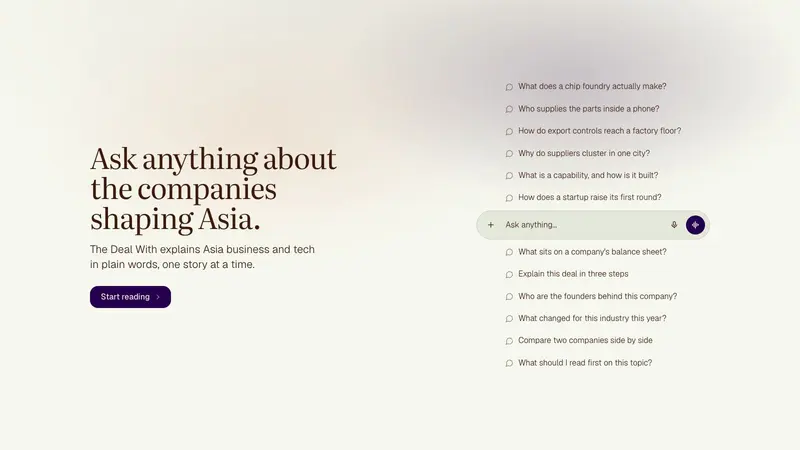
A fictional community repair guide helps first-time volunteers diagnose bicycle problems. Its launch includes written guides, not a question-answering engine.

Example slot fills
headline: Understand the bicycle repairs you can tackle.

blurb: Short guides help new volunteers inspect common faults and recognise when a mechanic is needed.

button: Browse guides

suggestions: Why does the chain slip?
How do I check tyre wear?
What causes squeaking brakes?
When should a wheel be replaced?
How tight should a chain be?
Which tools suit this repair?
Can I patch this inner tube?
Why is the handlebar wobbling?
How do I clean the gears?
When should I stop riding?
Which checks come before a repair?
When do I need a mechanic?

prompt: Choose a question

Why the example works
The questions translate a broad repair-guide promise into recognisable tasks. Browse guides leads to the documented material; the mock-up never implies an answer engine.

Example qualification
Illustrative fictional copy only. Real safety guidance would require expert review; no repair advice or working interaction is supplied here.

Evidence and review limits

Observed in the inspected material
The retained Tailark screenshot places a promise/action left, sample requests right and a pill over their middle; surrounding samples fade at the edges.
Current HTML has twelve list items, a decorative aria-hidden prompt and a Start reading link pointing to #. It does not implement search.
The local repair removes opaque lead/list backplates introduced by contrast CSS. The complete readable in-flow question list remains.

Interpretation for reuse
The composition can orient by examples of user intent. This is a layout-based reuse interpretation, not a verified statement of source author intent.

Not verified
The source author's intended persuasion and user outcomes are not independently established.
No proposal-archive corpus or user testing was used.

References inspected
02_product/spreads/S67-prompt-hero/source.webp
S67-prompt-hero/spread.html
S67-prompt-hero/spread.json
https://oss.tailark.com/view/veil-hero-section-3?theme=light

Review basis
reviewed: Loom inspected source capture, actual HTML/CSS, live defect and local rendering; semantic adaptation reviewed as a layout interpretation.

Relationship to the default
base

Read the semantic guide · Review coverage

hero · airy · 2 columns · deck / page

Original reference · Tailark

Tailark veil hero 3
Visit original source

Slot reference · all variations

headline
the promise, leftunder 9 words
blurb
one plain sentenceunder 20 words
button
one call to action with a chevron2-3 words
suggestions
sample questions, one line each, faded top and bottom10-12 lines, under 8 words each
prompt
pill-shaped ask box over the middle of the list: add icon, placeholder, mic and voice button1-3 words
signup
option signup only: card with label, one line, email field, subscribe button and one line of reassurancelabel 2-4 words; line under 15 words; reassurance under 10 words

Variations

  • Signup Email signup card in place of the ask box (newsletter hero)
Open live preview
Cover letter adapted layout previewPreview layout

Cover letter

S68

Why are you writing to me, and what is the personal proposal?

Colour & variationsPaper · Default
Use with AI

Copy this prompt. Add your content, brand and output format. The public layout files are linked below.

Layout HTML / live preview
Content slots and credits

How to use this prompt
Details & source

Use when
An editor's note, a welcome or a thank-you at the front of an issue or deck, where the voice should feel addressed to one person.

Meaning & narrative

Reader question
Why are you writing to me, and what is the personal proposal?

Reasoning relationship
direct address and proposal

Meaning and reuse: reviewed · layout interpretation; author intent unverified.

The point
An accountable writer explains why they are addressing this reader and what they intend to offer.

Communication job
Answer why this letter matters to me and what the writer is asking or promising.

What the audience gains
Perspective and reassurance: gives the reader a human rationale and explicit commitments without pretending personal tone is evidence.

How to read it
Read the salutation as a real audience address.
Follow the letter from reason for writing to central commitment and three practical implications.
Read the sign-off as accountability; the image sets context rather than proving sincerity.

How to adapt it

Inputs needed
A real audience and authorized writer.
A reason for writing, one governing commitment and three concrete implications.
A relevant illustrative image.

What belongs in each slot
illustration: Contextual image beside the letter, with provenance.

salutation: Address the intended audience accurately.

letter: Four to six short paragraphs, one emphasized commitment and a three-item list; keep reasons, promise and ask connected.

signoff: The accountable, authorized author.

What can change
Subject, names and wording within the active slot roles.
Illustrations or supporting values where present, with their provenance and limits.

What must survive
The writer owns the promise.
The ask follows the stated reason for writing.
Warmth does not conceal limitations.

Before this page
Establish the relationship or explain why the reader is receiving the proposal.

What it prepares next
Present the pilot outline, evidence and practical terms.

Good uses
An opening note from a named team.
An editorial or proposal preface.

Poor fits
A personal endorsement written without authority.
A long argument that needs evidence comparison.

Fictional worked example

Fictional worked example
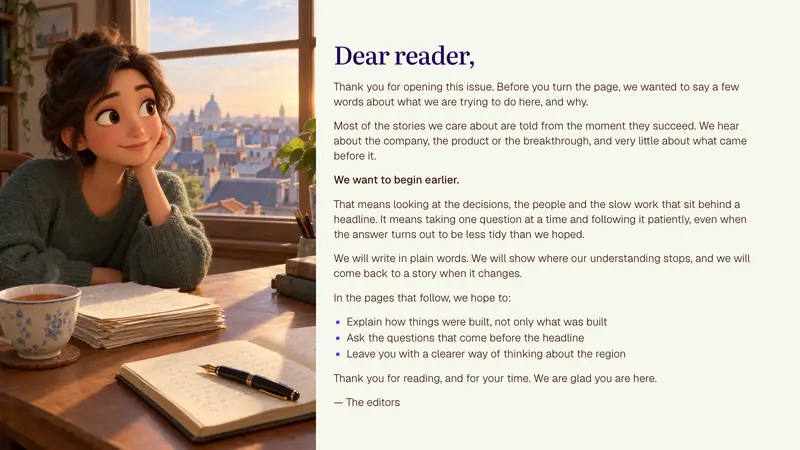
A fictional repair pilot team writes to neighborhood members.

Example slot fills
illustration: Illustrative workbench with a notebook and a lamp awaiting inspection.

salutation: Dear neighborhood members,

letter: We are writing because a broken appliance can leave people unsure where to begin. Our proposed workshop starts with that uncertainty.

We will help people find a responsible next step. Repair is one possible outcome; referral is another.

The pilot has three commitments: explain what we can assess; record what remains uncertain; refer work beyond our skills.

We will begin with three staffed sessions at one branch. The schedule and exclusions will be shared before anyone books.

Please read the pilot outline and tell us which part is unclear. Your questions will help us improve the explanation before launch.

signoff: The pilot team

Why the example works
The letter moves from a recognizable reader problem to a bounded commitment, practical obligations and a proportionate response.

Example qualification
Every organization, value and assertion in this example is fictional. Replace it with approved, sourced content before use.

Evidence and review limits

Observed in the inspected material
Current markup uses a salutation, short paragraphs, one bold line, three-item list and sign-off beside a tall image.
Viewed source capture is blurred; only arrangement is observable.

Interpretation for reuse
The communication job and reuse advice are inferred from the current arrangement and slot contract, not independently confirmed source intent.

Not verified
Original author intent, factual accuracy of sample copy and persuasion effects are not verified.
No confidential archive or proposal corpus was used.

References inspected
dist/S68-cover-letter/spread.json
dist/S68-cover-letter/spread.html
02_product/spreads/S68-cover-letter/source.webp (viewed for arrangement)

Review basis
reviewed: Motif inspected current metadata, active markup and the retained source arrangement, then checked the fictional example against the content roles. This is a layout-contract adaptation review.

Relationship to the default
base

Read the semantic guide · Review coverage

letter · dense · 2 columns · deck / page

Original reference · Hoffman

Private deck reference; original evidence retained in the private Spreads library.

Slot reference · all variations

illustration
one scene down the left, full height (bleeds top, left, bottom)3:4 scene
salutation
who the letter is to2-5 words
letter
paragraphs, one bold line, a list of threeunder 200 words
signoff
who it is from2-4 words

Variations

  • Mirror Picture on the right
  • Framed Smaller framed picture at the top left instead of a full-height bleed
  • Text Short letter with no picture: centred column, bold title, subline, two paragraphs, an ornament, centred sign-off and handle
Open live preview
Sign-up panel adapted layout previewPreview layout

Sign-up panel

S95

Why should I sign up, and what would submission mean?

Colour & variationsBarley · Default
Use with AI

Copy this prompt. Add your content, brand and output format. The public layout files are linked below.

Layout HTML / live preview
Content slots and credits

How to use this prompt
Details & source

Use when
At the end of a piece or a deck when the next step is to subscribe or register; the reasons sit beside the form so the reader sees what they get.

Meaning & narrative

Reader question
Why should I sign up, and what would submission mean?

Reasoning relationship
benefit-led invitation and input

Meaning and reuse: reviewed · layout interpretation; author intent unverified.

The point
An invitation places the requested information beside the reasons someone might choose to provide it.

Communication job
Explain a sign-up ask and its value while representing the actual submission behaviour truthfully.

What the audience gains
Offers decision support about joining. It addresses “Why give this information?”; the displayed arrangement does not establish a working form, privacy protection or consent.

How to read it
Read the invitation title and benefits.
Inspect the information being requested.
Read the action as a proposal or real submission only according to the implementation’s disclosed state.

How to adapt it

Inputs needed
Names the thing the reader would join.
Three labelled information requests, collecting only what the real workflow needs; current implementation is illustrative divs.
A truthful action label; the current element is not an operable submit button.
Three specific reasons to join, each with a short explanatory line.

What belongs in each slot
form-title: Names the thing the reader would join.

form: Three labelled information requests, collecting only what the real workflow needs; current implementation is illustrative divs.

button: A truthful action label; the current element is not an operable submit button.

benefits: Three specific reasons to join, each with a short explanatory line.

What can change
Replace the fictional subject and its supported content while retaining the roles and relationship described here.

What must survive
Current fields and action are static illustrations, not inputs or submit controls.
Any implemented form needs truthful purpose, handling and outcome text.
Benefits cannot promise unimplemented behaviour.

Before this page
Explain the workshop or service.

What it prepares next
Use a real consent and submission workflow only after implementing it separately.

Good uses
A sign-up concept in a pitch.
A UI arrangement reference.

Poor fits
A production registration flow using this static markup unchanged.
Sensitive information collection without a real handling policy.

Fictional worked example

Fictional worked example
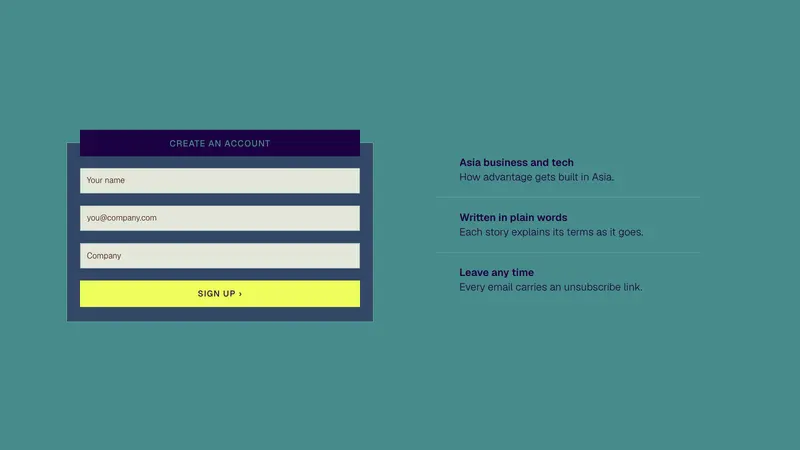
Fictional Cedar sketches a workshop mailing-list invitation; no personal data is collected by this spread.

Example slot fills
form-title: Join the workshop list

form: Name | Email | Preferred session — fictional non-submitting example

button: Illustrative sign-up

benefits: Preparation | Receive the safety checklist before attending.
Places | Hear when a new session opens.
Control | Choose whether to receive further notices.

Why the example works
The reasons correspond to the proposed ask; the form must not appear to have submitted anything when it has no backend.

Example qualification
Fictional teaching example. Replace invented details with authorised content and keep any source, scope, status or uncertainty that affects interpretation.

Evidence and review limits

Observed in the inspected material
Viewed source: three fields and a sign-up action face three reasons to join.
Current HTML explicitly labels the form illustration-only and uses divs for fields and action.

Interpretation for reuse
An invitation places the requested information beside the reasons someone might choose to provide it. This is an interpretation of the inspected composition, not a verified claim of author intent.

Not verified
Original author intent, historical claims, persuasion and archive-wide frequency have not been independently verified.

References inspected
02_product/spreads/S95-signup-panel/source.webp
02_product/spreads-semantics-2026-10-13/dist/S95-signup-panel/spread.html
02_product/spreads-semantics-2026-10-13/dist/S95-signup-panel/spread.json
https://webslides.tv/demos/components#slide=91

Review basis
reviewed: Viewed the retained base source capture and inspected current HTML and matching slots; reviewed the fictional adaptation at layout-contract level.

Relationship to the default
base

Read the semantic guide · Review coverage

signup · airy · 2 columns · deck / page

Original reference · WebSlides

WebSlides components 91
Visit original source

Slot reference · all variations

form-title
the header bar riding over the card's top edgeunder 5 words
form
three stacked fields (placeholder text only); drawn, not wired: nothing submits3 fields, 1-3 words each
button
the full-width action1-3 words
benefits
three reasons stacked between hairlines, each a bold title over one linetitle under 5 words, line under 10 words
Open live preview
Title between picture strips adapted layout previewPreview layout

Title between picture strips

S98

Which visual collection or subject is this section introducing?

Colour & variationsPaper · Default
Use with AI

Copy this prompt. Add your content, brand and output format. The public layout files are linked below.

Layout HTML / live preview
Content slots and credits

How to use this prompt
Details & source

Use when
When a picture-led section needs a cover. For a picture set without a held headline, use S48 Picture bento; for labelled pictures in a row, S16 Card row.

Meaning & narrative

Reader question
Which visual collection or subject is this section introducing?

Reasoning relationship
visual collection cover

Meaning and reuse: reviewed · layout interpretation; author intent unverified.

The point
A visual collection frames a single theme that introduces the section to follow.

Communication job
Open a gallery or chapter by showing the breadth of one coherent subject.

What the audience gains
Offers orientation and anticipation. It answers “What world or collection are we entering?” without making eight images into eight proof points.

How to read it
Scan the top strip for the subject’s range.
Read the central headline and line as the unifying theme.
Scan the bottom strip as further facets of that same theme.

How to adapt it

Inputs needed
The section’s governing theme or promise.
Explains what holds the eight views together.
Eight cleared images or labelled illustrations; four above and four below, all relevant to the same theme.

What belongs in each slot
headline: The section’s governing theme or promise.

subtitle: Explains what holds the eight views together.

illustration: Eight cleared images or labelled illustrations; four above and four below, all relevant to the same theme.

What can change
Replace the fictional subject and its supported content while retaining the roles and relationship described here.

What must survive
Maintain a single theme across all eight images.
Distinguish images of real work from illustrative scenes.
Do not assign sequence or weighting unless explicitly stated.

Before this page
Give the audience a reason to enter this section.

What it prepares next
Explain the selected facets and their relationship in detail.

Good uses
A gallery cover or chapter opener.

Poor fits
A detailed case-results page.
An arbitrary stock-image collage.

Fictional worked example

Fictional worked example
Fictional Cedar introduces a chapter about the conditions that make repair workshops repeatable.

Example slot fills
headline: Repair starts long before the first screwdriver

subtitle: The people, preparation and spaces behind Cedar’s fictional workshop.

illustration: Fictional illustration: venue access inspection.
Fictional illustration: tools checked before opening.
Fictional illustration: volunteers rehearsing intake.
Fictional illustration: participants reading the safety guide.
Fictional illustration: labelled parts drawers.
Fictional illustration: experienced repairer advising a volunteer.
Fictional illustration: issue notes reviewed after the session.
Fictional illustration: room reset for the next workshop.

Why the example works
Each image is a different facet of preparation and learning. The headline gives the collection its argument; the montage does not prove outcomes.

Example qualification
Fictional teaching example. Replace invented details with authorised content and keep any source, scope, status or uncertainty that affects interpretation.

Evidence and review limits

Observed in the inspected material
Viewed source: four picture placeholders above and four below a central headline/subtitle.
Current HTML retains eight image slots in two strips.

Interpretation for reuse
A visual collection frames a single theme that introduces the section to follow. This is an interpretation of the inspected composition, not a verified claim of author intent.

Not verified
Original author intent, historical claims, persuasion and archive-wide frequency have not been independently verified.

References inspected
02_product/spreads/S98-picture-strips/source.webp
02_product/spreads-semantics-2026-10-13/dist/S98-picture-strips/spread.html
02_product/spreads-semantics-2026-10-13/dist/S98-picture-strips/spread.json

Review basis
reviewed: Viewed the retained base source capture and inspected current HTML and matching slots; reviewed the fictional adaptation at layout-contract level.

Relationship to the default
base

Read the semantic guide · Review coverage

picture-cover · airy · 4 columns · deck / page

Original reference · Minimal Light

Private deck reference; original evidence retained in the private Spreads library.

Slot reference · all variations

headline
the section title, centred between the stripsunder 8 words
subtitle
one centred line under the headlineunder 12 words
illustration
8 equal landscape scenes, four in the top strip and four in the bottom strip4:3, 1 scene each
Open live preview

One big line

Give a claim, quote or turning point room to land.

7 layouts
Statement with picture adapted layout previewPreview layout

Statement with picture

S04

What single claim should I notice, and what makes it tangible?

Colour & variationsPaper · Default
Use with AI

Copy this prompt. Add your content, brand and output format. The public layout files are linked below.

Layout HTML / live preview
Content slots and credits

How to use this prompt
Details & source

Use when
The turn of an argument; the sentence you would put on a slide.

Meaning & narrative

Reader question
What single claim should I notice, and what makes it tangible?

Reasoning relationship
dominant claim with supporting scene

Meaning and reuse: reviewed · layout interpretation; author intent unverified.

The point
One bounded claim becomes tangible through a short reason and a related image.

Communication job
Land a point of view that the surrounding story can support.

What the audience gains
Perspective and explanation: clarifies the proposed stance without making an illustration carry the burden of proof.

How to read it
Read the eyebrow to recognise the moment’s role.
Read claim then support: the support should explain why the claim matters.
Inspect the image as a concrete illustration of the same idea, with any evidence status made clear.

How to adapt it

Inputs needed
One supportable claim or clearly labelled hypothesis.
A concise reason or qualification.
A relevant cleared illustration.

What belongs in each slot
eyebrow: Indicate stance, finding or proposal.

claim: One bounded proposition, not a stack of benefits.

support: Reason, mechanism or limitation that makes the claim intelligible.

photo: A relevant illustration of the subject; the legacy name does not make the image photographic evidence.

What can change
Claim and illustration subject.
The selected source-supported composition option.

What must survive
Image, support and claim concern the same point.
Necessary qualification remains visible.
Visual prominence does not establish truth.

Before this page
Establish the booking uncertainty with evidence or label it as an assumption.

What it prepares next
Explain the trial design, the service detail or the evidence needed.

Good uses
A strategic point of view
One central finding with support
A concept introduction

Poor fits
A multi-factor comparison
A claim requiring extensive caveats
Visual proof of a historical event using generated imagery

Fictional worked example

Fictional worked example
A fictional repair cooperative is preparing a pilot proposal; all people, events and data are teaching examples.

Example slot fills
eyebrow: Pilot hypothesis

claim: Certainty may matter more than speed.

support: We propose confirming parts availability before offering selected repair appointments, then comparing missed promises with the current booking process.

photo: Labelled illustration of a repairer checking a parts tray before confirming a booking.

Why the example works
The support names the mechanism and test; the image makes the process imaginable but does not verify the hypothesis.

Example qualification
Fictional teaching example. Replace with authorised facts, evidence and destinations before delivery; no results or audience effect are claimed.

Evidence and review limits

Observed in the inspected material
Viewed source: point-of-view label, large claim, a brief supporting paragraph and a large prescribed supporting image region.
Current markup and the named slot contract were inspected.

Interpretation for reuse
Communication job, audience value and adaptation advice are layout-contract interpretations. They are not verified statements of source-author intent.

Not verified
Source-author intent, surrounding source sequence, sample factual claims and audience effect were not independently verified.

References inspected
02_product/spreads/S04-statement/source.webp
dist/S04-statement/spread.html
dist/S04-statement/spread.json
https://github.com/neekchan/hoffman-agency-design-system/blob/main/templates/deck/Deck.dc.html

Review basis
reviewed: Viewed base source capture, inspected current markup/slots and reviewed the example for reasoning fit; no source-intent or empirical validation claim.

Relationship to the default
base

Read the semantic guide · Review coverage

claim · airy · 1 column · deck / page

Original reference · Hoffman

Hoffman L08 Statement
Visit original source

Slot reference · all variations

eyebrow
what kind of moment1-3 words
claim
the claimunder 12 words
support
one short paragraphunder 30 words
photo
one illustration that earns the claim; bleeds top, right, bottom3:4

Variations

  • Mirror Picture on the left
  • Half Even 50/50 split
  • Framed Framed picture with a caption band
  • Role Highlighted role box under the text
  • List Short list under the text
  • Buttons Hero: two buttons under the text
  • Logos Hero: a "read at" logo row
  • Screen Hero: a tilted product screen instead of the picture
  • Text only Statement alone, no picture, anchored top left
  • Anchor mid Statement alone, anchored at the vertical middle (combine with anchor-centre or anchor-right)
  • Anchor bottom Statement alone, anchored at the bottom (combine with anchor-centre or anchor-right)
  • Anchor centre Statement alone, centred across (combine with anchor-mid or anchor-bottom)
  • Anchor right Statement alone, set in the right part (combine with anchor-mid or anchor-bottom)
  • Phones Two upright phone frames on the right, cut off by the bottom edge, each screen a picture (for app or product slides)
  • Reveal Tap to reveal the take: the claim is blurred until the reader taps 'Reveal the take' (motion.take-reveal; behaviour in ../motion.js). One per piece, only on the take itself, never on facts or sources.
Open live preview
Punchline adapted layout previewPreview layout

Punchline

S05 · Motion

Which final word changes the meaning of this sentence?

Colour & variationsPlum · Default
Use with AI

Copy this prompt. Add your content, brand and output format. The public layout files are linked below.

Layout HTML / live preview
Content slots and credits

How to use this prompt
Details & source

Use when
Once per piece, at the loudest moment.

Meaning & narrative

Reader question
Which final word changes the meaning of this sentence?

Reasoning relationship
rhetorical setup and final-word emphasis

Meaning and reuse: reviewed · layout interpretation; author intent unverified.

The point
One final word changes how the setup should be understood.

Communication job
Create a short rhetorical turn before the argument resumes.

What the audience gains
Perspective: makes the decisive distinction memorable while leaving explanation to the surrounding story.

How to read it
Read the setup as an incomplete sentence.
Complete it with the oversized word.
Read the aside as the immediate qualification or question, not a second unrelated punchline.

How to adapt it

Inputs needed
A sentence whose meaning genuinely turns on one word.
Prior context that makes the turn intelligible.
A concise qualification or implication.

What belongs in each slot
setup: The grammatical lead-in to the final word.

word: One decisive word that completes or reframes the setup.

aside: Clarify why the turn matters or what question follows.

emoji: Optional deck-only pictorial emphasis; remove for editorial page use without losing meaning.

What can change
Setup, single word and supporting aside.
Decorative deck symbol only.

What must survive
Setup plus final word forms a coherent utterance.
The aside preserves the point rather than introducing another.

Before this page
Explain why missed appointments damage confidence.

What it prepares next
Specify the readiness criteria behind a credible booking.

Good uses
A transition after diagnosis
A succinct reframe
An emphatic contrast

Poor fits
A self-contained explanation
A nuanced finding that depends on a paragraph of caveats

Fictional worked example

Fictional worked example
A fictional repair cooperative is preparing a pilot proposal; all people, events and data are teaching examples.

Example slot fills
setup: An appointment is a

word: promise.

aside: Only offer the slot once the parts are ready.

emoji: Deck-only calendar symbol; decorative, not required to understand the claim.

Why the example works
Promise reframes an appointment as an operational commitment, preparing a discussion of what must be ready.

Example qualification
Fictional teaching example. Replace with authorised facts, evidence and destinations before delivery; no results or audience effect are claimed.

Evidence and review limits

Observed in the inspected material
Viewed source: a short setup leads to a single oversized word, with a small aside in the opposite corner.
Current markup and the named slot contract were inspected.

Interpretation for reuse
Communication job, audience value and adaptation advice are layout-contract interpretations. They are not verified statements of source-author intent.

Not verified
Source-author intent, surrounding source sequence, sample factual claims and audience effect were not independently verified.

References inspected
02_product/spreads/S05-punchline/source.webp
dist/S05-punchline/spread.html
dist/S05-punchline/spread.json
https://github.com/neekchan/hoffman-agency-design-system/blob/main/templates/deck/Deck.dc.html

Review basis
reviewed: Viewed base source capture, inspected current markup/slots and reviewed the example for reasoning fit; no source-intent or empirical validation claim.

Relationship to the default
base

Read the semantic guide · Review coverage

hinge-word · airy · 1 column · deck / page

Original reference · Hoffman

Hoffman L45 Punchline
Visit original source

Slot reference · all variations

setup
the words before the hinge, small, top leftunder 6 words
word
the hinge word, enormous1 word
aside
one whispered line, bottom rightunder 20 words
emoji
one Noto emoji beside the aside (decks only)1

Variations

  • Underline The underline draws left to right after the original half-second pause.

Motion preview

The underline draws left to right after the original half-second pause. Open the live preview and use Replay, Step through or Show all. Reduced motion shows the complete layout.

Motion recipe Open live preview
Two-beat adapted layout previewPreview layout

Two-beat

S07

How does this setup change when I hear the payoff?

Colour & variationsBerry · Default
Use with AI

Copy this prompt. Add your content, brand and output format. The public layout files are linked below.

Layout HTML / live preview
Content slots and credits

How to use this prompt
Details & source

Use when
Widening the stakes: "it is not just about X, it is about Y".

Meaning & narrative

Reader question
How does this setup change when I hear the payoff?

Reasoning relationship
setup and payoff

Meaning and reuse: reviewed · layout interpretation; author intent unverified.

The point
The second sentence completes, qualifies or broadens the first.

Communication job
Carry the audience from an initial idea to its consequence in two distinct beats.

What the audience gains
Perspective: makes the logical turn explicit with enough pause to notice it.

How to read it
Read the top-left sentence first.
Cross the page to the lower-right payoff; it must respond to the first sentence.
Read both aloud as one connected thought.

How to adapt it

Inputs needed
Two short statements with an explicit contrast, qualification or consequence.
Prior support if either statement makes a factual claim.

What belongs in each slot
beat-1: The setup: a familiar observation or proposition.

beat-2: The payoff: what that observation really means or fails to settle.

emoji-1: Deck-only decoration reinforcing the setup.

emoji-2: Deck-only decoration reinforcing the payoff.

What can change
Two lines and their rhetorical relationship.
Deck-only symbols.

What must survive
The second line changes or completes the first.
No essential explanation is assigned only to decoration.

Before this page
Establish what the team currently counts as success.

What it prepares next
Show the readiness problem and choose a better measure.

Good uses
A qualification before evidence
A memorable transition
A wider implication of a finding

Poor fits
Two unrelated slogans
A three-stage process

Fictional worked example

Fictional worked example
A fictional repair cooperative is preparing a pilot proposal; all people, events and data are teaching examples.

Example slot fills
beat-1: A full booking calendar can look like success.

beat-2: Until customers arrive for repairs that cannot begin.

emoji-1: Deck-only calendar symbol.

emoji-2: Deck-only parts-box symbol.

Why the example works
The payoff qualifies the apparent success metric by introducing readiness; neither line alone makes the full argument.

Example qualification
Fictional teaching example. Replace with authorised facts, evidence and destinations before delivery; no results or audience effect are claimed.

Evidence and review limits

Observed in the inspected material
Viewed source: two statements occupy opposing corners, with decorative symbols; the second qualifies the apparent celebration in the first.
Current markup and the named slot contract were inspected.

Interpretation for reuse
Communication job, audience value and adaptation advice are layout-contract interpretations. They are not verified statements of source-author intent.

Not verified
Source-author intent, surrounding source sequence, sample factual claims and audience effect were not independently verified.

References inspected
02_product/spreads/S07-two-beat/source.webp
dist/S07-two-beat/spread.html
dist/S07-two-beat/spread.json
https://github.com/neekchan/hoffman-agency-design-system/blob/main/templates/deck/Deck.dc.html

Review basis
reviewed: Viewed base source capture, inspected current markup/slots and reviewed the example for reasoning fit; no source-intent or empirical validation claim.

Relationship to the default
base

Read the semantic guide · Review coverage

two-beat · airy · 2 columns · deck / page

Original reference · Hoffman

Hoffman L46 Two-beat
Visit original source

Slot reference · all variations

beat-1
the setup, top leftunder 12 words
beat-2
the payoff, bottom right, right-alignedunder 12 words
emoji-1
Noto emoji, top right (decks only)1
emoji-2
Noto emoji, bottom left (decks only)1
Open live preview
Pull quote adapted layout previewPreview layout

Pull quote

S10

What exactly did this person say that matters to this argument?

Colour & variationsBarley · Default
Use with AI

Copy this prompt. Add your content, brand and output format. The public layout files are linked below.

Layout HTML / live preview
Content slots and credits

How to use this prompt
Details & source

Use when
The piece's finding, or a source's best line. Highlight one phrase, never the whole line.

Meaning & narrative

Reader question
What exactly did this person say that matters to this argument?

Reasoning relationship
verbatim testimony and attribution

Meaning and reuse: reviewed · layout interpretation; author intent unverified.

The point
One person’s exact words articulate a point relevant to the argument.

Communication job
Let the reader understand an attributable perspective and the phrase that makes it relevant.

What the audience gains
Testimony or perspective with an accountable source; answers what this person experienced or believes without treating the statement as independent proof.

How to read it
Read the short context label, then the whole quotation.
Notice the highlighted phrase within its sentence, without changing the sentence’s meaning.
Read the attribution to judge the speaker’s relation to the subject.

How to adapt it

Inputs needed
A verified quotation or a clearly labelled fictional teaching example.
Speaker, role, source/date and context needed to prevent distortion.
A reason this testimony bears on the argument.

What belongs in each slot
eyebrow: Identify the context or kind of testimony.

quote: Exact complete wording of the selected line; do not rewrite as a better endorsement.

highlight: An exact substring carrying the point, never a substitute claim.

attribution: Speaker and relevant role plus source/date where needed; distinguish a customer, employee or author.

What can change
Which properly sourced line is selected.
The highlighted phrase, if emphasis does not distort the speaker’s meaning.

What must survive
Quote and attribution remain paired.
Necessary caveats stay with the statement.
Anecdotal testimony does not become a measured or representative finding.

Before this page
Establish the repair-delay problem and the context in which this person was asked.

What it prepares next
Compare the perspective with broader evidence or explain the test it motivates.

Good uses
A sourced customer perspective
A memorable expert qualification
A first-person illustration of an established issue

Poor fits
Unattributed marketing claims
Invented endorsements presented as real
A claim requiring population-level measurement

Fictional worked example

Fictional worked example
A fictional repair pilot includes an explicitly invented resident interview for teaching purposes.

Example slot fills
eyebrow: Fictional resident

quote: Knowing the part was ready mattered more than getting the earliest appointment.

highlight: the part was ready

attribution: Mira Vale · fictional resident · invented interview

Why the example works
The line illustrates why appointment certainty could matter; it does not establish how common that preference is.

Example qualification
Fictional teaching example only; proposed actions and testimony are not measured outcomes or real endorsements.

Evidence and review limits

Observed in the inspected material
The source capture isolates one attributed quotation with a highlighted phrase.
The default HTML retains quotation, embedded highlight and attribution; the portrait is hidden unless its option is selected.

Interpretation for reuse
The communication job and adaptation rules below are an interpretation of the viewed composition and current implementation, not a statement from the source author.

Not verified
Original author intent, surrounding source-deck argument, factual sample claims and audience effects have not been independently verified.

References inspected
02_product/spreads/S10-pull-quote/source.webp
dist/S10-pull-quote/spread.html
dist/S10-pull-quote/spread.json

Review basis
reviewed: Viewed retained source capture and inspected current markup/slot contract; reviewed reasoning and example mapping. This is layout-contract review, not source-intent confirmation.

Relationship to the default
base

Read the semantic guide · Review coverage

quote · airy · 1 column · deck / page

Original reference · Hoffman

Hoffman L29 Pull quote
Visit original source

Slot reference · all variations

eyebrow
who or what1-3 words
quote
the sentenceunder 25 words
highlight
the phrase that carries itpart of the quote
attribution
rule, name, mono role linename + role
portrait
opt-portrait: cut-out portrait of the speaker, standing on the bottom edgeillustration, cut-out

Variations

  • Portrait Speaker quote: quote on the left half, cut-out portrait of the speaker standing on the bottom edge at right
  • Fill Text fill: the quote inks in word by word as it crosses the screen (motion.text-fill; ../motion.js). At most three lines per piece.
  • Focus voices Six attributed voices in one flowing passage with inline portraits; four initially, read all expansion.
  • Quote stack Four quote cards in a cycling pile, with next/previous and complete show-all state.

Focus voices reference

useLayouts Focus Testimonials

Quote stack reference

useLayouts Shake Testimonial Open live preview
Full bleed adapted layout previewPreview layout

Full bleed

S24

What short claim should this scene make memorable?

Colour & variationsPlum · Default
Use with AI

Copy this prompt. Add your content, brand and output format. The public layout files are linked below.

Layout HTML / live preview
Content slots and credits

How to use this prompt
Details & source

Use when
A single emotional beat carried by one picture. One line of type only; if it needs a paragraph, use another spread.

Meaning & narrative

Reader question
What short claim should this scene make memorable?

Reasoning relationship
single claim over a scene

Meaning and reuse: reviewed · layout interpretation; author intent unverified.

The point
One image-led line establishes a scene or crystallises a point.

Communication job
Connect a concise idea with a concrete visual setting.

What the audience gains
Perspective and orientation: gives the audience a memorable context for the next part, without using atmosphere as proof.

How to read it
Read the theme label for orientation.
Read the headline against the scene.
Carry the stated relation into the next explanation; the scene remains illustrative unless documented as evidence.

How to adapt it

Inputs needed
One short central line.
A scene that makes that line understandable.
Clear distinction between illustration and factual record.

What belongs in each slot
illustration: The full-field visual context; preserve room for the text and label generated scenes.

eyebrow: The theme or chapter cue.

headline: A short proposition that relates meaningfully to the scene.

What can change
Scene and thematic line.
Supported card or sequential-story option when the task changes.

What must survive
Text and image refer to the same idea.
Image status is explicit.
The next page earns any claim.

Before this page
Explain why the visible appointment is only part of service reliability.

What it prepares next
Show the readiness checks and who owns them.

Good uses
A visual chapter opening
A concise editorial bridge
An image-led proposition

Poor fits
A complex comparison
A statistical finding
A scene used to imply a real event without evidence

Fictional worked example

Fictional worked example
Fictional repair cooperative proposal; all events, people and evidence are invented teaching material.

Example slot fills
illustration: Labelled generated scene of a repair workshop with a prepared parts tray in the foreground.

eyebrow: Before the visit

headline: A dependable repair begins before the doorbell.

Why the example works
The scene makes preparation concrete while the line sets up the unseen work behind a visit.

Example qualification
Fictional teaching example only. Proposed benefits and results are not verified; replace with authorised material for a real use.

Evidence and review limits

Observed in the inspected material
Viewed source: one short statement over a prescribed full-bleed image with overlay; no detailed proof region.
Current HTML and active slot contract were inspected.

Interpretation for reuse
The guidance interprets the layout’s communication affordances; it does not assert source-author intent.

Not verified
Original author intent, surrounding source sequence, sample factual claims and persuasion effects are not independently verified.

References inspected
02_product/spreads/S24-full-bleed/source.webp
dist/S24-full-bleed/spread.html
dist/S24-full-bleed/spread.json
https://github.com/neekchan/hoffman-agency-design-system/blob/main/templates/deck/Deck.dc.html

Review basis
reviewed: Viewed retained source capture and inspected current markup/slot contract; reviewed reasoning and example mapping. This is layout-contract review, not source-intent confirmation.

Relationship to the default
base

Read the semantic guide · Review coverage

claim · airy · 1 column · deck / page

Original reference · Hoffman

Hoffman L27 Full-bleed
Visit original source

Slot reference · all variations

illustration
edge-to-edge illustration under a 66% plum veil that guarantees the type16:9
eyebrow
theme tag, top left1-3 words
headline
one line, vertically centred left, one lime italic phraseunder 10 words

Variations

  • Low Hero: headline low, buttons right, logo row along the bottom
  • Card Text card: eyebrow, headline, paragraph and one button in a solid card floating right over the scene, no veil
  • Stack reveal Four full-image stories stacked in depth; front cards lift away with slight X tilt on native scroll. Static/narrow/reduced views show all stories in order.

Stack reveal reference

useLayouts Stack Scroll Reveal Open live preview
Big number adapted layout previewPreview layout

Big number

S81

What does this single figure count, over what scope?

Colour & variationsDeep · Default
Use with AI

Copy this prompt. Add your content, brand and output format. The public layout files are linked below.

Layout HTML / live preview
Content slots and credits

How to use this prompt
Details & source

Use when
When a single number is the beat and the reader should stop on it. One figure only; if two or more numbers need to sit side by side, use S15 Stat strip or S46 Stat grid.

Meaning & narrative

Reader question
What does this single figure count, over what scope?

Reasoning relationship
single quantitative anchor

Meaning and reuse: reviewed · layout interpretation; author intent unverified.

The point
One carefully scoped quantity anchors the reader’s understanding of the subject.

Communication job
Make one number legible and state exactly what it counts.

What the audience gains
Offers scale and perspective. It answers “How much?” but a large numeral cannot supply a missing denominator or establish importance by itself.

How to read it
Read the figure.
Read its caption as part of the same statement: measure, population and period.
Read visible source context before accepting the quantity; the image is contextual, not proof.

How to adapt it

Inputs needed
A contextual full-field scene with no quantitative encoding; label generated work as illustration.
One verified value, with unit or symbol where necessary.
The measure, population and reporting period needed to interpret the value.

What belongs in each slot
illustration: A contextual full-field scene with no quantitative encoding; label generated work as illustration.

figure: One verified value, with unit or symbol where necessary.

caption: The measure, population and reporting period needed to interpret the value.

What can change
Replace the fictional subject and its supported content while retaining the roles and relationship described here.

What must survive
Caption and number form one indivisible claim.
Preserve units, period, scope and a traceable source in the caption or surrounding context.
Rolling digits are an entrance effect, not a growth history.

Before this page
Establish why trained capacity matters.

What it prepares next
Explain how training was assessed or what capacity it enables.

Good uses
A single decisive, sourced quantitative anchor.

Poor fits
Several measures needing comparison.
A percentage without a clear denominator.

Fictional worked example

Fictional worked example
Fictional Cedar trained 24 distinct volunteers during its June pilot.

Example slot fills
illustration: Labelled fictional illustration of a community repair workshop.

figure: 24

caption: Volunteers trained in Cedar’s fictional June pilot.

Why the example works
The figure is a count of trained volunteers, not sessions, attendance visits or successful repairs.

Example qualification
Fictional teaching example. Replace invented details with authorised content and keep any source, scope, status or uncertainty that affects interpretation.

Evidence and review limits

Observed in the inspected material
Viewed source: one oversized download count and its reporting-window caption over a placeholder image.
Current base shows a figure/caption over an illustration; noted alone exposes eyebrow and source.

Interpretation for reuse
One carefully scoped quantity anchors the reader’s understanding of the subject. This is an interpretation of the inspected composition, not a verified claim of author intent.

Not verified
Original author intent, historical claims, persuasion and archive-wide frequency have not been independently verified.

References inspected
02_product/spreads/S81-big-number/source.webp
02_product/spreads-semantics-2026-10-13/dist/S81-big-number/spread.html
02_product/spreads-semantics-2026-10-13/dist/S81-big-number/spread.json
https://webslides.tv/demos/components#slide=62

Review basis
reviewed: Viewed the retained base source capture and inspected current HTML and matching slots; reviewed the fictional adaptation at layout-contract level.

Relationship to the default
base

Read the semantic guide · Review coverage

big-number · airy · 1 column · deck / page

Original reference · WebSlides

WebSlides components 62
Visit original source

Slot reference · all variations

illustration
edge-to-edge scene under a field-colour veil that guarantees the type; the plain option drops it16:9
figure
the one number, centred a little above the middle1-8 characters (00%, $0.0B, 0,000,000)
caption
what the number counts, one line under it4-12 words
eyebrow
noted option: a theme tag above the figure1-3 words
source
noted option: where the number comes from, on the bottom edgeunder 10 words

Variations

  • Plain No picture: the figure and caption on the field alone, with a quiet top-to-bottom fall
  • Left The figure and caption set left over the scene, vertically centred
  • Noted An eyebrow above the figure and a source line on the bottom edge
  • Roll Rolling figure: the number rolls to its value like an odometer, once (motion.number-roll; ../motion.js).
Open live preview
Lockup adapted layout previewPreview layout

Lockup

S91

What does this oversized item mean or buy?

Colour & variationsBerry · Default
Use with AI

Copy this prompt. Add your content, brand and output format. The public layout files are linked below.

Layout HTML / live preview
Content slots and credits

How to use this prompt
Details & source

Use when
When one figure, mark or glyph needs a short line beside it and nothing else on the slide: an offer, a sign-off, a brand moment, a type specimen.

Meaning & narrative

Reader question
What does this oversized item mean or buy?

Reasoning relationship
focal item and definition

Meaning and reuse: reviewed · layout interpretation; author intent unverified.

The point
One focal amount or symbol is immediately defined by the adjacent line and qualification.

Communication job
Make a compact offer or definition understandable as one unit.

What the audience gains
Offers clarity about what a focal item means or buys. It answers “What does that amount include?”; size and emphasis do not validate an offer.

How to read it
Read the focal item and adjacent definition together.
Read the short note for the qualification that affects the offer.

How to adapt it

Inputs needed
A short amount, symbol or other focal item.
What that item means, includes or buys.
The essential scope or condition of the statement.

What belongs in each slot
big: A short amount, symbol or other focal item.

line: What that item means, includes or buys.

note: The essential scope or condition of the statement.

What can change
Replace the fictional subject and its supported content while retaining the roles and relationship described here.

What must survive
Keep focal item, definition and qualification together.
Never invent an actual price, entitlement or availability.

Before this page
Establish the subject and relevant need.

What it prepares next
Explain inclusions, conditions or the next action.

Good uses
A single scoped offer.
A compact symbol-and-definition moment.

Poor fits
Multiple pricing tiers.
A number requiring a long methods explanation.

Fictional worked example

Fictional worked example
Fictional Cedar illustrates a kit offer for a teaching example.

Example slot fills
big: $20

line: One fictional workshop materials kit

note: Illustrative price; tools and attendance are not included.

Why the example works
The price means little without the kit scope; the note prevents readers inferring that it buys a workshop place.

Example qualification
Fictional teaching example. Replace invented details with authorised content and keep any source, scope, status or uncertainty that affects interpretation.

Evidence and review limits

Observed in the inspected material
Viewed source: an oversized price is paired with a short service line.
Current default uses amount/line/note; mark swaps in the wordmark; specimen shows a type sample and glyph rows.

Interpretation for reuse
One focal amount or symbol is immediately defined by the adjacent line and qualification. This is an interpretation of the inspected composition, not a verified claim of author intent.

Not verified
Original author intent, historical claims, persuasion and archive-wide frequency have not been independently verified.

References inspected
02_product/spreads/S91-lockup/source.webp
02_product/spreads-semantics-2026-10-13/dist/S91-lockup/spread.html
02_product/spreads-semantics-2026-10-13/dist/S91-lockup/spread.json
https://webslides.tv/demos/components#slide=78

Review basis
reviewed: Viewed the retained base source capture and inspected current HTML and matching slots; reviewed the fictional adaptation at layout-contract level.

Relationship to the default
base

Read the semantic guide · Review coverage

lockup · airy · 2 columns · deck / page

Original reference · WebSlides

WebSlides components 78
Visit original source

Slot reference · all variations

big
the oversized element on the left: a price or figure (default), the TDW wordmark (mark option) or a type glyph (specimen option)1-4 characters
line
the line right of the hairline, two lines at mostunder 8 words
note
a small supporting note under the lineunder 10 words
line-mark
mark option: the one line beside the wordmarkunder 6 words
eyebrow
specimen option: the typeface name, one word highlightedunder 6 words
line-specimen
specimen option: a bold two-line sample sentenceunder 10 words
specimen
specimen option: capitals, lower case, figures and punctuation3 rows
illustration
photo option: one full-bleed scene behind the lockup, veiled in the field colour16:9

Variations

  • Mark The TDW wordmark as the big element, one line of text beside it
  • Specimen A type glyph (Ag) with eyebrow, a bold two-line sample and three character rows
  • Photo The lockup over a full-bleed illustration veiled in the field colour
Open live preview

Lists and comparisons

Put parallel ideas beside each other.

32 layouts
Parallel four adapted layout previewPreview layout

Parallel four

S03

What common pattern appears across these three or four cases?

Colour & variationsPaper · Default
Use with AI

Copy this prompt. Add your content, brand and output format. The public layout files are linked below.

Layout HTML / live preview
Content slots and credits

How to use this prompt
Details & source

Use when
A list of comparable actors, places or moves.

Meaning & narrative

Reader question
What common pattern appears across these three or four cases?

Reasoning relationship
parallel cases under a common claim

Meaning and reuse: reviewed · layout interpretation; author intent unverified.

The point
Several audiences share a theme but need distinct reasons to care and distinct desired responses.

Communication job
Compare parallel profiles without losing their common frame.

What the audience gains
Perspective: shows whom the work is for and how their needs differ; prevents one generic message being mistaken for universal relevance.

How to read it
Read the common claim and scope line.
Read each card from identity and need through context to the desired shift in its footer.
Compare the same roles across cards, rather than treating the cards as ranked winners.

How to adapt it

Inputs needed
Three or four genuinely distinct audiences or parallel cases.
The same descriptive dimensions for every item.
Evidence or an explicit hypothesis behind each need.

What belongs in each slot
head: The pattern that unites the set.

sub: Define the comparison basis and whether these profiles are researched or proposed.

items: Three or four complete profiles: illustrative image, identity, need/tag, short context, footer label and intended shift.

What can change
Three or four items.
Audience or case identities and accompanying illustrations.

What must survive
All cards answer the same questions.
A desired shift is not evidence that it occurred.
Differences must be substantive, not demographic decoration.

Before this page
Define the overall adoption problem and the basis for segmentation.

What it prepares next
Develop a persona, audience-specific story or plan matrix.

Good uses
Audience segmentation
Parallel market situations
Several cases with the same analytical dimensions

Poor fits
Ranked options without criteria
An unordered timeline

Fictional worked example

Fictional worked example
A fictional repair cooperative is preparing a pilot proposal; all people, events and data are teaching examples.

Example slot fills
head: Repair adoption depends on three different kinds of confidence.

sub: These fictional audience hypotheses distinguish convenience, upkeep and accountability; research must test them before campaign planning.

items: Residents | Illustration: household lamp | Need: confidence it is worth trying | Context: A broken item competes with an easy replacement. | Desired shift: Ask for a repair assessment first.
Landlords | Illustration: rental fixtures | Need: dependable upkeep | Context: They need repairs that fit tenant access windows. | Desired shift: Include repairs in planned maintenance.
Employers | Illustration: office equipment | Need: accountable spending | Context: Managers must explain repair costs and downtime. | Desired shift: Compare repair and replacement explicitly.

Why the example works
Each card uses identical semantic roles while differentiating the motivation; the footer states a proposed response rather than an observed result.

Example qualification
Fictional teaching example. Replace with authorised facts, evidence and destinations before delivery; no results or audience effect are claimed.

Evidence and review limits

Observed in the inspected material
Viewed source: three audience cards pair identity, motivational tag and context with a separate desired-response footer. Current default extends this structure to four illustrative cases.
Current markup and the named slot contract were inspected.

Interpretation for reuse
Communication job, audience value and adaptation advice are layout-contract interpretations. They are not verified statements of source-author intent.

Not verified
Source-author intent, surrounding source sequence, sample factual claims and audience effect were not independently verified.

References inspected
02_product/spreads/S03-parallel-four/source.webp
dist/S03-parallel-four/spread.html
dist/S03-parallel-four/spread.json
https://github.com/neekchan/hoffman-agency-design-system/blob/main/templates/deck/Deck.dc.html

Review basis
reviewed: Viewed base source capture, inspected current markup/slots and reviewed the example for reasoning fit; no source-intent or empirical validation claim.

Relationship to the default
base

Read the semantic guide · Review coverage

parallel-points · standard · 4 columns · deck / page

Original reference · Hoffman

Hoffman L13 Three audiences
Visit original source

Slot reference · all variations

head
what the set has in commonunder 16 words
sub
one supporting lineunder 30 words
items
3-4 x (illustration 1:1, name, italic tag, one sentence, footer label + short statement)sentence under 20 words
Open live preview
Hinge adapted layout previewPreview layout

Hinge

S06

What earlier view are we replacing, through what shift, with what new view?

Colour & variationsPaper · Default
Use with AI

Copy this prompt. Add your content, brand and output format. The public layout files are linked below.

Layout HTML / live preview
Content slots and credits

How to use this prompt
Details & source

Use when
Reframing: "instead of X, we ask Y". The persimmon colon is the arrow.

Meaning & narrative

Reader question
What earlier view are we replacing, through what shift, with what new view?

Reasoning relationship
before, turning point and after

Meaning and reuse: reviewed · layout interpretation; author intent unverified.

The point
A specific limitation in the current view motivates a new question or way of working.

Communication job
Explain why the audience should change its frame, including the turning point.

What the audience gains
Perspective on what the old frame misses and what the new frame would let the audience examine; reduces the uncertainty of why a change is warranted.

How to read it
Read the headline as the proposed shift.
Read left to right: current frame, the reason to reconsider it, replacement frame.
Treat the arrows as a logical dependency: the middle must explain the move, not merely repeat the headline.

How to adapt it

Inputs needed
A fair statement of the current frame.
A documented limitation or clearly labelled hypothesis that motivates a change.
A replacement question that responds to that limitation.

What belongs in each slot
eyebrow: Name the act of reconsidering the frame, not an unrelated topic.

head: State the change of question or approach.

steps: Three linked units: current view; the evidence or lens that challenges it; the resulting view. Give each a short title, sentence and illustrative icon.

What can change
Subject, vocabulary and icons.
Use an observed change or a proposed reframing, clearly labelled.

What must survive
Three ordered roles and an explicit reason for the transition.
The old view must be represented fairly.
A proposed benefit stays a hypothesis until supported.

Before this page
Show the delay diagnosis and how jobs were classified.

What it prepares next
Explain a parts-readiness trial and how its effect would be measured.

Good uses
Strategy pivots
Reframing a problem after diagnosis
Explaining a change of operating principle

Poor fits
A chronology with no changed interpretation
Unrelated before and after claims
A benefit claim without the mechanism

Fictional worked example

Fictional worked example
A fictional repair cooperative notices that most late jobs wait for parts rather than technicians.

Example slot fills
eyebrow: Change the question

head: Parts readiness should govern repair scheduling.

steps: Current question: How can we fit more repairs into each day?
Turning point: In our fictional job review, missing parts caused most delays.
Better question: Which parts must be ready before we promise a slot?

Why the example works
The obstacle changes the optimisation target from technician capacity to parts readiness; the middle box earns the new question.

Example qualification
Fictional teaching example only; proposed actions and testimony are not measured outcomes or real endorsements.

Evidence and review limits

Observed in the inspected material
The source capture shows three arrow-linked boxes labelled before, shift and after, with the middle box highlighted.
The current HTML uses the same three-part flow for old question, lens and new question.

Interpretation for reuse
The communication job and adaptation rules below are an interpretation of the viewed composition and current implementation, not a statement from the source author.

Not verified
Original author intent, surrounding source-deck argument, factual sample claims and audience effects have not been independently verified.

References inspected
02_product/spreads/S06-hinge/source.webp
dist/S06-hinge/spread.html
dist/S06-hinge/spread.json

Review basis
reviewed: Viewed retained source capture and inspected current markup/slot contract; reviewed reasoning and example mapping. This is layout-contract review, not source-intent confirmation.

Relationship to the default
base

Read the semantic guide · Review coverage

before-after · standard · 3 columns · deck / page

Original reference · Hoffman

Hoffman L35 Flow diagram
Visit original source

Slot reference · all variations

eyebrow
the framing words2-4 words
head
what changesunder 10 words
steps
3 x (icon, title, one sentence): before, the shift (highlighted), aftersentence under 25 words
Open live preview
Picture columns adapted layout previewPreview layout

Picture columns

S11

How do these cases differ when each needs a picture and a short explanation?

Colour & variationsPaper · Default
Use with AI

Copy this prompt. Add your content, brand and output format. The public layout files are linked below.

Layout HTML / live preview
Content slots and credits

How to use this prompt
Details & source

Use when
When each of three things deserves its own explanation.

Meaning & narrative

Reader question
How do these cases differ when each needs a picture and a short explanation?

Reasoning relationship
parallel cases with supporting detail

Meaning and reuse: reviewed · layout interpretation; author intent unverified.

The point
Several cases illuminate the same issue through comparable detail.

Communication job
Let the reader compare what each case contributes without collapsing them into one claim.

What the audience gains
Explanation and perspective: enough context to understand distinct cases and see why they belong together.

How to read it
Read the title as the shared analytical frame.
Read each column’s image, heading, explanation and tags together.
Compare like roles across columns; the tags should expose meaningful distinctions rather than decorate.

How to adapt it

Inputs needed
Three cases with a shared question.
A short explanation and two concise descriptors per case.
Relevant labelled illustrations and any supporting evidence.

What belongs in each slot
head: State the shared finding or question.

items: Three parallel case units: image, case-specific heading, explanation and two comparable tags.

What can change
Case subject and illustrations.
Supported options can change count or replace images with icons/text.

What must survive
Comparable analytical roles across every column.
Context remains attached to its case.
One highlighted heading does not by itself mean a better case.

Before this page
Define the delay categories and their evidence base.

What it prepares next
Map a suitable response to each cause, or examine one case in depth.

Good uses
Comparable cases
Audience or market differences
Three supporting mechanisms

Poor fits
A ranking with no shared criteria
Unrelated anecdotes

Fictional worked example

Fictional worked example
A fictional repair cooperative is preparing a pilot proposal; all people, events and data are teaching examples.

Example slot fills
head: Three repair delays need different responses.

items: Missing parts | Illustration: empty parts tray | A job cannot start until the correct component arrives. | Tags: Parts / Availability
Unclear fault | Illustration: inspection bench | A technician must diagnose the fault before estimating the work. | Tags: Diagnosis / Uncertainty
Missed access | Illustration: closed doorway | The repairer and resident need an agreed access window. | Tags: Access / Scheduling

Why the example works
The same service outcome is blocked by three different mechanisms; the comparison prepares differentiated remedies.

Example qualification
Fictional teaching example. Replace with authorised facts, evidence and destinations before delivery; no results or audience effect are claimed.

Evidence and review limits

Observed in the inspected material
Viewed source: three image-and-text columns under one shared finding, each with paired contextual chips. Current default uses historical case examples instead.
Current markup and the named slot contract were inspected.

Interpretation for reuse
Communication job, audience value and adaptation advice are layout-contract interpretations. They are not verified statements of source-author intent.

Not verified
Source-author intent, surrounding source sequence, sample factual claims and audience effect were not independently verified.

References inspected
02_product/spreads/S11-three-detail/source.webp
dist/S11-three-detail/spread.html
dist/S11-three-detail/spread.json
https://github.com/neekchan/hoffman-agency-design-system/blob/main/templates/deck/Deck.dc.html

Review basis
reviewed: Viewed base source capture, inspected current markup/slots and reviewed the example for reasoning fit; no source-intent or empirical validation claim.

Relationship to the default
base

Read the semantic guide · Review coverage

parallel-detail · standard · 3 columns · deck / page

Original reference · Hoffman

Hoffman L11 Image columns
Visit original source

Slot reference · all variations

head
what the three have in commonunder 14 words
items
3 x (illustration 4:3, title, one or two sentences, two chips)under 30 words each

Variations

  • Two Two columns instead of three
  • Cards Colour cards with an icon instead of pictures
  • Bullets Bullet points instead of a paragraph
  • Text Text columns: a heading and a short paragraph per column, no pictures, under a ruled title; one heading in the accent colour
  • Polaroid Three captioned photos, centre portrait taller; drag or arrow-key repositioning, reset button and static reading order.

Polaroid reference

useLayouts Polaroid Drag Open live preview
Numbered adapted layout previewPreview layout

Numbered

S12

What are the successive moves that build this answer?

Colour & variationsPaper · Default
Use with AI

Copy this prompt. Add your content, brand and output format. The public layout files are linked below.

Layout HTML / live preview
Content slots and credits

How to use this prompt
Details & source

Use when
A build: each line goes one step further than the last.

Meaning & narrative

Reader question
What are the successive moves that build this answer?

Reasoning relationship
ordered accumulation

Meaning and reuse: reviewed · layout interpretation; author intent unverified.

The point
A few ordered actions build toward one named outcome.

Communication job
Explain a compact method in an intentional order.

What the audience gains
Explanation: helps the audience understand what to do first and how later steps depend on earlier ones.

How to read it
Read the lead line for the purpose of the sequence.
Read numbered points from first to last.
Check that each action hands something useful to the next.

How to adapt it

Inputs needed
Three short steps in the current markup.
A reason for their order.
A defined outcome and necessary conditions.

What belongs in each slot
eyebrow: Name the method or capability being explained.

head: State what the method is for.

points: Three numbered units: action title, concise explanation and optional deck symbol; do not imply time durations with the numbers.

What can change
Step names and explanations.
Decorative symbols or stagger timing without changing order.

What must survive
The order is justified.
All steps remain visible in complete and reduced-motion views.

Before this page
Explain why confirming appointments too early causes difficulty.

What it prepares next
Assign owners and measurement to the proposed steps.

Good uses
A short process
An ordered explanation
A method summary

Poor fits
A detailed branching workflow
Independent principles that do not need ordering

Fictional worked example

Fictional worked example
A fictional repair cooperative is preparing a pilot proposal; all people, events and data are teaching examples.

Example slot fills
eyebrow: A dependable booking

head: Check readiness before promising a repair.

points: 01 Diagnose: Ask what failed and establish whether an inspection is needed.
02 Prepare: Confirm the required part and technician are available.
03 Promise: Offer an appointment only after those checks are complete.

Why the example works
Diagnosis determines preparation; preparation earns the promise. The order is part of the method.

Example qualification
Fictional teaching example. Replace with authorised facts, evidence and destinations before delivery; no results or audience effect are claimed.

Evidence and review limits

Observed in the inspected material
Viewed source: three numbered approach steps, each with a title and one supporting sentence.
Current markup and the named slot contract were inspected.

Interpretation for reuse
Communication job, audience value and adaptation advice are layout-contract interpretations. They are not verified statements of source-author intent.

Not verified
Source-author intent, surrounding source sequence, sample factual claims and audience effect were not independently verified.

References inspected
02_product/spreads/S12-numbered/source.webp
dist/S12-numbered/spread.html
dist/S12-numbered/spread.json
https://github.com/neekchan/hoffman-agency-design-system/blob/main/templates/deck/Deck.dc.html

Review basis
reviewed: Viewed base source capture, inspected current markup/slots and reviewed the example for reasoning fit; no source-intent or empirical validation claim.

Relationship to the default
base

Read the semantic guide · Review coverage

sequence · standard · 1 column · deck / page

Original reference · Hoffman

Hoffman L37 Numbered points
Visit original source

Slot reference · all variations

eyebrow
what the list is2-4 words
head
the lead lineunder 10 words
points
3 x (big mono number, Noto emoji, short title, one sentence)sentence under 20 words

Variations

  • Stagger Staggered points: the points rise in one after another, once, when they start below the fold (motion.line-stagger, 80ms apart; ../motion.js).
Open live preview
Plan on a page adapted layout previewPreview layout

Plan on a page

S25

How do the strategy and activities address each audience within one plan?

Colour & variationsPaper · Default
Use with AI

Copy this prompt. Add your content, brand and output format. The public layout files are linked below.

Layout HTML / live preview
Content slots and credits

How to use this prompt
Details & source

Use when
The strategic spine of a deck, audiences across and workstreams down. A reference page the speaker walks; one per deck at most.

Meaning & narrative

Reader question
How do the strategy and activities address each audience within one plan?

Reasoning relationship
strategy hierarchy and audience cross-mapping

Meaning and reuse: reviewed · layout interpretation; author intent unverified.

The point
One strategic choice becomes different stories for three audiences, supported by shared ongoing work.

Communication job
Make a plan traceable from its governing idea to audience-specific activity.

What the audience gains
Explanation of why the activities belong together and which audience each serves; addresses the objection that the plan is merely a list of tactics.

How to read it
Read the banner and shared strategy first: they state the unifying promise and approach.
Choose one audience column, then read its lead story and ongoing angles vertically.
Compare across a row to check that the same communication job is being answered for each audience.
Read the full-width footer rows as work shared across all audiences, not a fourth audience.

How to adapt it

Inputs needed
One agreed objective and strategic choice.
Three distinct audiences with different information needs.
One lead story and two continuing angles for each audience.
Two activities that genuinely serve all three audiences.

What belongs in each slot
title: Name the plan or decision scope.

banner: Express the common platform all audience stories support.

row-label: Keep the matrix categories explicit: strategy, audience, lead story, ongoing stories and two shared programmes. Only the first label is annotated; edit all corresponding labels in markup.

strategy: Describe the chosen way to move the audiences toward the objective.

column-head: Three audience names, used consistently down their columns. Only the first is annotated; map all three.

cell: Map lead stories and two ongoing angles per audience. The annotation marks only the first cell; fill every peer in row/column order.

footer-row: Two shared programmes and their contribution. Only the first is annotated; preserve both full-width rows.

What can change
Audience names and platform.
Story topics and shared programme types, keeping each row comparable.

What must survive
Every story has an audience and supports the shared strategy.
Rows retain one meaning across columns.
Shared rows genuinely span all audiences.
No empty cell is silently interpreted as exclusion.

Before this page
Establish barriers to repair adoption and why these three audiences matter.

What it prepares next
Develop the activity owners, timing, cost and honest measures of trial success.

Good uses
Campaign architecture
Stakeholder communication plans
An overview before workstream detail

Poor fits
An unprioritised task inventory
Independent programmes with incompatible row meanings
A detailed schedule requiring dates and dependencies

Fictional worked example

Fictional worked example
A fictional municipal repair cooperative needs residents, landlords and employers to try a repair-first service.

Example slot fills
title: Make repair the first choice

banner: Keep useful things working

row-label: Strategy
Audience
Lead story
Ongoing stories
Shared explainers
Shared evidence

strategy: Replace disposal habits with credible examples of convenient local repair.

column-head: Residents
Landlords
Employers

cell: Lead / Residents: Repair a favourite household item
Lead / Landlords: Keep rental fixtures in service
Lead / Employers: Extend office equipment life
Ongoing / Residents: What can be repaired; Booking without guesswork
Ongoing / Landlords: Tenant handover checks; Parts worth stocking
Ongoing / Employers: Repair approval guide; Equipment care routines

footer-row: Monthly explainers clarify repair limits, warranties and safe disposal when repair is unsuitable.
An openly labelled pilot log records attempted repairs, failures and follow-up checks.

Why the example works
The same adoption strategy is translated into each audience’s practical situation; the shared explainers and log support every column.

Example qualification
Fictional teaching example only; proposed actions and testimony are not measured outcomes or real endorsements.

Evidence and review limits

Observed in the inspected material
The source capture has a campaign platform spanning three audience columns, then strategy, hero stories, ongoing angles and two always-on rows.
Current markup retains that hierarchy; repeated row labels, audience headings, cells and second footer are only partly annotated.

Interpretation for reuse
The communication job and adaptation rules below are an interpretation of the viewed composition and current implementation, not a statement from the source author.

Not verified
Original author intent, surrounding source-deck argument, factual sample claims and audience effects have not been independently verified.

References inspected
02_product/spreads/S25-plan-on-a-page/source.webp
dist/S25-plan-on-a-page/spread.html
dist/S25-plan-on-a-page/spread.json

Review basis
reviewed: Viewed retained source capture and inspected current markup/slot contract; reviewed reasoning and example mapping. This is layout-contract review, not source-intent confirmation.

Relationship to the default
base

Read the semantic guide · Review coverage

matrix · dense · 4 columns · deck

Original reference · Hoffman

Hoffman L10 Plan-on-a-page
Visit original source

Slot reference · all variations

title
page title, top leftunder 6 words
banner
the platform line in a lime bar across the three columnsunder 8 words
row-label
row names in the left column (strategy, audience, lead story, ongoing, always-on)1-3 words each
strategy
the strategy, one full-width cellunder 16 words
column-head
three audience names in plum cells1-2 words each
cell
terse labels per audience; the tall row takes two bullets eachunder 8 words each
footer-row
two full-width always-on rowsunder 20 words each
Open live preview
Two stories adapted layout previewPreview layout

Two stories

S31

What are the two story angles, and where would each run?

Colour & variationsBerry · Default
Use with AI

Copy this prompt. Add your content, brand and output format. The public layout files are linked below.

Layout HTML / live preview
Content slots and credits

How to use this prompt
Details & source

Use when
Two distinct angles that serve one theme and must read as equals. Do not let one card balloon.

Meaning & narrative

Reader question
What are the two story angles, and where would each run?

Reasoning relationship
parallel story proposals

Meaning and reuse: reviewed · layout interpretation; author intent unverified.

The point
Two related story angles approach one shared issue from different directions.

Communication job
Demonstrate how a theme can sustain distinct publishable stories.

What the audience gains
Explanation and choice: lets a commissioning reader assess premise, angle and intended outlet separately for each story.

How to read it
Read the common theme.
Read each numbered card as a complete pitch: headline, premise, angle and destination.
Compare the angles for distinct contribution, not just different wording.

How to adapt it

Inputs needed
A shared theme with two genuinely different story questions.
Evidence or a reporting plan for each premise.
Appropriate intended formats/outlets without implying acceptance.

What belongs in each slot
eyebrow: Name the pair’s role in the plan.

title: The shared question or theme.

stories: Two complete pitches: headline, premise, reporting angle and proposed destination; target outlets are intentions, not booked placements.

What can change
Story topics, angles and proposed formats.
Order without implying priority unless explained.

What must survive
Premise, angle and target remain distinct.
Each card contributes something different.
Proposed publication is not reported as secured.

Before this page
Establish the theme, audience need and evidence available.

What it prepares next
Choose an angle and commission its reporting or show the wider content plan.

Good uses
Editorial planning
Two complementary campaign angles
A choice of concrete stories

Poor fits
Two identical messages with different headlines
A measured results comparison

Fictional worked example

Fictional worked example
Fictional repair cooperative proposal; all events, people and evidence are invented teaching material.

Example slot fills
eyebrow: Reporting ideas

title: What makes local repair dependable?

stories: 01 The appointment before the appointment | Premise: Parts checks may shape whether a repair can begin. | Angle: Follow one proposed booking from enquiry to readiness decision. | Runs in: fictional service explainer, proposed.
02 When repair is the wrong answer | Premise: Some faults make replacement safer or more practical. | Angle: Explain the decision criteria using cleared examples. | Runs in: fictional consumer guide, proposed.

Why the example works
The first story explains readiness; the second sets honest limits. Together they develop trust through operational detail, not repeated promotional claims.

Example qualification
Fictional teaching example only. Proposed benefits and results are not verified; replace with authorised material for a real use.

Evidence and review limits

Observed in the inspected material
Viewed source: two equal cards each contain a headline, premise, explicit angle and target-publication line.
Current HTML and active slot contract were inspected.

Interpretation for reuse
The guidance interprets the layout’s communication affordances; it does not assert source-author intent.

Not verified
Original author intent, surrounding source sequence, sample factual claims and persuasion effects are not independently verified.

References inspected
02_product/spreads/S31-two-story/source.webp
dist/S31-two-story/spread.html
dist/S31-two-story/spread.json
https://github.com/neekchan/hoffman-agency-design-system/blob/main/templates/deck/Deck.dc.html

Review basis
reviewed: Viewed retained source capture and inspected current markup/slot contract; reviewed reasoning and example mapping. This is layout-contract review, not source-intent confirmation.

Relationship to the default
base

Read the semantic guide · Review coverage

story-pair · standard · 2 columns · deck / page

Original reference · Hoffman

Hoffman L18 Two-story
Visit original source

Slot reference · all variations

eyebrow
what the pair is1-3 words
title
the shared theme, one italic mint wordunder 8 words
stories
2 x (mono story number, Noto emoji at right (decks only), headline, premise, angle, ruled "runs in" line at the foot)headline under 8 words, premise and angle under 30 words each
Open live preview
Stories with a rail adapted layout previewPreview layout

Stories with a rail

S32

How do these two story angles serve this particular audience?

Colour & variationsMint · Default
Use with AI

Copy this prompt. Add your content, brand and output format. The public layout files are linked below.

Layout HTML / live preview
Content slots and credits

How to use this prompt
Details & source

Use when
Two parallel story pitches for the same reader, each naming a headline, a premise and where it runs, when the audience itself needs to be named and pictured.

Meaning & narrative

Reader question
How do these two story angles serve this particular audience?

Reasoning relationship
audience-framed story comparison

Meaning and reuse: reviewed · layout interpretation; author intent unverified.

The point
One audience can be served by two distinct continuing stories.

Communication job
Make the connection between an audience’s needs and the stories proposed for it.

What the audience gains
Perspective and explanation: shows why these angles belong in this audience’s plan, rather than simply being interesting ideas.

How to read it
Read the audience rail first.
Read each story’s premise and angle through that audience’s decision needs.
Check the destination at each card’s foot against the audience named on the rail.

How to adapt it

Inputs needed
One defined audience and its information need.
Two distinct story angles with support or a reporting plan.
Appropriate proposed destinations.

What belongs in each slot
segment: The single audience these stories serve.

title: The programme or type of engagement.

illustration: Illustrate the audience situation without pretending it is source evidence.

stories: Two pitches: headline, premise, angle and proposed destination. Different card colours distinguish entries; they do not establish a recommendation.

What can change
Audience and supporting scene.
Story angles that preserve the shared audience focus.

What must survive
One audience anchors both stories.
Angles and destinations respond to its needs.
Proposed targets remain proposals.

Before this page
Establish the audience’s needs and the common strategic choice.

What it prepares next
Translate selected angles into a schedule, reporting brief or sample story.

Good uses
An audience-specific content programme
Two continuing engagement ideas

Poor fits
Stories for unrelated audiences
A headline inventory without premises

Fictional worked example

Fictional worked example
Fictional repair cooperative proposal; all events, people and evidence are invented teaching material.

Example slot fills
segment: Landlords

title: Ongoing stories

illustration: Labelled fictional illustration of a landlord and tenant arranging maintenance access.

stories: A slot the tenant can trust | Premise: Repeated visits disrupt access arrangements. | Angle: Explain the checks that should precede a confirmed visit. | Runs in: proposed landlord bulletin.
Repair decisions worth documenting | Premise: A decision to replace needs an understandable reason. | Angle: Show a clear record of fault, options and safety limits. | Runs in: proposed maintenance guide.

Why the example works
Both stories address the same audience but different uncertainties: appointment reliability and defensible replacement decisions.

Example qualification
Fictional teaching example only. Proposed benefits and results are not verified; replace with authorised material for a real use.

Evidence and review limits

Observed in the inspected material
Viewed source: a named audience and supporting image occupy a rail beside two full-height story cards with target lines.
Current HTML and active slot contract were inspected.

Interpretation for reuse
The guidance interprets the layout’s communication affordances; it does not assert source-author intent.

Not verified
Original author intent, surrounding source sequence, sample factual claims and persuasion effects are not independently verified.

References inspected
02_product/spreads/S32-story-engagement/source.webp
dist/S32-story-engagement/spread.html
dist/S32-story-engagement/spread.json
https://github.com/neekchan/hoffman-agency-design-system/blob/main/templates/deck/Deck.dc.html

Review basis
reviewed: Viewed retained source capture and inspected current markup/slot contract; reviewed reasoning and example mapping. This is layout-contract review, not source-intent confirmation.

Relationship to the default
base

Read the semantic guide · Review coverage

story-pair · dense · 3 columns · deck

Original reference · Hoffman

Hoffman L39 Story engagement
Visit original source

Slot reference · all variations

segment
the audience, uppercase mono, top of the rail1 word
title
section title, large, under the segmentunder 4 words
illustration
illustration anchored to the foot of the rail4:3
stories
2 x ("Story" pill, headline, premise, one angle line, "runs in" at the foot); first card light, second plumheadline under 12 words, premise under 55 words
Open live preview
Journey adapted layout previewPreview layout

Journey

S34

What changes as someone moves through these named stages?

Colour & variationsMint · Default
Use with AI

Copy this prompt. Add your content, brand and output format. The public layout files are linked below.

Layout HTML / live preview
Content slots and credits

How to use this prompt
Details & source

Use when
When the shape of the model is the point: name each stage and let the row carry it. The speaker explains; the slide only names.

Meaning & narrative

Reader question
What changes as someone moves through these named stages?

Reasoning relationship
ordered state model

Meaning and reuse: reviewed · layout interpretation; author intent unverified.

The point
A person or system moves through a small set of distinct stages.

Communication job
Provide an intelligible model of a journey before detailing interventions.

What the audience gains
Explanation: tells the audience what changes between stages and where a particular intervention belongs.

How to read it
Read the model’s scope and title.
Move through stages from left to right.
Use the short line in each stage to distinguish its state from neighbouring stages.

How to adapt it

Inputs needed
Four to six defined stages.
A meaningful order and a named actor or system.
Evidence or a disclosed hypothesis about transitions and loops.

What belongs in each slot
eyebrow: What kind of journey or model this is.

head: The model’s governing idea.

stages: Four to six stage-name and short-state pairs; use the same actor and level of abstraction throughout.

What can change
Four-to-six stages.
The model’s domain, if transitions are meaningful.

What must survive
One actor/system and consistent stage granularity.
Order is defined, not inferred merely from position.
Loops or exceptions are acknowledged when material.

Before this page
Define the audience and the problem the journey helps solve.

What it prepares next
Map barriers, content, owners or measures to each stage.

Good uses
Customer journeys
A capability-building model
A simple process overview

Poor fits
A measured funnel without counts
A guaranteed linear path where loops dominate

Fictional worked example

Fictional worked example
Fictional repair cooperative proposal; all events, people and evidence are invented teaching material.

Example slot fills
eyebrow: Proposed resident journey

head: Confidence grows through clear decisions.

stages: Notice | Something stops working
Consider | Is repair worthwhile?
Assess | What is wrong?
Book | Everything is ready
Repair | Work is completed
Review | Did it last?

Why the example works
The stages describe changing questions for one resident, making room to assign service support at each point.

Example qualification
Fictional teaching example only. Proposed benefits and results are not verified; replace with authorised material for a real use.

Evidence and review limits

Observed in the inspected material
Viewed source: six customer-journey stages each pair a name with a short first-person state; current default adapts the structure to capability stages.
Current HTML and active slot contract were inspected.

Interpretation for reuse
The guidance interprets the layout’s communication affordances; it does not assert source-author intent.

Not verified
Original author intent, surrounding source sequence, sample factual claims and persuasion effects are not independently verified.

References inspected
02_product/spreads/S34-journey/source.webp
dist/S34-journey/spread.html
dist/S34-journey/spread.json
https://github.com/neekchan/hoffman-agency-design-system/blob/main/templates/deck/Deck.dc.html

Review basis
reviewed: Viewed retained source capture and inspected current markup/slot contract; reviewed reasoning and example mapping. This is layout-contract review, not source-intent confirmation.

Relationship to the default
base

Read the semantic guide · Review coverage

stages · airy · 6 columns · deck / page

Original reference · Hoffman

Hoffman L21 Journey
Visit original source

Slot reference · all variations

eyebrow
what the model is2-4 words
head
the model's name or claim, top left, one italic wordunder 10 words
stages
4-6 x (stage name + short italic line), one bordered row across the middlename 1-2 words, line 4 words or fewer
Open live preview
Timeline adapted layout previewPreview layout

Timeline

S35

What progression connects these milestones from left to right?

Colour & variationsPaper · Default
Use with AI

Copy this prompt. Add your content, brand and output format. The public layout files are linked below.

Layout HTML / live preview
Content slots and credits

How to use this prompt
Details & source

Use when
When the order or the build-up matters. The rising line carries the sense of progress; notes are captions, not paragraphs.

Meaning & narrative

Reader question
Which complementary measures define success, or which explicitly ordered milestones explain the progression?

Reasoning relationship
parallel evaluation dimensions or explicit progression; state which relationship applies

Meaning and reuse: reviewed · layout interpretation; author intent unverified.

The point
Five complementary measurement lenses define what success would mean; the same geometry can also carry an explicitly ordered progression, as the current adaptation does.

Communication job
For the source-supported use, show which different aspects of success need assessment. For the current chronological adaptation, show groundwork in an explicit order; state which relation the content uses.

What the audience gains
Explanation: helps a reader locate milestones or evaluation lenses without mistaking a rising decorative line for measured improvement.

How to read it
Read the title to identify the relation: complementary measures or explicit progression.
For the source-supported measurement use, read every node as a separate evaluation lens and its note as the definition.
Compare coverage across the set; no metric substitutes for the others and the arc has no numeric scale.
For the alternate chronological use only, follow the dates/order given in the content.

How to adapt it

Inputs needed
Four to six complementary evaluation dimensions, or explicitly ordered milestones for the alternate use.
State which relationship is intended.
For measures: definition, denominator, period and method available in supporting detail. For milestones: dates/order and transition conditions.

What belongs in each slot
head: Name the chosen relationship: stages over time or complementary success measures.

arc: Decorative directional cue, not a chart. Do not attach an unsupported growth claim to its slope.

nodes: Four to six category-definition pairs for complementary measures; alternatively milestones with explicit dates/order. Never infer sequence from horizontal placement alone.

What can change
Milestones or measurement dimensions, explicitly labelled.
Four-to-six nodes while preserving the chosen relation.

What must survive
State whether nodes are sequential or parallel.
Do not use slope as data.
Temporal order alone does not prove causation.

Before this page
Define the pilot objective and what a successful outcome would need to include; disclose measurement limits. For the alternate progression use, establish the objective and why ordered learning is needed.

What it prepares next
Specify definitions, data collection and decision thresholds for the measurement framework; for progression, show owners and dependencies.

Good uses
A high-level planned progression
Complementary evaluation dimensions when explicitly labelled
Historical groundwork with verified dates

Poor fits
A numeric trend chart
Automatic causal inference from sequence
A detailed Gantt schedule

Fictional worked example

Fictional worked example
A fictional repair pilot needs a balanced measurement framework. Five parallel lenses follow the source capture’s category-plus-definition reasoning; they are proposed measures, not observed results.

Example slot fills
head: Judge reliability from several directions.

arc: Decorative arc only; no numeric scale, chronology or implied improvement.

nodes: Arrival readiness | Share of confirmed appointments with required parts and technician ready.
First-visit completion | Share of eligible repairs completed on the first confirmed visit.
Repeat visits | Additional visits per job, with reasons recorded.
Resident certainty | Reported confidence in the appointment, using the same question for all respondents.
Checking workload | Staff minutes spent confirming readiness per booking.

Why the example works
The lenses distinguish operational readiness, completion, rework, resident experience and cost of checking. An improvement in one does not prove improvement in all five.

Example qualification
Fictional proposed framework. Define denominators, eligibility, period and collection method before measuring; no pilot result or causal effect is asserted.

Alternate fictional example 1
Alternate inferred use from current HTML: an explicitly planned chronological pilot, not the source capture’s parallel measurement framework.

head: Prepare the service before expanding it.

arc: Retain decorative arc; no numeric scale or growth claim.

nodes: Week 1 | Define readiness criteria with technicians.
Week 2 | Rehearse checks using fictional test bookings.
Weeks 3–4 | Run the limited pilot and log exceptions.
Week 5 | Review failures, workload and resident feedback.
Week 6 | Decide whether to revise, expand or stop.

The ordered planned milestones establish a learning sequence; the final decision is conditional, so the upward art cannot imply inevitable success.

Fictional teaching example only. Proposed benefits and results are not verified; replace with authorised material for a real use.

Evidence and review limits

Observed in the inspected material
Viewed source: five success-measurement categories under a decorative rising line; it is not a dated timeline. Current markup instead contains five capability-building milestones. The two uses share geometry but differ semantically.
Current HTML and active slot contract were inspected.

Interpretation for reuse
The guidance interprets the layout’s communication affordances; it does not assert source-author intent.

Not verified
Original author intent, surrounding source sequence, sample factual claims and persuasion effects are not independently verified.

References inspected
02_product/spreads/S35-timeline/source.webp
dist/S35-timeline/spread.html
dist/S35-timeline/spread.json
https://github.com/neekchan/hoffman-agency-design-system/blob/main/templates/deck/Deck.dc.html

Review basis
reviewed: Viewed retained source capture and inspected current markup/slot contract; reviewed reasoning and example mapping. This is layout-contract review, not source-intent confirmation.

Relationship to the default
base

Read the semantic guide · Review coverage

sequence · standard · 5 columns · deck / page

Original reference · Hoffman

Hoffman L20 Timeline
Visit original source

Slot reference · all variations

head
the claim, top left, one italic wordunder 8 words
arc
TDW generated rising line with an arrow head, drawn from tokensgenerated
nodes
4-6 x (icon in a filled circle, label, note)label 3 words, note under 15 words
Open live preview
Orbit adapted layout previewPreview layout

Orbit

S36

What six equal parts coordinate around this central idea?

Colour & variationsPaper · Default
Use with AI

Copy this prompt. Add your content, brand and output format. The public layout files are linked below.

Layout HTML / live preview
Content slots and credits

How to use this prompt
Details & source

Use when
When the whole matters more than any part: a model, an offer or a system seen at a glance.

Meaning & narrative

Reader question
What six equal parts coordinate around this central idea?

Reasoning relationship
hub and peer parts

Meaning and reuse: reviewed · layout interpretation; author intent unverified.

The point
Six complementary parts contribute to one named whole.

Communication job
Explain the breadth of a system without implying order or ranking.

What the audience gains
Explanation: shows what must be considered together and helps spot a missing dimension.

How to read it
Read the title and central concept.
Scan the six surrounding parts as peers connected to that core.
Ask how each contributes to the whole; do not read clockwise as a process unless explicitly reauthored.

How to adapt it

Inputs needed
One precisely defined whole.
Six distinct parts at the same conceptual level.
A defensible relationship from each part to the core.

What belongs in each slot
eyebrow: Identify the system or whole.

head: State what the six parts collectively explain.

core: Name the common capability or proposition.

parts: Six peer contributors. There is no data-slot annotation for this group; map the six actual .orb > .part nodes and retain the explicit limitation.

What can change
Core and part labels.
Icons without adding unsupported relationships.

What must survive
One coherent whole and six distinct peers.
No ranking or percentage implied by placement.
Use a different diagram if links among parts are the actual argument.

Before this page
Define dependability and its practical stakes.

What it prepares next
Explain one part, assign ownership or show how the parts interact.

Good uses
A system overview
Complementary capabilities
A diagnostic checklist

Poor fits
A timeline
A weighted contribution chart
A causal network needing explicit links

Fictional worked example

Fictional worked example
Fictional repair cooperative proposal; all events, people and evidence are invented teaching material.

Example slot fills
eyebrow: The complete service

head: Dependable repair needs more than technicians.

core: Dependable repair

parts: Diagnosis
Parts
Skills
Access
Safety
Follow-up

Why the example works
Each part supplies a different condition for dependability; none is presented as a timed step or a measured share of success.

Example qualification
Fictional teaching example only. Proposed benefits and results are not verified; replace with authorised material for a real use.

Evidence and review limits

Observed in the inspected material
Viewed source: a central idea with six equally treated surrounding functions; current HTML preserves six parts and central core without individual relationship lines.
Current HTML and active slot contract were inspected.

Interpretation for reuse
The guidance interprets the layout’s communication affordances; it does not assert source-author intent.

Not verified
Original author intent, surrounding source sequence, sample factual claims and persuasion effects are not independently verified.

References inspected
02_product/spreads/S36-orbit/source.webp
dist/S36-orbit/spread.html
dist/S36-orbit/spread.json
https://github.com/neekchan/hoffman-agency-design-system/blob/main/templates/deck/Deck.dc.html

Review basis
reviewed: Viewed retained source capture and inspected current markup/slot contract; reviewed reasoning and example mapping. This is layout-contract review, not source-intent confirmation.

Relationship to the default
base

Read the semantic guide · Review coverage

hub-and-parts · airy · 3 columns · deck / page

Original reference · Hoffman

Hoffman L34 Orbit
Visit original source

Slot reference · all variations

eyebrow
what the whole is2-4 words
head
the claim, top left, one italic wordunder 8 words
core
the centre word or two, in the filled circle1-3 words
parts
6 x (outlined icon circle + label), placed round the ringlabel 3 words or fewer
Open live preview
Pill rows adapted layout previewPreview layout

Pill rows

S37

Which short moves support the claim, and which one deserves emphasis?

Colour & variationsPaper · Default
Use with AI

Copy this prompt. Add your content, brand and output format. The public layout files are linked below.

Layout HTML / live preview
Content slots and credits

How to use this prompt
Details & source

Use when
A scannable list where every point earns a line. Highlight exactly one row, the one the speaker lands on.

Meaning & narrative

Reader question
Which short moves support the claim, and which one deserves emphasis?

Reasoning relationship
parallel moves with one emphasized member

Meaning and reuse: reviewed · layout interpretation; author intent unverified.

The point
A small set of practical moves supports one operating approach, with one move singled out for attention.

Communication job
Explain what the team will do and why each move earns a place.

What the audience gains
Explanation: lets the audience see a coherent way of working and understand any stated priority.

How to read it
Read the governing claim.
Read each row’s action and supporting reason from top to bottom.
Read the highlighted row as an authored emphasis whose reason must be stated, not a statistical result.

How to adapt it

Inputs needed
Three to five complementary actions.
One concise reason or mechanism for each.
A justified emphasis if one row is highlighted.

What belongs in each slot
eyebrow: The method’s context.

head: What the actions collectively aim to accomplish.

rows: Three to five action-title and reason pairs; mark why one is the present focus, if highlighted.

What can change
Three-to-five actions.
Which action receives emphasis, when justified.

What must survive
Actions jointly support the title.
The highlight has an explicit reason.
A method is not evidence that outcomes occurred.

Before this page
Explain the diagnosed problem and scope of the proposed approach.

What it prepares next
Assign owners, timing and measures to these actions.

Good uses
Ways of working
A compact method
Prioritised moves with reasons

Poor fits
A complex branching workflow
A ranking without criteria

Fictional worked example

Fictional worked example
Fictional repair cooperative proposal; all events, people and evidence are invented teaching material.

Example slot fills
eyebrow: How we will work

head: Make each promise testable.

rows: Define readiness | Agree which checks a booking must pass.
Focus: confirm parts | Start here because the pilot is testing parts-related delay.
Record exceptions | Keep uncertain diagnoses and access problems visible.
Review outcomes | Compare reliability with the extra work the checks create.

Why the example works
The highlighted action is the specific test focus; the other rows make it possible to execute and learn honestly.

Example qualification
Fictional teaching example only. Proposed benefits and results are not verified; replace with authorised material for a real use.

Evidence and review limits

Observed in the inspected material
Viewed source: four icon-and-text rows with one highlighted border; each row names an action and a short explanation.
Current HTML and active slot contract were inspected.

Interpretation for reuse
The guidance interprets the layout’s communication affordances; it does not assert source-author intent.

Not verified
Original author intent, surrounding source sequence, sample factual claims and persuasion effects are not independently verified.

References inspected
02_product/spreads/S37-pill-rows/source.webp
dist/S37-pill-rows/spread.html
dist/S37-pill-rows/spread.json
https://github.com/neekchan/hoffman-agency-design-system/blob/main/templates/deck/Deck.dc.html

Review basis
reviewed: Viewed retained source capture and inspected current markup/slot contract; reviewed reasoning and example mapping. This is layout-contract review, not source-intent confirmation.

Relationship to the default
base

Read the semantic guide · Review coverage

parallel-points · standard · 1 column · deck / page

Original reference · Hoffman

Hoffman L36 Pill rows
Visit original source

Slot reference · all variations

eyebrow
what the list is2-4 words
head
the claim, top left, one italic wordunder 8 words
rows
3-5 x (outlined icon circle, title, one line); one row in the lime bordertitle 5 words or fewer, line under 16 words
Open live preview
Cell grid adapted layout previewPreview layout

Cell grid

S38

Which six to eight concise reasons collectively support the point?

Colour & variationsPlum · Default
Use with AI

Copy this prompt. Add your content, brand and output format. The public layout files are linked below.

Layout HTML / live preview
Content slots and credits

How to use this prompt
Details & source

Use when
When the sum is the point (here is why) and each cell is one beat. Long copy kills the rhythm.

Meaning & narrative

Reader question
Which six to eight concise reasons collectively support the point?

Reasoning relationship
numbered supporting set

Meaning and reuse: reviewed · layout interpretation; author intent unverified.

The point
Several distinct reasons contribute to one case for choosing or understanding something.

Communication job
Summarise a bounded set of supporting reasons with enough explanation to distinguish them.

What the audience gains
Explanation and reassurance: shows breadth of the case while preserving the need to verify each claimed advantage.

How to read it
Read the category label as the common question.
Scan each reason’s title and short explanation.
Compare the reasons for overlap and missing support; numbering organises the set, not a ranking.

How to adapt it

Inputs needed
Six to eight distinct reasons in the default.
A short support or mechanism for each.
Evidence for factual advantages and clear labels for proposed design choices.

What belongs in each slot
eyebrow: The common case or question the reasons address.

cells: Six to eight title-and-explanation units; each must add a different reason, not restate the same benefit.

What can change
Six-to-eight reasons.
Ruled option supports six concise reasons under a headline.

What must survive
Each cell adds a distinct reason.
Claims remain proportionate to support.
Do not infer ranking from number or colour.

Before this page
Establish the decision criteria for the pilot.

What it prepares next
Inspect the evidence or operational detail behind the most material reasons.

Good uses
A case for a proposal
Distinct benefits with support
A compact principles or safeguard set

Poor fits
A strict sequence
Eight synonyms for one benefit
A claim requiring full evidence in every cell

Fictional worked example

Fictional worked example
Fictional repair cooperative proposal; all events, people and evidence are invented teaching material.

Example slot fills
eyebrow: Proposed pilot safeguards

cells: Bounded scope | Start with a small set of repair types.
Clear diagnosis | Separate reported symptoms from confirmed faults.
Visible readiness | Record the part and technician checks.
Honest exceptions | Keep provisional bookings visibly provisional.
Safe alternatives | Explain when replacement is preferable.
Resident feedback | Ask whether the confirmed window was useful.
Workload tracking | Record the time staff spend checking.
Stop criteria | Agree when the process needs revision.

Why the example works
The reasons span scope, technical readiness, honesty, safety and learning; they support responsible testing rather than claiming success.

Example qualification
Fictional teaching example only. Proposed benefits and results are not verified; replace with authorised material for a real use.

Evidence and review limits

Observed in the inspected material
Viewed source: eight numbered benefit tiles with short supporting lines; current default retains the eight-cell structure.
Current HTML and active slot contract were inspected.

Interpretation for reuse
The guidance interprets the layout’s communication affordances; it does not assert source-author intent.

Not verified
Original author intent, surrounding source sequence, sample factual claims and persuasion effects are not independently verified.

References inspected
02_product/spreads/S38-benefit-grid/source.webp
dist/S38-benefit-grid/spread.html
dist/S38-benefit-grid/spread.json
https://github.com/neekchan/hoffman-agency-design-system/blob/main/templates/deck/Deck.dc.html

Review basis
reviewed: Viewed retained source capture and inspected current markup/slot contract; reviewed reasoning and example mapping. This is layout-contract review, not source-intent confirmation.

Relationship to the default
base

Read the semantic guide · Review coverage

beats-grid · standard · 4 columns · deck / page

Original reference · Hoffman

Hoffman L22 Benefit grid
Visit original source

Slot reference · all variations

eyebrow
what the grid adds up to2-4 words
cells
6-8 x (numbered square, title, one line), four acrosstitle 4 words or fewer, line under 18 words

Variations

  • Ruled Ruled cells with a headline, three columns, no fill
Open live preview
Scope table adapted layout previewPreview layout

Scope table

S40

Exactly which items are included across these scopes, and in what quantity?

Colour & variationsPaper · Default
Use with AI

Copy this prompt. Add your content, brand and output format. The public layout files are linked below.

Layout HTML / live preview
Content slots and credits

How to use this prompt
Details & source

Use when
The one place dense text is right: a schedule, a scope, what is in and what is out. Trim sub-lines to phrases.

Meaning & narrative

Reader question
Exactly which items are included across these scopes, and in what quantity?

Reasoning relationship
item-by-scope reference comparison

Meaning and reuse: reviewed · layout interpretation; author intent unverified.

The point
Readers can see exactly which deliverables or items are included in each scope.

Communication job
Make commitments comparable and checkable.

What the audience gains
Reassurance and decision support: resolves uncertainty about inclusion, quantities and the time period covered.

How to read it
Read the period and table headers before cells.
Read across each deliverable row to compare the same item in every scope.
Distinguish inclusion ticks, counts, exclusions and unknowns using an explicit legend.

How to adapt it

Inputs needed
Two or three defined scopes or editions.
Three to six deliverables with consistent units.
A period, inclusion rules and any material exclusions.

What belongs in each slot
eyebrow: The scope and applicable period.

table: Header plus three-to-six rows: item and sub-line, then each scope’s inclusion or count. A tick means included only when that meaning is declared.

What can change
Deliverables, two-to-three scopes and period.
Ticks or quantities with explicit meaning.

What must survive
Every column uses the same row definitions.
Planned commitments stay distinct from completion.
Exclusions and unknowns are not left as unexplained blanks.

Before this page
Agree the objective, proposed period and scope options.

What it prepares next
Discuss resourcing, exclusions, acceptance criteria or approval.

Good uses
Scope of work
Edition or market coverage
A delivery commitment summary

Poor fits
Unbounded service promises
Outcome evidence
A calendar needing dependencies

Fictional worked example

Fictional worked example
Fictional repair cooperative proposal; all events, people and evidence are invented teaching material.

Example slot fills
eyebrow: Fictional pilot scope · October 2026

table: Headers: Deliverable | North site | South site. Legend: Included means committed in this proposed pilot.

Readiness checks | Before selected bookings | Included | Included

Resident interviews | Completed interviews planned | 3 | 3

Weekly review | Exceptions and workload | 1 per week | 1 per week

Why the example works
The same deliverable is compared across two sites; explicit units prevent a tick being mistaken for a count or a completed result.

Example qualification
Fictional teaching example only. Proposed benefits and results are not verified; replace with authorised material for a real use.

Evidence and review limits

Observed in the inspected material
Viewed source: deliverable descriptions are crossed with two market columns containing ticks and counts, under a dated scope label.
Current HTML and active slot contract were inspected.

Interpretation for reuse
The guidance interprets the layout’s communication affordances; it does not assert source-author intent.

Not verified
Original author intent, surrounding source sequence, sample factual claims and persuasion effects are not independently verified.

References inspected
02_product/spreads/S40-scope-table/source.webp
dist/S40-scope-table/spread.html
dist/S40-scope-table/spread.json
https://github.com/neekchan/hoffman-agency-design-system/blob/main/templates/deck/Deck.dc.html

Review basis
reviewed: Viewed retained source capture and inspected current markup/slot contract; reviewed reasoning and example mapping. This is layout-contract review, not source-intent confirmation.

Relationship to the default
base

Read the semantic guide · Review coverage

table · dense · 3 columns · deck / page

Original reference · Hoffman

Hoffman L24 Scope table
Visit original source

Slot reference · all variations

eyebrow
what the table covers, with datesunder 8 words
table
dark header row, then 3-6 rows of (item, sub-line) x 2-3 columns of ticks or countsitem 6 words, sub-line under 12 words
Open live preview
Matched pairs adapted layout previewPreview layout

Matched pairs

S41

What response corresponds to each expressed need?

Colour & variationsPlum · Default
Use with AI

Copy this prompt. Add your content, brand and output format. The public layout files are linked below.

Layout HTML / live preview
Content slots and credits

How to use this prompt
Details & source

Use when
When every concern has a matching answer. Keep the left side in the speaker's or source's words, short.

Meaning & narrative

Reader question
What response corresponds to each expressed need?

Reasoning relationship
one-to-one mapping

Meaning and reuse: reviewed · layout interpretation; author intent unverified.

The point
Each stated concern has one directly corresponding response.

Communication job
Show a precise need-to-response mapping.

What the audience gains
Explanation and reassurance: helps readers judge whether the proposed response actually addresses their concern.

How to read it
Read the two column labels to understand the relation.
Read each concern and its answer on the same row.
Check the response against the specific need; a short service label may need explanation on the next page.

How to adapt it

Inputs needed
Three or four distinct concerns.
One directly relevant response for each.
Verified wording if quotes are presented as real; otherwise disclose illustrative wording.

What belongs in each slot
eyebrow-left: Identify whether the lines are observed concerns, quotations or fictional examples.

eyebrow-right: Identify the status of the responses: proposed, available or tested.

lines: Three or four short concerns in parallel order.

answers: Exactly one response per concern in the same order.

What can change
Concerns and matched responses.
Glossary option only when the job becomes definition.

What must survive
Equal concern/response counts and stable order.
No response without a matching need.
A label alone is not proof the problem is solved.

Before this page
Show the research or explicitly identify these as hypotheses.

What it prepares next
Explain and test the mechanism behind each response.

Good uses
Need-to-solution mapping
An objection-response overview
A reframing with exact counterparts

Poor fits
Many-to-many dependencies
Unrelated service names
Fictional quotes presented as research

Fictional worked example

Fictional worked example
Fictional repair cooperative proposal; all events, people and evidence are invented teaching material.

Example slot fills
eyebrow-left: Fictional concerns

eyebrow-right: Proposed responses

lines: “Will the part be there?”
“Must I wait at home twice?”
“What if repair is unsafe?”
“Who explains a failed repair?”

answers: Parts confirmation
Agreed access window
Safety assessment
Named follow-up owner

Why the example works
Each response addresses a different source of uncertainty; the row alignment makes the one-to-one mapping auditable.

Example qualification
Fictional teaching example only. Proposed benefits and results are not verified; replace with authorised material for a real use.

Evidence and review limits

Observed in the inspected material
Viewed source: four first-person pain statements are paired with four service labels; current HTML preserves one-to-one alignment but uses a framing contrast.
Current HTML and active slot contract were inspected.

Interpretation for reuse
The guidance interprets the layout’s communication affordances; it does not assert source-author intent.

Not verified
Original author intent, surrounding source sequence, sample factual claims and persuasion effects are not independently verified.

References inspected
02_product/spreads/S41-pain-vs-solutions/source.webp
dist/S41-pain-vs-solutions/spread.html
dist/S41-pain-vs-solutions/spread.json
https://github.com/neekchan/hoffman-agency-design-system/blob/main/templates/deck/Deck.dc.html

Review basis
reviewed: Viewed retained source capture and inspected current markup/slot contract; reviewed reasoning and example mapping. This is layout-contract review, not source-intent confirmation.

Relationship to the default
base

Read the semantic guide · Review coverage

matched-pairs · airy · 2 columns · deck / page

Original reference · Hoffman

Hoffman L24b Pain vs Solutions
Visit original source

Slot reference · all variations

eyebrow-left
what the left column is2-3 words
eyebrow-right
what the right column is2-3 words
lines
3-4 italic lines in quotes, hairlines betweenunder 10 words each
answers
3-4 lime labels, one per line, same orderunder 4 words each

Variations

  • Glossary Glossary: centred title and intro, then rows of a small-caps term and its one-line definition on hairlines
Open live preview
Values adapted layout previewPreview layout

Values

S42

Which principles will govern the choices that follow?

Colour & variationsBarley · Default
Use with AI

Copy this prompt. Add your content, brand and output format. The public layout files are linked below.

Layout HTML / live preview
Content slots and credits

How to use this prompt
Details & source

Use when
Ways of working, principles, the terms of a relationship. One line each, no nested points.

Meaning & narrative

Reader question
Which principles will govern the choices that follow?

Reasoning relationship
governing principles

Meaning and reuse: reviewed · layout interpretation; author intent unverified.

The point
A few explicit principles define how a partnership or system should behave.

Communication job
Set expectations that can guide later decisions.

What the audience gains
Reassurance and perspective: clarifies the standards the audience can hold the team to, without claiming those standards have already been met.

How to read it
Read the context and title for what the principles govern.
Read the principles as peer commitments.
Ask what observable behaviour each would require in practice.

How to adapt it

Inputs needed
Three or four distinct principles.
A clear scope and ownership for those commitments.
Concrete implications that can be explained when challenged.

What belongs in each slot
eyebrow: The relationship or practice governed.

head: The purpose of the principles.

values: Three or four complete principles expressed as behaviour or decision rules, not isolated virtue words.

What can change
Three-to-four principles and their wording.
Domain while preserving actionable expectations.

What must survive
Principles are distinct and actionable.
Commitments do not become unverified performance claims.
Scope remains clear.

Before this page
Establish the relationship, service promise and potential tensions.

What it prepares next
Show the operational rules, owners or examples that enact these principles.

Good uses
Partnership expectations
Operating principles
A synthesis after a wider argument

Poor fits
A chronological process
Unverifiable virtue claims
Results reporting

Fictional worked example

Fictional worked example
Fictional repair cooperative proposal; all events, people and evidence are invented teaching material.

Example slot fills
eyebrow: Working commitments

head: Reliability begins with honest limits.

values: Keep a booking provisional until its readiness checks are complete.
Explain uncertainty before asking a resident to wait.
Recommend replacement when a safe repair is not justified.
Review failed repairs openly and use them to improve the process.

Why the example works
The principles define observable conduct in difficult cases, so they can guide decisions rather than act as decorative values.

Example qualification
Fictional teaching example only. Proposed benefits and results are not verified; replace with authorised material for a real use.

Evidence and review limits

Observed in the inspected material
Viewed source: a partnership heading faces four ruled one-line commitments about collaboration and communication.
Current HTML and active slot contract were inspected.

Interpretation for reuse
The guidance interprets the layout’s communication affordances; it does not assert source-author intent.

Not verified
Original author intent, surrounding source sequence, sample factual claims and persuasion effects are not independently verified.

References inspected
02_product/spreads/S42-values/source.webp
dist/S42-values/spread.html
dist/S42-values/spread.json
https://github.com/neekchan/hoffman-agency-design-system/blob/main/templates/deck/Deck.dc.html

Review basis
reviewed: Viewed retained source capture and inspected current markup/slot contract; reviewed reasoning and example mapping. This is layout-contract review, not source-intent confirmation.

Relationship to the default
base

Read the semantic guide · Review coverage

principles · airy · 2 columns · deck / page

Original reference · Hoffman

Hoffman L26 Values
Visit original source

Slot reference · all variations

eyebrow
what the principles are about2-3 words
head
stacked title, left, one italic wordunder 8 words
values
3-4 x one line, hairlines betweenunder 18 words each
Open live preview
Picture and numbered lists adapted layout previewPreview layout

Picture and numbered lists

S52

How do these themed lists organize the programme and its next move?

Colour & variationsPaper · Default
Use with AI

Copy this prompt. Add your content, brand and output format. The public layout files are linked below.

Layout HTML / live preview
Content slots and credits

How to use this prompt
Details & source

Use when
A content-rich update: a few themes, each with two or three proof points, grounded by one picture.

Meaning & narrative

Reader question
How do these themed lists organize the programme and its next move?

Reasoning relationship
themed action grouping

Meaning and reuse: reviewed · layout interpretation; author intent unverified.

The point
A program becomes understandable when activities are grouped into distinct themes and followed by a concrete next move.

Communication job
Answer what the main work areas are and how each contributes.

What the audience gains
Explanation: turns a loose activity list into a bounded program without pretending the numbered themes are sequential.

How to read it
Read the title on the picture to establish the subject.
Read the two or three numbered themes and the bullets beneath each.
Use the highlight to identify what follows from the whole program.

How to adapt it

Inputs needed
Two or three distinct themes, each with two or three concrete activities.
One relevant image and one next move.

What belongs in each slot
illustration: Set the shared context; do not use it as proof of delivery.

title: Name the program or its governing point.

sections: Two or three named themes; each bullet belongs to that theme and contributes to the same goal.

highlight: The next move or implication of the combined themes.

What can change
Subject, names and wording within the active slot roles.
Illustrations or supporting values where present, with their provenance and limits.

What must survive
Each theme makes a distinct contribution.
Numbering organizes the list unless a sequence is explicitly justified.

Before this page
Define the barriers the program must remove.

What it prepares next
Assign owners, timing and a success criterion to each theme.

Good uses
Program or workstream overview.

Poor fits
A dependency chain requiring strict order.
A theme with unrelated bullet points.

Fictional worked example

Fictional worked example
A fictional repair-cooperative pilot groups its proposed activities.

Example slot fills
illustration: Fictional volunteers crossing from a tool store to a neighborhood workshop.

title: Build support on three fronts.

sections: Access: Open evening sessions; Share safe tools.
Learning: Demonstrate diagnosis; Keep written repair notes.
Continuity: Refer complex repairs; Follow up unresolved cases.

highlight: Pilot all three at one branch before expanding.

Why the example works
Access, learning and continuity solve different barriers; the highlight commits to testing their combination instead of treating themes as a delivery sequence.

Example qualification
Every organization, value and assertion in this example is fictional. Replace it with approved, sourced content before use.

Evidence and review limits

Observed in the inspected material
Retained source has a tall image/title left, three numbered theme lists right and a highlight beneath.
Current HTML repeats that structure, with separate wheel and accordion branches.

Interpretation for reuse
The communication job and reuse advice are inferred from the current arrangement and slot contract, not independently confirmed source intent.

Not verified
Original author intent, factual accuracy of sample copy and persuasion effects are not verified.
No confidential archive or proposal corpus was used.

References inspected
dist/S52-photo-lists/spread.json
dist/S52-photo-lists/spread.html
02_product/spreads/S52-photo-lists/source.webp (viewed for arrangement)

Review basis
reviewed: Motif inspected current metadata, active markup and the retained source arrangement, then checked the fictional example against the content roles. This is a layout-contract adaptation review.

Relationship to the default
base

Read the semantic guide · Review coverage

themed-lists · standard · 2 columns · deck / page

Original reference · Hoffman

Hoffman L48 Photo + lists
Visit original source

Slot reference · all variations

illustration
full-height illustration bleeding off the left edge, 3:4, plum wash over it1 scene
title
over the illustration, bone, one word in lime italicunder 6 words
sections
2-3 x (number, heading, 2-3 bullets)heading under 4 words; bullets under 7 words
highlight
lime box under the lists: what comes nextunder 14 words

Variations

  • Wheel Portrait picture left, curved vertical theme selector right; selection changes paired picture. Static views expose every pair.
  • Accordion Expandable numbered themes left, paired picture right; keyboard and button selection, show-all fallback. Also absorbs Vertical Tabs.

Wheel reference

useLayouts Wheel Carousel

Accordion reference

useLayouts Accordionos useLayouts Vertical Tabs useLayouts Feature Carousel Open live preview
Scope page adapted layout previewPreview layout

Scope page

S56

What does this particular scope let me learn, and what does it leave open?

Colour & variationsPaper · Default
Use with AI

Copy this prompt. Add your content, brand and output format. The public layout files are linked below.

Layout HTML / live preview
Content slots and credits

How to use this prompt
Details & source

Use when
Research or proposal decks read alone: one page per option, on an identical grid, so a run of them reads as a set.

Meaning & narrative

Reader question
What does this particular scope let me learn, and what does it leave open?

Reasoning relationship
option strength, caveat and scope

Meaning and reuse: reviewed · layout interpretation; author intent unverified.

The point
A scope earns its fee through specific learning, while its exclusions remain visible.

Communication job
Answer what this option buys, what remains unknown and why its added effort is relevant.

What the audience gains
Decision support and reassurance: makes a proposal inspectable without suggesting it answers every question.

How to read it
Read the option name and the increment stated in the headline.
Compare what the reader will know with what remains open.
Use the effort chart and example question to understand the work, then assess fee and takeaway together.

How to adapt it

Inputs needed
A defined scope and baseline alternative.
Three or four learning outcomes, two exclusions, effort allocation, an example question and approved fee basis.

What belongs in each slot
title-bar: Identify this option and section.

headline: Explain the meaningful addition over the baseline.

know: Three or four specific questions this scope can answer.

leaves-open: Two material unanswered questions or exclusions.

bars: Effort allocation by stage, distinguishing baseline from added work on a common scale.

question: One concrete question that demonstrates the added scope.

fee: Approved total and five or six explanatory commercial rows.

takeaway: State when this scope is enough, without concealing exclusions.

What can change
Subject, names and wording within the active slot roles.
Illustrations or supporting values where present, with their provenance and limits.

What must survive
Learning, method, effort and cost agree.
Two material exclusions remain visible.
Placeholder bar geometry must be regenerated from the new numbers.

Before this page
State the decision and the baseline scope.

What it prepares next
Compare alternatives or approve this scope with its boundaries.

Good uses
A detailed page for one proposal option.

Poor fits
A fee tile without a deliverable or learning basis.
Claims that research volume alone guarantees valid findings.

Fictional worked example

Fictional worked example
A fictional cooperative decides whether a two-branch booking study is sufficient.

Example slot fills
title-bar: Option B: both branches | Scope

headline: Test booking and arrival at both branches.

know: How visitors reserve a slot.
Where arrival instructions confuse visitors.
Whether North and South need different instructions.

leaves-open: Long-term repeat behavior.
Unstaffed out-of-hours access.

bars: Fictional proposed observations: booking A6+B6; arrival A4+B4; handover A2+B2. Total B24; added12. Redraw bars from these values.

question: Where do first-time visitors at South branch expect to check in after booking online?

fee: Total 3,200 credits. Baseline: 2,000; added observations: 12; field sessions: 4; analysis: included; workshop: 1; tax: excluded.

takeaway: Choose B to resolve differences between staffed branches; repeat behavior and unstaffed access require separate work.

Why the example works
The learning outcomes, added effort and example question explain the fee increment; the exclusions prevent the recommendation from claiming universal coverage.

Example qualification
All counts and fees are fictional proposal assumptions, not a real quote or validated sample-size recommendation.

Evidence and review limits

Observed in the inspected material
Retained source and current markup combine two knowledge cards, an effort chart, one sample question, fee tile and takeaway.

Interpretation for reuse
The communication job and reuse advice are inferred from the current arrangement and slot contract, not independently confirmed source intent.

Not verified
Original author intent, factual accuracy of sample copy and persuasion effects are not verified.
No confidential archive or proposal corpus was used.

References inspected
dist/S56-scope-page/spread.json
dist/S56-scope-page/spread.html
02_product/spreads/S56-scope-page/source.webp (viewed for arrangement)

Review basis
reviewed: Motif inspected current metadata, active markup and the retained source arrangement, then checked the fictional example against the content roles. This is a layout-contract adaptation review.

Relationship to the default
base

Read the semantic guide · Review coverage

option-scope · dense · 3 columns · deck / page

Original reference · Hoffman

Hoffman L52 Scope page
Visit original source

Slot reference · all variations

title-bar
plum bar across the top: the page title left, a lime italic section marker righttitle under 9 words; marker 1-2 words
headline
what this option adds over the cheaper one, one italic word; RECOMMENDED chip top right when it appliesunder 16 words
know
card, lime top rule: numbered list of what the reader will know3-4 items, under 16 words each
leaves-open
card, berry top rule: what this option does not answer, dashed list2 items, under 12 words each
bars
small horizontal bar chart: carried-over amount in plum, added amount in berry, per stage, total and key belowplaceholder values only
question
card with one example question in italic serifunder 25 words
fee
plum tile: label, the fee large, then label and value rows5-6 rows
takeaway
mint band across the foot: an italic Takeaway: label and one sentenceone sentence, under 25 words
Open live preview
Comparison columns adapted layout previewPreview layout

Comparison columns

S57

How do the options compare on the same decision criteria?

Colour & variationsPaper · Default
Use with AI

Copy this prompt. Add your content, brand and output format. The public layout files are linked below.

Layout HTML / live preview
Content slots and credits

How to use this prompt
Details & source

Use when
The page a reader keeps open while choosing between options. Dense on purpose, so it carries no takeaway band.

Meaning & narrative

Reader question
How do the options compare on the same decision criteria?

Reasoning relationship
like-for-like option comparison

Meaning and reuse: reviewed · layout interpretation; author intent unverified.

The point
A choice can be judged against shared criteria and genuine tradeoffs.

Communication job
Help a buyer answer: which option meets our stated needs, and what do we give up by spending less or more?

What the audience gains
Decision support: puts benefits, exclusions and price on the same basis so the reader can challenge the recommendation rather than accept a highlighted column.

How to read it
Read the title to identify the decision, then the shared foundation to separate common work from real differences.
Scan each criterion across columns before reading one option down: like-for-like rows reveal tradeoffs.
Test the emphasized option against the stated decision criteria, then read the footnote for pricing and scope limits.

How to adapt it

Inputs needed
Two to four viable alternatives.
Six to eight identical comparison criteria with comparable units and periods.
Genuinely common inclusions and explicit exclusions.
An evidence-based selection rationale and terms.

What belongs in each slot
title-bar: Name the buying decision; use the section marker only for orientation.

foundation: State work included in every option once; do not hide a variable scope here.

columns: Each option answers the same six to eight questions in the same order. Values explain the consequence of buying that option.

footnote: State currency, basis, validity or limits that could change the comparison.

What can change
Option names, subject, number of columns within two to four, criteria and prices.
The recommended option, only when criteria justify it.

What must survive
Identical row meanings and units across options.
Common work separated from added work.
Visible limitations; a color highlight is not supporting evidence.

Before this page
Establish the decision: whether one booking process can work at both branches, and whether language access is in scope.

What it prepares next
Confirm the chosen scope, then show the method and delivery commitments.

Good uses
Scope or supplier decisions with aligned criteria.
A reference page buyers can revisit during discussion.

Poor fits
Sequential work stages.
Options with different denominators or important qualifications that cannot fit.

Fictional worked example

Fictional worked example
A fictional repair cooperative chooses how broadly to test a new booking process.

Example slot fills
title-bar: Choose the booking test scope | Scope

foundation: Every option includes a protocol, consent process, findings report and one decision workshop.

columns: A · One branch. Coverage: North branch. Participants: 12. Journey: booking only. Second audience: none. Comparison: current process. Fee: 2,000 credits. Repeat: 1,500 credits.
B · Both branches. Coverage: North and South. Participants: 24. Journey: booking and arrival. Second audience: reception staff. Comparison: current process. Fee: 3,200 credits. Repeat: 2,400 credits.
C · Both plus access. Coverage: North and South. Participants: 36. Journey: booking and arrival. Second audience: staff and interpreters. Comparison: current and telephone booking. Fee: 4,800 credits. Repeat: 3,600 credits.

footnote: Fictional fixed fees in credits; same protocol. B covers both branches; C is needed only if interpreter access joins the decision.

Why the example works
B closes the stated two-branch coverage gap. C answers an additional access question; it is not simply a more impressive number.

Example qualification
All organizations, fees and counts are invented to demonstrate comparison logic, not a commercial offer.

Evidence and review limits

Observed in the inspected material
The retained capture shows a shared inclusion band, three aligned scope columns, a highlighted middle option and a terms footnote.
Current HTML retains those roles and repeats the same row labels in each column.

Interpretation for reuse
The structure is useful for explaining sufficient scope and the marginal value of optional modules.

Not verified
Original author intent, factual claims and persuasion effects are not independently verified.
No confidential proposal corpus was used or validated.

References inspected
dist/S57-comparison-columns/spread.json
dist/S57-comparison-columns/spread.html
02_product/spreads/S57-comparison-columns/source.webp (viewed; structure only)
Hoffman L53 Comparison columns

Review basis
reviewed: Motif reviewed the current slot contract, selected markup and cited local source captures for faithful adaptation; this is not confirmation of original author intent.

Relationship to the default
base

Read the semantic guide · Review coverage

option-comparison · dense · 3 columns · deck / page

Original reference · Hoffman

Hoffman L53 Comparison columns
Visit original source

Slot reference · all variations

title-bar
plum bar across the top: the page title left, a lime italic section marker righttitle under 9 words; marker 1-2 words
foundation
plum row across all columns: lime label, then what every option includesunder 20 words
columns
2-4 x (option name, then the same 6-8 labelled rows); recommended column lime rule, lime wash and chip, others clay rulerow value under 18 words
footnote
one small italic line under the columns: basis of the figuresunder 30 words

Variations

  • Pricing Pricing plans: centred title, plan cards with a tier bar, big price, two lines and a button; the recommended plan raised
  • Plan selector Compact vertical plan selector: period controls above three plan rows; selected row expands its approved features. No billing engine.

Plan selector reference

useLayouts Pricing Card Open live preview
Self-check table adapted layout previewPreview layout

Self-check table

S58

Which option fits my answers to these concrete questions?

Colour & variationsPaper · Default
Use with AI

Copy this prompt. Add your content, brand and output format. The public layout files are linked below.

Layout HTML / live preview
Content slots and credits

How to use this prompt
Details & source

Use when
Letting readers point themselves at the right option by answering three or four questions.

Meaning & narrative

Reader question
Which option fits my answers to these concrete questions?

Reasoning relationship
conditional self-assessment and decision

Meaning and reuse: reviewed · layout interpretation; author intent unverified.

The point
An option should be chosen because it meets the reader’s actual requirements.

Communication job
Answer which option fits a pattern of yes/no needs.

What the audience gains
Decision support: exposes the minimum sufficient option and highlights when an extra requirement changes the choice.

How to read it
Read the instructions before checking the rows.
Answer each requirement independently, then inspect which columns actually satisfy every must-have.
Read the decision band as a rule derived from those answers, not a universal recommendation.

How to adapt it

Inputs needed
Three or four concrete requirements.
Two or three viable options with verified coverage and short qualifiers.
A defensible selection rule.

What belongs in each slot
title-bar: Name the decision or self-check.

intro: Explain how to use the answers, including must-have versus optional needs.

table: Requirement questions crossed with options; ticks mean supported capability, dashes mean not included.

decision: Summarize the condition that points to the recommended option.

What can change
Subject, names and wording within the active slot roles.
Illustrations or supporting values where present, with their provenance and limits.

What must survive
Question wording is concrete.
Ticks have one meaning across columns.
No hidden qualification reverses a tick.

Before this page
Define each option and clarify which needs are mandatory.

What it prepares next
Confirm selected scope or revise it to cover a remaining must-have.

Good uses
Choosing between documented scopes or service levels.

Poor fits
Opinion questions disguised as objective capability.
A preselected winner that fails a must-have row.

Fictional worked example

Fictional worked example
A fictional cooperative selects the pilot that answers its required questions.

Example slot fills
title-bar: Find the smallest useful pilot | Choice

intro: Mark your must-have questions. Choose the lowest scope that answers every one; an unmet requirement means this comparison needs revising.

table: Columns A one branch; B both branches; C both plus access. Rows: Compare both branches? A no/B yes/C yes. Observe arrival? A no/B yes/C yes. Include interpreters? A no/B no/C yes. Study unstaffed access? A no/B no/C no.

decision: Both branches plus arrival, without interpreters, points to B.

Why the example works
The unmet unstaffed-access row makes a real gap visible; three columns cannot magically satisfy a requirement no option covers.

Example qualification
Every organization, value and assertion in this example is fictional. Replace it with approved, sourced content before use.

Evidence and review limits

Observed in the inspected material
Source arrangement and HTML use question rows, option columns and a final decision rule.

Interpretation for reuse
The communication job and reuse advice are inferred from the current arrangement and slot contract, not independently confirmed source intent.

Not verified
Original author intent, factual accuracy of sample copy and persuasion effects are not verified.
No confidential archive or proposal corpus was used.

References inspected
dist/S58-self-check-table/spread.json
dist/S58-self-check-table/spread.html
02_product/spreads/S58-self-check-table/source.webp (viewed for arrangement)

Review basis
reviewed: Motif inspected current metadata, active markup and the retained source arrangement, then checked the fictional example against the content roles. This is a layout-contract adaptation review.

Relationship to the default
base

Read the semantic guide · Review coverage

self-check · dense · 4 columns · deck / page

Original reference · Hoffman

Hoffman L54 Self-check table
Visit original source

Slot reference · all variations

title-bar
plum bar across the top: the page title left, a lime italic section marker righttitle under 9 words; marker 1-2 words
intro
one line on how to read the tableunder 30 words
table
3-4 question rows x 2-3 option columns; tick or dash, optional qualifier; recommended column header lime, column washedquestion under 14 words; qualifier under 3 words
decision
berry band at the foot: small label and the sentence that says which answers point whereunder 14 words
Open live preview
Takeaways band adapted layout previewPreview layout

Takeaways band

S69

What three conclusions should I retain, and what follows from them?

Colour & variationsMint · Default
Use with AI

Copy this prompt. Add your content, brand and output format. The public layout files are linked below.

Layout HTML / live preview
Content slots and credits

How to use this prompt
Details & source

Use when
Closing a section or a research readout, when the reader should leave with one line, three supporting points and one sentence of consequence.

Meaning & narrative

Reader question
What three conclusions should I retain, and what follows from them?

Reasoning relationship
three-part synthesis and consequence

Meaning and reuse: reviewed · layout interpretation; author intent unverified.

The point
Three supported conclusions combine into one larger interpretation and a next implication.

Communication job
Answer what to retain from the preceding argument and why it matters beyond this page.

What the audience gains
Synthesis: compresses the reasoning without discarding the distinction between what happened and what it means.

How to read it
Read the framing statement.
Read the three conclusions across, each with its paired explanation and consequence.
Use the closing band to connect the set to the next decision; the object is a mnemonic only.

How to adapt it

Inputs needed
A previously established argument.
Three distinct conclusions with two supporting or explanatory points each.
One bounded closing implication.

What belongs in each slot
head: Name the summary moment.

statement: State the governing synthesis.

points: Three conclusions, each with a label, subhead and two explicitly related points such as observation/implication.

illustration: A contextual cutout that does not add an unsupported claim.

close: Explain what follows from all three conclusions together.

What can change
Subject, names and wording within the active slot roles.
Illustrations or supporting values where present, with their provenance and limits.

What must survive
Conclusions are distinct and supported earlier.
The closing implication follows from the set.
Summary does not turn hypotheses into findings.

Before this page
Present the evidence and limits for each of the three conclusions.

What it prepares next
Propose the next pilot or ask for its scope decision.

Good uses
A section or pitch synthesis.

Poor fits
Three new unproven claims introduced at the close.
A recap that omits a qualification necessary to the decision.

Fictional worked example

Fictional worked example
A fictional repair-pilot review turns three observations into a next-step recommendation.

Example slot fills
head: What the pilot taught

statement: A repair service needs continuity, not just tools.

points: Access · A door is only a start. Observation: three fictional sessions made assessment available. Implication: access still depends on staffed opening times.
Learning · Advice must travel home. Observation: visitors received written next steps. Implication: handover quality deserves a separate check.
Limits · Referral is part of service. Observation: excluded jobs were referred onward. Implication: the pilot needs a maintained specialist list.

illustration: A fictional toolbox beside a repair notebook, clearly illustrative.

close: The next pilot should test the whole handover, from booking to advice or referral. More tools alone would not address the identified continuity gaps.

Why the example works
Each column links an observation to an implication; the closing statement synthesizes them into a testable next move.

Example qualification
All observations are fictional for this worked example; a real summary must point back to actual evidence.

Evidence and review limits

Observed in the inspected material
Current layout has a top statement, three columns with paired text roles, optional cutout and closing band.
Viewed source capture is blurred; only arrangement is observable.

Interpretation for reuse
The communication job and reuse advice are inferred from the current arrangement and slot contract, not independently confirmed source intent.

Not verified
Original author intent, factual accuracy of sample copy and persuasion effects are not verified.
No confidential archive or proposal corpus was used.

References inspected
dist/S69-takeaways-band/spread.json
dist/S69-takeaways-band/spread.html
02_product/spreads/S69-takeaways-band/source.webp (viewed for arrangement)

Review basis
reviewed: Motif inspected current metadata, active markup and the retained source arrangement, then checked the fictional example against the content roles. This is a layout-contract adaptation review.

Relationship to the default
base

Read the semantic guide · Review coverage

takeaways · dense · 4 columns · deck / page

Original reference · Hoffman

Private deck reference; original evidence retained in the private Spreads library.

Slot reference · all variations

head
what this page is2-5 words
statement
the one line, in a band across the top of the cardunder 14 words
points
3 x (label, subhead, two labelled points)subhead under 8 words, each point under 20 words
illustration
one cut-out object on the right of the card1:1 cut-out
close
closing statement in a band bled along the bottomtwo sentences, under 45 words

Variations

  • No picture Three columns only, no picture
  • No close No closing band; the card fills the page
Open live preview
Text bento adapted layout previewPreview layout

Text bento

S71

What distinct reasons form this mixed-size supporting set?

Colour & variationsPaper · Default
Use with AI

Copy this prompt. Add your content, brand and output format. The public layout files are linked below.

Layout HTML / live preview
Content slots and credits

How to use this prompt
Details & source

Use when
When the sum is the point and one or two reasons deserve a bigger card than the rest. Text only; for pictures use S48.

Meaning & narrative

Reader question
What distinct reasons form this mixed-size supporting set?

Reasoning relationship
supporting reasons in asymmetric tiles

Meaning and reuse: reviewed · layout interpretation; author intent unverified.

The point
Several distinct reasons combine into one supporting case without forming a sequence.

Communication job
Answer which different contributions uphold the same idea.

What the audience gains
Explanation: makes a multifaceted argument scannable while requiring each card to add something different.

How to read it
Read each card’s short reason before its explanatory line.
Scan the full set to connect complementary contributions.
Treat mixed sizes and tones as reading emphasis, not measured importance.

How to adapt it

Inputs needed
Seven or eight distinct supporting reasons.
One concise explanation for each.
A governing point established nearby.

What belongs in each slot
cards: Seven or eight reason/explanation/icon cards. The icon is a mnemonic; the line supplies the substantive contribution.

What can change
Subject, names and wording within the active slot roles.
Illustrations or supporting values where present, with their provenance and limits.

What must survive
Distinct contributions, not filler.
Size and color do not imply quantitative ranking.
Explanations remain understandable without icons.

Before this page
State the proposed service and the argument the reasons support.

What it prepares next
Prioritize the most uncertain reason for testing or show the implementation plan.

Good uses
A compact supporting case with multiple dimensions.

Poor fits
A ranked scorecard.
Eight restatements of the same benefit.

Fictional worked example

Fictional worked example
A fictional cooperative explains what a complete repair service requires.

Example slot fills
cards: Access · Evening hours fit members with daytime commitments.
Safety · Supervision sets boundaries for what volunteers can attempt.
Records · Intake notes keep the original fault visible.
Learning · Demonstrations help members understand the assessment.
Tools · Shared equipment removes a practical barrier to participation.
Referral · Excluded work has an explicit next destination.
Follow-up · Unresolved cases stay visible after the session.
Ownership · Each handover names who acts next.

Why the example works
Each reason removes a different service barrier. No card can substitute for the others, and the large middle card does not automatically count as the strongest evidence.

Example qualification
Every organization, value and assertion in this example is fictional. Replace it with approved, sourced content before use.

Evidence and review limits

Observed in the inspected material
Current markup has eight text cards with icons and a hidden optional headline.
The retained blurred arrangement shows mixed card sizes and tones.
Viewed source capture is blurred; only arrangement is observable.

Interpretation for reuse
The communication job and reuse advice are inferred from the current arrangement and slot contract, not independently confirmed source intent.

Not verified
Original author intent, factual accuracy of sample copy and persuasion effects are not verified.
No confidential archive or proposal corpus was used.

References inspected
dist/S71-text-bento/spread.json
dist/S71-text-bento/spread.html
02_product/spreads/S71-text-bento/source.webp (viewed for arrangement)

Review basis
reviewed: Motif inspected current metadata, active markup and the retained source arrangement, then checked the fictional example against the content roles. This is a layout-contract adaptation review.

Relationship to the default
base

Read the semantic guide · Review coverage

beats-grid · standard · 3 columns · deck / page

Original reference · Hoffman

Private deck reference; original evidence retained in the private Spreads library.

Slot reference · all variations

head
optional headline above the grid (opt-headline)under 10 words
cards
8 x (title, one line, icon): one tall card in the middle, three across on top, a different three-way split belowtitle 4 words or fewer, line under 16 words

Variations

  • Headline A headline above the grid
  • One tone All cards in one tone, no dark plates
Open live preview
Scattered cards adapted layout previewPreview layout

Scattered cards

S72

Which related ideas belong together without a prescribed order?

Colour & variationsPlum · Default
Use with AI

Copy this prompt. Add your content, brand and output format. The public layout files are linked below.

Layout HTML / live preview
Content slots and credits

How to use this prompt
Details & source

Use when
Methods, habits or tools where order would be false and a loose, playful field suits the tone. For ranked or sequenced items use S38 or S12.

Meaning & narrative

Reader question
Which related ideas belong together without a prescribed order?

Reasoning relationship
unordered idea collection

Meaning and reuse: reviewed · layout interpretation; author intent unverified.

The point
Related ideas belong in one field of inquiry without pretending to have a fixed order.

Communication job
Answer which questions or themes should remain in view together.

What the audience gains
Perspective: widens the reader’s frame while preserving the difference between a collection of prompts and a ranked plan.

How to read it
Read the headline and setup to understand what unites the notes.
Enter the scattered notes in any order, reading each title and explanatory line.
Return to the shared purpose; positions do not establish chronology or priority.

How to adapt it

Inputs needed
Six or seven distinct ideas under one theme.
A short explanation of why they belong together.
An optional illustrative object.

What belongs in each slot
head: Name the shared inquiry.

sub: Explain the boundary and purpose of the collection.

illustration: An optional mnemonic cutout; never essential to reading a note.

notes: Six or seven idea/title pairs, each with one specific contribution and no implied sequence.

What can change
Subject, names and wording within the active slot roles.
Illustrations or supporting values where present, with their provenance and limits.

What must survive
One shared theme and distinct contributions.
Free placement does not encode time, status or causation.

Before this page
Introduce the proposed pilot and its decision stage.

What it prepares next
Turn selected questions into an ordered plan or evidence request.

Good uses
Exploration prompts or principles that belong together.

Poor fits
A project schedule with dependencies.
A ranking where position carries importance.

Fictional worked example

Fictional worked example
A fictional pilot team surfaces preparation questions before scheduling work.

Example slot fills
head: Questions before the first session

sub: Before the fictional repair pilot opens, these questions keep practical access and responsible limits in view. Their positions do not indicate priority.

illustration: Illustrative notebook with a loose pencil; no documentary implication.

notes: Who can attend? Define the intended audience.
What is excluded? Name work beyond available skills.
Who supervises? Assign responsibility for each session.
Where do records go? Keep intake and handover linked.
How are tools checked? Specify the inspection before use.
What happens next? Prepare referrals for unresolved work.
How will we learn? Agree what the pilot should reveal.

Why the example works
The notes define a field of preparation questions; they deliberately do not claim that one task must precede another.

Example qualification
Every organization, value and assertion in this example is fictional. Replace it with approved, sourced content before use.

Evidence and review limits

Observed in the inspected material
Current markup has seven note cards, a headline, setup paragraph and optional object.
Viewed source capture is blurred; only arrangement is observable.

Interpretation for reuse
The communication job and reuse advice are inferred from the current arrangement and slot contract, not independently confirmed source intent.

Not verified
Original author intent, factual accuracy of sample copy and persuasion effects are not verified.
No confidential archive or proposal corpus was used.

References inspected
dist/S72-scattered-cards/spread.json
dist/S72-scattered-cards/spread.html
02_product/spreads/S72-scattered-cards/source.webp (viewed for arrangement)

Review basis
reviewed: Motif inspected current metadata, active markup and the retained source arrangement, then checked the fictional example against the content roles. This is a layout-contract adaptation review.

Relationship to the default
base

Read the semantic guide · Review coverage

scattered-notes · standard · 3 columns · deck / page

Original reference · Hoffman

Private deck reference; original evidence retained in the private Spreads library.

Slot reference · all variations

head
the headline, one italic wordunder 7 words
sub
one short paragraph, one highlighted phraseunder 40 words
illustration
one cut-out object top right, overlapping the board1:1 cut-out
notes
7 x (title, one line) in soft-cornered cards of three tones, placed at varied positions and sizestitle under 6 words, line under 12 words

Variations

  • Plain Plain rounded cards, no drops
  • No object No cut-out object
Open live preview
Step rows adapted layout previewPreview layout

Step rows

S73

Which steps differ between the longer and shorter process?

Colour & variationsPaper · Default
Use with AI

Copy this prompt. Add your content, brand and output format. The public layout files are linked below.

Layout HTML / live preview
Content slots and credits

How to use this prompt
Details & source

Use when
Showing which steps one path has and the other skips, or how a proposed process differs from the current one.

Meaning & narrative

Reader question
Which steps differ between the longer and shorter process?

Reasoning relationship
aligned process compression

Meaning and reuse: reviewed · layout interpretation; author intent unverified.

The point
A shorter process can omit foundations that the fuller process depends on.

Communication job
Answer which steps differ between two approaches and why those differences matter.

What the audience gains
Explanation and challenge: makes omissions visible without assuming that more steps always produce better results.

How to read it
Read the claim and context before interpreting the rows.
Follow the seven-step row, noting which early stages are dimmed and what that dimming means.
Compare the five-step alternative and identify genuine omissions or substitutions; alignment alone does not prove equivalent stages.

How to adapt it

Inputs needed
Two clearly named processes with seven and five stages.
A justified explanation for dimmed early steps.
Evidence or an explicit hypothesis for why the omissions matter.

What belongs in each slot
kicker: Introduce the tension or missing foundation.

head: State the bounded comparison claim.

context: Explain what the comparison does and does not establish.

rows: Seven stages above and five below, each with short labels; state the meaning of dimming and row alignment.

What can change
Subject, names and wording within the active slot roles.
Illustrations or supporting values where present, with their provenance and limits.

What must survive
Rows describe real or explicitly hypothetical alternatives.
Dimmed status is explained.
Geometric alignment does not silently assert equivalence.

Before this page
Describe the shared goal and define each process fairly.

What it prepares next
Show which foundations are actually missing and how to supply them.

Good uses
Contrasting capability-building and activity-only approaches.

Poor fits
A measured efficiency comparison without time or outcome data.
Straw-man alternatives invented to guarantee a preferred winner.

Fictional worked example

Fictional worked example
A fictional repair team compares a capability-first plan with a venue-first shortcut.

Example slot fills
kicker: Before opening day

head: A room is not a service.

context: The fictional comparison contrasts a capability-first proposal with a venue-first shortcut. It is a planning hypothesis, not outcome evidence.

rows: Capability first: 1 Define remit; 2 Train hosts; 3 Check tools; 4 Open intake; 5 Diagnose safely; 6 Refer limits; 7 Record handover. First three dimmed = foundations often omitted, not completed work. Venue first: 1 Book hall; 2 Buy tools; 3 Invite members; 4 Attempt repairs; 5 Count attendance. Row alignment is schematic, not matched timing.

Why the example works
The short route starts visible activity without defining the safeguards. The claim concerns omitted preparation, not a universal law that seven steps beat five.

Example qualification
Every organization, value and assertion in this example is fictional. Replace it with approved, sourced content before use.

Evidence and review limits

Observed in the inspected material
Current HTML contrasts a seven-step row with three dimmed early steps against a five-step lower row.
Viewed source capture is blurred; only arrangement is observable.

Interpretation for reuse
The communication job and reuse advice are inferred from the current arrangement and slot contract, not independently confirmed source intent.

Not verified
Original author intent, factual accuracy of sample copy and persuasion effects are not verified.
No confidential archive or proposal corpus was used.

References inspected
dist/S73-step-grid/spread.json
dist/S73-step-grid/spread.html
02_product/spreads/S73-step-grid/source.webp (viewed for arrangement)

Review basis
reviewed: Motif inspected current metadata, active markup and the retained source arrangement, then checked the fictional example against the content roles. This is a layout-contract adaptation review.

Relationship to the default
base

Read the semantic guide · Review coverage

step-rows · standard · 7 columns · deck / page

Original reference · Hoffman

Private deck reference; original evidence retained in the private Spreads library.

Slot reference · all variations

kicker
large first line of the headline2-4 words
head
second line: the claimunder 9 words
context
two short lines of contextunder 20 words each
rows
row label + 7 steps (first 3 dimmed with a note) above; row label + 5 steps below, under steps 3-7step label under 4 words

Variations

  • Plain No arrows between the steps
  • One row One row of seven only
Open live preview
Venn adapted layout previewPreview layout

Venn

S74

What value exists where these two domains overlap?

Colour & variationsPaper · Default
Use with AI

Copy this prompt. Add your content, brand and output format. The public layout files are linked below.

Layout HTML / live preview
Content slots and credits

How to use this prompt
Details & source

Use when
When the argument is the overlap: two forces, two audiences or two assets, and the point is what only exists where they meet.

Meaning & narrative

Reader question
What value exists where these two domains overlap?

Reasoning relationship
set intersection

Meaning and reuse: reviewed · layout interpretation; author intent unverified.

The point
The shared space between two domains has a meaning distinct from either domain alone.

Communication job
Answer what exists at the intersection and why both sides are necessary to understand it.

What the audience gains
Explanation: distinguishes overlapping membership or a shared capability without implying calibrated quantities.

How to read it
Read the title and each circle’s definition.
Identify what each side contributes independently.
Follow the caption’s leader to the overlap and test whether the named intersection truly requires both.

How to adapt it

Inputs needed
Two clearly defined domains.
An explicit, defensible intersection.

What belongs in each slot
title: Name the relationship being explained.

circle-a: Define the first domain and up to two clarifying attributes.

circle-b: Define the second domain on the same conceptual level.

caption: Name the intersection, with a short cue explaining why it is shared.

What can change
Subject, names and wording within the active slot roles.
Illustrations or supporting values where present, with their provenance and limits.

What must survive
The overlap has a precise meaning.
Circle area does not imply measured proportion.
Both circles are at compatible conceptual levels.

Before this page
Define the practical barrier the two domains address.

What it prepares next
Show how the program supplies both and where its limits remain.

Good uses
Explaining an intersection or shared capability.

Poor fits
A causal equation disguised as overlap.
Quantitative set sizes without calibrated areas.

Fictional worked example

Fictional worked example
A fictional workshop explains the relationship between tool access and practical judgment.

Example slot fills
title: Where supported practice becomes possible

circle-a: Tool access · Shared equipment; Staffed bench

circle-b: Practical judgment

caption: Together enable · Supported practice

Why the example works
Access without judgment leaves uncertainty about safe use; judgment without access may not enable practice. The overlap is a conceptual relationship, not measured population size.

Example qualification
Every organization, value and assertion in this example is fictional. Replace it with approved, sourced content before use.

Evidence and review limits

Observed in the inspected material
Current HTML labels two overlapping circles and connects the caption to their shared region.
Viewed source capture is blurred; only arrangement is observable.

Interpretation for reuse
The communication job and reuse advice are inferred from the current arrangement and slot contract, not independently confirmed source intent.

Not verified
Original author intent, factual accuracy of sample copy and persuasion effects are not verified.
No confidential archive or proposal corpus was used.

References inspected
dist/S74-venn/spread.json
dist/S74-venn/spread.html
02_product/spreads/S74-venn/source.webp (viewed for arrangement)

Review basis
reviewed: Motif inspected current metadata, active markup and the retained source arrangement, then checked the fictional example against the content roles. This is a layout-contract adaptation review.

Relationship to the default
base

Read the semantic guide · Review coverage

venn · airy · 1 column · deck / page

Original reference · Hoffman

Private deck reference; original evidence retained in the private Spreads library.

Slot reference · all variations

title
the page title, top leftunder 6 words
circle-a
left circle: a label and up to two short dash lineslabel 3 words or fewer, lines under 6 words
circle-b
right circle: a label (lines optional)label 3 words or fewer
caption
what the overlap is: a mono kicker and one large italic word, joined to a dot in the overlap by a leader linekicker 3 words, word 1-2 words

Variations

  • Below Caption under the overlap, leader line running down
Open live preview
Equation adapted layout previewPreview layout

Equation

S75

Why do these two ingredients produce value together?

Colour & variationsPaper · Default
Use with AI

Copy this prompt. Add your content, brand and output format. The public layout files are linked below.

Layout HTML / live preview
Content slots and credits

How to use this prompt
Details & source

Use when
When the point is the combination, not either part: a strategy of two moves, two assets that add up. The result option spells out what they make.

Meaning & narrative

Reader question
Why do these two ingredients produce value together?

Reasoning relationship
complementary ingredients

Meaning and reuse: reviewed · layout interpretation; author intent unverified.

The point
Two different ingredients make a useful combination that neither provides alone.

Communication job
Answer what each ingredient contributes and why they are being joined.

What the audience gains
Explanation: clarifies complementarity while keeping the plus sign from masquerading as a proven quantitative formula.

How to read it
Read the governing point.
Read the left term for its distinct contribution, then the right term on the same terms.
Interpret the plus as a stated combination, checking the text for the mechanism that joins them.

How to adapt it

Inputs needed
Two distinct complementary inputs.
A credible explanation of what their combination enables.

What belongs in each slot
title: State what combination is being considered.

term-a: Name the first ingredient, its role and one explanatory line.

term-b: Name the second ingredient with the same level of specificity.

What can change
Subject, names and wording within the active slot roles.
Illustrations or supporting values where present, with their provenance and limits.

What must survive
Distinct contributions and an explicit mechanism.
The symbolic equation does not guarantee results.

Before this page
Explain why either ingredient alone leaves a gap.

What it prepares next
Show the combined service and the evidence needed to test it.

Good uses
A two-part mechanism or partnership explanation.

Poor fits
A precise causal or mathematical claim without support.
Two unrelated benefits linked only by a plus sign.

Fictional worked example

Fictional worked example
A fictional workshop proposal connects shared tools with guided diagnosis.

Example slot fills
title: Tools need a way to teach.

term-a: Tool access · Practical capacity · A staffed bench gives members equipment they cannot use at home.

term-b: Guided diagnosis · Practical judgment · Supervised assessment helps members understand what can be attempted and what must be referred.

Why the example works
Equipment supplies capacity, while guidance supplies judgment. Their complementarity is a proposal mechanism, not numerical addition.

Example qualification
Every organization, value and assertion in this example is fictional. Replace it with approved, sourced content before use.

Evidence and review limits

Observed in the inspected material
Current default shows two equal term boxes separated by a plus; result is hidden until selected.
Viewed source capture is blurred; only arrangement is observable.

Interpretation for reuse
The communication job and reuse advice are inferred from the current arrangement and slot contract, not independently confirmed source intent.

Not verified
Original author intent, factual accuracy of sample copy and persuasion effects are not verified.
No confidential archive or proposal corpus was used.

References inspected
dist/S75-equation/spread.json
dist/S75-equation/spread.html
02_product/spreads/S75-equation/source.webp (viewed for arrangement)

Review basis
reviewed: Motif inspected current metadata, active markup and the retained source arrangement, then checked the fictional example against the content roles. This is a layout-contract adaptation review.

Relationship to the default
base

Read the semantic guide · Review coverage

equation · airy · 2 columns · deck / page

Original reference · Hoffman

Private deck reference; original evidence retained in the private Spreads library.

Slot reference · all variations

title
the page title, top leftunder 7 words
term-a
left box: heading, mono kicker, accent rule, one lineheading 1-3 words, kicker under 5 words, line under 20 words
term-b
right box, same parts as term-aas term-a
result
opt-result only: a third box after an equals sign, on the contrasting plateas term-a

Variations

  • Result A + B = C: an equals sign and a third box on the plate colour
Open live preview
Message house adapted layout previewPreview layout

Message house

S76

How do the umbrella message, audience and proof pillars connect?

Colour & variationsPaper · Default
Use with AI

Copy this prompt. Add your content, brand and output format. The public layout files are linked below.

Layout HTML / live preview
Content slots and credits

How to use this prompt
Details & source

Use when
When a story, a launch or a publication needs its message hierarchy on one page: one line on top, what holds it up underneath. A reference page, one per deck.

Meaning & narrative

Reader question
How do the umbrella message, audience and proof pillars connect?

Reasoning relationship
message hierarchy and supporting proof

Meaning and reuse: reviewed · layout interpretation; author intent unverified.

The point
One governing promise is made credible by three distinct reasons, each with its own support, for a named audience.

Communication job
Help a team answer: what are we saying, who needs it, and what makes each part credible?

What the audience gains
Explanation and alignment: separates the umbrella message from supporting claims and proof so an audience can see what the organization would need to substantiate.

How to read it
Read the roof as the governing message.
Read the two beams to understand what that message means and whose concern it addresses.
Move across three pillar headings, then down each pillar to its supporting details; each must uphold a different part of the same roof.

How to adapt it

Inputs needed
One umbrella message and a specific audience.
Three distinct supporting claims.
Three substantiating details per pillar, with sources or explicit evidence gaps.

What belongs in each slot
title: Name this reference framework.

roof: The single message every pillar supports.

row-label: Three short navigation labels identifying message, audience and proof levels, in that order.

beam-1: Expand the umbrella into a precise proposition, not a second unrelated slogan.

beam-2: Name the audience and the uncertainty that makes the proposition relevant.

pillar-head: Three distinct reasons to believe, expressed as short themes.

pillar: Three cards paired one-to-one with the headings; each has a support claim and three specific proof points.

What can change
Subject, wording, audience, pillar themes and proof.

What must survive
Roof-to-pillar logic: each pillar supports the same proposition.
Pillars make different contributions; repetition is not corroboration.
Evidence and aspirations are visibly distinct.

Before this page
Establish the audience’s barriers, positioning and what the cooperative can actually deliver.

What it prepares next
Turn each pillar into a story angle, spokesperson answer or channel example while keeping the governing message consistent.

Good uses
Launch messaging reference.
Aligning communications around a substantiated proposition.

Poor fits
A project timeline or reporting hierarchy.
Three slogans with no distinct supporting evidence.

Fictional worked example

Fictional worked example
A fictional neighborhood repair cooperative prepares its member-launch narrative.

Example slot fills
title: The repair message

roof: Keep useful things working, close to home.

row-label: Message
Audience
Proof

beam-1: Local repair support helps members maintain everyday equipment.

beam-2: For neighbors who want to repair small appliances but lack tools, space or confidence.

pillar-head: Access
Learning
Accountability

pillar: A place to begin. Two evening sessions weekly; shared hand-tool library; supervised bench booking.
Skills stay with members. Guided diagnosis sessions; written repair notes; practice on retired equipment.
Limits are explicit. Safety checks before work; specialist referrals for excluded repairs; incident records reviewed monthly.

Why the example works
Access answers the practical barrier, learning answers the confidence barrier, and accountability answers the safety concern. All three support local repair without promising every appliance can be fixed.

Example qualification
All services are fictional design assumptions, not existing proof. A real message house must replace each bullet with verified provision or label it planned.

Evidence and review limits

Observed in the inspected material
The viewed retained source is deliberately blurred: only the roof, horizontal beams, row-label column and three support columns can be observed.
Current HTML provides three row-label nodes, three pillar headings and three pillar cards with three bullets each.
Matching row-label cardinality now specifies the three visible labels.

Interpretation for reuse
The hierarchy can organize a promise, audience and reasons to believe; the blurred source does not establish its original wording or intended effect.

Not verified
Original source wording and author intent cannot be recovered from the blurred capture.
No factual proof, persuasion effect or confidential corpus claim has been verified.

References inspected
dist/S76-message-house/spread.json
dist/S76-message-house/spread.html
02_product/spreads/S76-message-house/source.webp (viewed; blurred arrangement only)

Review basis
reviewed: Motif reviewed the current slot contract, selected markup and cited local source captures for faithful adaptation; this is not confirmation of original author intent.

Relationship to the default
base

Read the semantic guide · Review coverage

message-house · dense · 4 columns · deck / page

Original reference · Hoffman

Private deck reference; original evidence retained in the private Spreads library.

Slot reference · all variations

title
the page title, top leftunder 5 words
roof
the umbrella message, in the triangleunder 10 words
row-label
row names in the left column (beam 1, beam 2, pillars)1-2 words each
beam-1
the message in one sentence, centredunder 14 words
beam-2
who it is for, or the supporting lineunder 24 words
pillar-head
3 pillar names on header bars1-3 words each
pillar
3 cards: a centred heading and three bulletsheading under 10 words, bullets under 10 words
Open live preview
Roadmap adapted layout previewPreview layout

Roadmap

S77

When do these workstreams run, and where do they overlap?

Colour & variationsPaper · Default
Use with AI

Copy this prompt. Add your content, brand and output format. The public layout files are linked below.

Layout HTML / live preview
Content slots and credits

How to use this prompt
Details & source

Use when
When the reader needs to see what runs when and what overlaps: a rollout, a campaign, a programme in phases. Keep bars to a name and one line.

Meaning & narrative

Reader question
When do these workstreams run, and where do they overlap?

Reasoning relationship
schedule and concurrent lanes

Meaning and reuse: reviewed · layout interpretation; author intent unverified.

The point
Workstreams overlap across a common period, so delivery is more than a list of isolated phases.

Communication job
Answer when each workstream runs and which activities must coexist.

What the audience gains
Planning clarity: reveals timing and overlap, making coordination needs visible without claiming the schedule is feasible merely because bars fit.

How to read it
Read the overall period and three phase purposes.
Follow each named lane across the phases its bar spans.
Compare overlaps, then read the note for assumptions or approval limits.

How to adapt it

Inputs needed
A defined period with three phases.
Three workstreams with start/end spans and named outcomes.
A material scheduling assumption or caveat.

What belongs in each slot
title: Name the plan or outcome.

sub: Explain what the workstreams collectively deliver.

row-label: Two navigation labels: timing/purpose and workstreams.

span: Overall bounded period.

phases: Three dates and phase purposes on a common time basis.

lanes: Three named workstreams with short outcomes and explicit phase spans.

note: State the plan’s status or a key dependency.

What can change
Subject, names and wording within the active slot roles.
Illustrations or supporting values where present, with their provenance and limits.

What must survive
Bar geometry agrees with named phases.
Overlapping work is feasible or explicitly provisional.
The note preserves assumptions rather than hiding them.

Before this page
Establish scope, owners, capacity and what counts as readiness.

What it prepares next
Resolve resource conflicts or specify milestones and approval gates.

Good uses
A phased plan with overlapping workstreams.

Poor fits
A precise critical-path schedule without dependencies or resource analysis.
Bars whose spans contradict the written dates.

Fictional worked example

Fictional worked example
A fictional repair pilot plans training, evaluation and coordination.

Example slot fills
title: Build, test and review the pilot

sub: Three workstreams overlap to support a responsible launch.

row-label: Timing
Workstreams

span: Six-week pilot

phases: Weeks1–2 · Prepare
Weeks3–4 · Test
Weeks5–6 · Review

lanes: Training · Phases1–2: prepare hosts and adjust guidance during the first sessions.
Evaluation · Phases2–3: collect session records and review unresolved cases.
Coordination · Phases1–3: maintain venue, staffing and referral arrangements.

note: Fictional plan; venue and supervisor availability must be confirmed.

Why the example works
Training overlaps early delivery, evaluation overlaps later delivery and review, and coordination spans all phases. Those overlaps imply shared resource needs.

Example qualification
Every organization, value and assertion in this example is fictional. Replace it with approved, sourced content before use.

Evidence and review limits

Observed in the inspected material
Current three bars span phases1–2,2–3 and1–3 respectively.
Selected default matching now includes three lanes and two row labels, agreeing with current markup.
Viewed source capture is blurred; only arrangement is observable.

Interpretation for reuse
The communication job and reuse advice are inferred from the current arrangement and slot contract, not independently confirmed source intent.

Not verified
Original author intent, factual accuracy of sample copy and persuasion effects are not verified.
No confidential archive or proposal corpus was used.

References inspected
dist/S77-roadmap/spread.json
dist/S77-roadmap/spread.html
02_product/spreads/S77-roadmap/source.webp (viewed for arrangement)

Review basis
reviewed: Motif rechecked the corrected selected matching contract against active markup and example roles/cardinality. This confirms layout-contract adaptation, not source author intent, factual proof or rendered usability.

Relationship to the default
base

Read the semantic guide · Review coverage

roadmap · standard · 4 columns · deck / page

Original reference · Hoffman

Private deck reference; original evidence retained in the private Spreads library.

Slot reference · all variations

title
the page title, top leftunder 7 words
sub
one line under the titleunder 14 words
row-label
two labels in the left column: one for the header rows, one for the lanes1-3 words each
span
the whole period, across the top band1-3 words
phases
3 phase cells: a mono date range and a phase name with its purposeunder 6 words each
lanes
3 swimlanes (4 with opt-four), each one bar: a mono underlined name and one line; the bar spans the phases it runs throughname 1-3 words, line under 16 words
note
a footnoteunder 12 words

Variations

  • Four A fourth swimlane
Open live preview
Quadrant adapted layout previewPreview layout

Quadrant

S79

How do these items differ on two independent dimensions?

Colour & variationsPaper · Default
Use with AI

Copy this prompt. Add your content, brand and output format. The public layout files are linked below.

Layout HTML / live preview
Content slots and credits

How to use this prompt
Details & source

Use when
Positioning or sorting: where things sit against two tensions, and which corner the argument lives in. The lit dots carry the point.

Meaning & narrative

Reader question
How do these items differ on two independent dimensions?

Reasoning relationship
two-dimensional classification

Meaning and reuse: reviewed · layout interpretation; author intent unverified.

The point
Two independent dimensions reveal a distinction that a single ranking would hide.

Communication job
Answer how the items differ on both dimensions and why the highlighted region matters.

What the audience gains
Perspective and comparison: makes a positioning argument inspectable, provided the axes and placements are defined.

How to read it
Read the point and the explanation of the two dimensions.
Read all four axis-end labels before judging any dot.
Compare positions across both dimensions, then assess why selected points are highlighted.

How to adapt it

Inputs needed
Two independent, meaningful dimensions with clear endpoints.
Four to eight items placed using a stated basis.
A bounded interpretation and uncertainty about placements.

What belongs in each slot
title: State what the map helps the reader see.

sub: Name the comparison lens.

body: Explain the point and basis of placement, including whether it is qualitative.

axis: Four endpoint labels in top,bottom,left,right order; define the dimension outside the plot if labels alone are ambiguous.

points: Four to eight short labels with justified placements; highlight because of the argument, not brand preference.

What can change
Subject, names and wording within the active slot roles.
Illustrations or supporting values where present, with their provenance and limits.

What must survive
Both axes have a defined meaning.
Placements are supported or labeled hypotheses.
Dot position, size and highlight do not create evidence.

Before this page
Define visibility, readiness and how positions will be judged.

What it prepares next
Test the placements with evidence or prioritize overlooked readiness work.

Good uses
A qualitative two-dimensional comparison with explicit criteria.

Poor fits
Unexplained axes or incompatible dimensions.
Precise market positioning inferred from arbitrary dot coordinates.

Fictional worked example

Fictional worked example
A fictional repair-pilot team distinguishes public launch activity from less visible readiness work.

Example slot fills
title: Preparation can be easy to overlook

sub: Visibility versus readiness contribution

body: This fictional planning map distinguishes how visible an activity is from how much it supports readiness. Placements are qualitative hypotheses for discussion.

axis: More visible
Less visible
Lower contribution
Higher contribution

points: Posters · upper-left: visible, limited readiness contribution.
Opening event · upper-middle: visible, moderate contribution.
Supervised session · upper-right: visible, high contribution.
Tool inspection · lower-right: less visible, high contribution.
Referral list · lower-right: less visible, high contribution.
Safety rehearsal · lower-right: less visible, high contribution.

Why the example works
The map challenges the assumption that visible launch activity equals readiness. Its qualitative positions are discussion claims that need operational evidence.

Example qualification
Every organization, value and assertion in this example is fictional. Replace it with approved, sourced content before use.

Evidence and review limits

Observed in the inspected material
Current markup contains four endpoint labels and seven positioned labels, with selected points emphasized.
Viewed source capture is blurred; only arrangement is observable.

Interpretation for reuse
The communication job and reuse advice are inferred from the current arrangement and slot contract, not independently confirmed source intent.

Not verified
Original author intent, factual accuracy of sample copy and persuasion effects are not verified.
No confidential archive or proposal corpus was used.

References inspected
dist/S79-quadrant/spread.json
dist/S79-quadrant/spread.html
02_product/spreads/S79-quadrant/source.webp (viewed for arrangement)

Review basis
reviewed: Motif inspected current metadata, active markup and the retained source arrangement, then checked the fictional example against the content roles. This is a layout-contract adaptation review.

Relationship to the default
base

Read the semantic guide · Review coverage

quadrant · standard · 2 columns · deck / page

Original reference · Hoffman

Private deck reference; original evidence retained in the private Spreads library.

Slot reference · all variations

title
the page title, top leftunder 7 words
sub
a mono kicker under the titleunder 6 words
body
left column: one lead sentence and one quieter lineunder 25 words + under 10 words
axis
4 axis-end labels: top, bottom, left, right1-2 words each
points
labelled dots placed in the quadrants; the ones that make the point lit in the strong colour4-8 dots, labels under 3 words
Open live preview
Dated timeline adapted layout previewPreview layout

Dated timeline

S89

What happened on each date, and how did the story develop?

Colour & variationsPaper · Default
Use with AI

Copy this prompt. Add your content, brand and output format. The public layout files are linked below.

Layout HTML / live preview
Content slots and credits

How to use this prompt
Details & source

Use when
When the order of events is the argument and each step needs a sentence or two, not just a label. For phases with an icon and a caption use S35 Timeline; for a scrolled story with a sticky dial use S80.

Meaning & narrative

Reader question
What happened on each date, and how did the story develop?

Reasoning relationship
dated event sequence

Meaning and reuse: reviewed · layout interpretation; author intent unverified.

The point
Dated events explain how a situation developed, with enough prose to distinguish occurrence from interpretation.

Communication job
Reconstruct a chronology so the audience can locate turning points and what was known when.

What the audience gains
Offers context and perspective. It answers “What happened first, and what changed next?” while resisting hindsight and unsupported causal claims.

How to read it
Read the title for the story being traced.
Follow dates in a declared chronological direction.
Read each event heading and its supporting description; several events may share a date.
Separate the observed event from the implication drawn from it.

How to adapt it

Inputs needed
Names the development this chronology explains.
Three to five date groups, using precise dates or honest ranges.
A concise event heading for every event, including multiple events on one date.
A short sourced description and relevant uncertainty for every event.

What belongs in each slot
title: Names the development this chronology explains.

date: Three to five date groups, using precise dates or honest ranges.

headline: A concise event heading for every event, including multiple events on one date.

text: A short sourced description and relevant uncertainty for every event.

What can change
Replace the fictional subject and its supported content while retaining the roles and relationship described here.

What must survive
Keep date certainty, chronology direction and event/source pairing.
Do not collapse multiple events into an invented single causal milestone.
Keep forecasts and retrospective observations explicitly distinct.

Before this page
Name the current situation or question.

What it prepares next
Assess the evidence for a proposed mechanism or decision.

Good uses
A documented sequence of decisions or events.

Poor fits
An undated process.
A forecast presented as completed history.

Fictional worked example

Fictional worked example
Fictional Cedar’s repair pilot evolves over three months.

Example slot fills
title: How the pilot became repeatable

date: January — fictional
February — fictional
March — fictional

headline: Intake queues expose a handoff problem
Volunteers rehearse a common checklist
A practice session identifies confusing wording
The team records a revised method

text: Visitors waited after reaching a repair table while volunteers repeated intake questions.
Cedar proposed a shared safety checklist and rehearsed it with new volunteers.
A fictional March practice session identified confusing wording in two intake questions.
The team rewrote those questions and recorded what changed.
This fictional sequence does not establish that the revision reduced waiting; a separate comparison would be needed.

Why the example works
Dates anchor separate events; prose explains their relevance without converting “after” into “because of”.

Example qualification
Fictional teaching example. Replace invented details with authorised content and keep any source, scope, status or uncertainty that affects interpretation.

Evidence and review limits

Observed in the inspected material
Viewed source: dates form a vertical rail, with multiple titled events and descriptive paragraphs within one date.
Current markup has three dates and four events; only the first date/headline/text are individually annotated.
Corrected matching uses explicit selectors for all three date groups and four event headings, plus five paragraphs when visible; the compact state excludes hidden paragraphs.

Interpretation for reuse
Dated events explain how a situation developed, with enough prose to distinguish occurrence from interpretation. This is an interpretation of the inspected composition, not a verified claim of author intent.

Not verified
Original author intent, historical claims, persuasion and archive-wide frequency have not been independently verified.

References inspected
02_product/spreads/S89-dated-timeline/source.webp
02_product/spreads-semantics-2026-10-13/dist/S89-dated-timeline/spread.html
02_product/spreads-semantics-2026-10-13/dist/S89-dated-timeline/spread.json
https://reuters-graphics.github.io/graphics-components/iframe.html?id=components-text-elements-simpletimeline--multiple-events&viewMode=story

Review basis
reviewed: Viewed the retained base source capture and inspected current HTML and matching slots; reviewed the fictional adaptation at layout-contract level. Rechecked integrated matching on 2026-10-13: required roles, example fills and repeated-item counts agree. Previously provisional because repeated events were represented by the first annotated entry. Explicit selectors and counts now cover three dates, four event headings and five paragraphs; compact correctly omits hidden paragraphs. Historical issue details remain in contract-issues-reading.json. This review does not establish original author intent or verify playback.

Relationship to the default
base

Read the semantic guide · Review coverage

dated-events · standard · 1 column · deck / page

Original reference · Reuters

Reuters SimpleTimeline
Visit original source

Slot reference · all variations

title
page title, top left of the columnunder 7 words
date
per block: the date as a small accent caps kicker beside a hollow dot on the rail1-4 words
headline
per event: a short headline (a date block may hold two events)under 10 words
text
per event: one to three sentences, optionally a second paragraph; hidden in the compact optionunder 45 words

Variations

  • Rows No rail: hairline-separated rows of date, bold title and description across the full width (WebSlides dated rows)
  • Compact Date kickers and headlines only, like a contents list (Reuters BlogTOC)
Open live preview
Long list adapted layout previewPreview layout

Long list

S93

Which short items belong to this finite set?

Colour & variationsPaper · Default
Use with AI

Copy this prompt. Add your content, brand and output format. The public layout files are linked below.

Layout HTML / live preview
Content slots and credits

How to use this prompt
Details & source

Use when
When the list itself is the content and each item is a few words; bold one item to show where the talk or the piece has reached.

Meaning & narrative

Reader question
Which short items belong to this finite set?

Reasoning relationship
finite enumeration

Meaning and reuse: reviewed · layout interpretation; author intent unverified.

The point
A defined set can be scanned as short parallel members without implying hierarchy among them.

Communication job
Show what belongs in a finite inventory, agenda or checklist.

What the audience gains
Offers orientation and completeness within a declared scope. It answers “What is in the set?” rather than explaining each member.

How to read it
Read the title to understand the set boundary.
Scan items using their parallel wording.
Treat numbering, if present, as indexing unless sequence or priority is explicitly declared.

How to adapt it

Inputs needed
Defines the set and its scope.
Six to sixteen short members at the same conceptual level.

What belongs in each slot
title: Defines the set and its scope.

items: Six to sixteen short members at the same conceptual level.

What can change
Replace the fictional subject and its supported content while retaining the roles and relationship described here.

What must survive
Keep items parallel and the set boundary clear.
Declare when order is meaningful.
Do not claim completeness without checking the inventory.

Before this page
Explain what the set is for.

What it prepares next
Develop the selected member or use the list as a checking aid.

Good uses
Finite inventories.
Agendas or chapter lists.

Poor fits
A causal argument.
An exhaustive claim when the set is only a sample.

Fictional worked example

Fictional worked example
Fictional Cedar lists the eight parts of its workshop guide.

Example slot fills
title: What the workshop guide contains

items: Safety scope
Intake questions
Stop conditions
Referral routes
Tool list
Parts record
Volunteer briefing
Review notes

Why the example works
All items are guide components; mixing a goal, person and task would break the enumeration’s meaning.

Example qualification
Fictional teaching example. Replace invented details with authorised content and keep any source, scope, status or uncertainty that affects interpretation.

Evidence and review limits

Observed in the inspected material
Viewed source: a titled two-column list enumerates sixteen named background options.
Current numbered option changes markers; centred adds intro and a rule without adding a new reasoning relation.

Interpretation for reuse
A defined set can be scanned as short parallel members without implying hierarchy among them. This is an interpretation of the inspected composition, not a verified claim of author intent.

Not verified
Original author intent, historical claims, persuasion and archive-wide frequency have not been independently verified.

References inspected
02_product/spreads/S93-long-list/source.webp
02_product/spreads-semantics-2026-10-13/dist/S93-long-list/spread.html
02_product/spreads-semantics-2026-10-13/dist/S93-long-list/spread.json
https://webslides.tv/demos/components#slide=98

Review basis
reviewed: Viewed the retained base source capture and inspected current HTML and matching slots; reviewed the fictional adaptation at layout-contract level.

Relationship to the default
base

Read the semantic guide · Review coverage

long-list · medium · 2 columns · deck / page

Original reference · WebSlides

WebSlides components 98
Visit original source

Slot reference · all variations

title
what the list is, top leftunder 8 words
intro
centred option only: one line that frames the listunder 25 words
items
short items flowing into two balanced columns; class now bolds the current one, <b> bolds a key word6-16 items, under 8 words each

Variations

  • Numbered Numbers in place of the square bullets
  • Centred A narrow centred block: title, intro line, hairline rule, numbered items, wordmark bottom right
Open live preview
Index columns adapted layout previewPreview layout

Index columns

S94

Where does each entry belong within this reference index?

Colour & variationsPaper · Default
Use with AI

Copy this prompt. Add your content, brand and output format. The public layout files are linked below.

Layout HTML / live preview
Content slots and credits

How to use this prompt
Details & source

Use when
A reading guide, a contents page by theme, or a map of what a long piece or a series covers, when every entry is a few words.

Meaning & narrative

Reader question
Where does each entry belong within this reference index?

Reasoning relationship
classified reference index

Meaning and reuse: reviewed · layout interpretation; author intent unverified.

The point
A reference set becomes easier to navigate when entries are grouped by a meaningful classification.

Communication job
Help the reader find where a short entry belongs within the larger subject.

What the audience gains
Offers orientation and retrieval. It answers “Which group contains what I need?” without asserting a sequence or score just from column position.

How to read it
Read title and subline for the classification rule.
Choose the relevant group heading.
Scan the short entries within that group.

How to adapt it

Inputs needed
Names the full reference set.
Explains the grouping logic or intended retrieval task.
Three or four named groups, each with six to ten parallel short entries.

What belongs in each slot
title: Names the full reference set.

subline: Explains the grouping logic or intended retrieval task.

columns: Three or four named groups, each with six to ten parallel short entries.

What can change
Replace the fictional subject and its supported content while retaining the roles and relationship described here.

What must survive
Keep group boundaries clear and entry granularity comparable.
Do not imply equal importance from equal width.

Before this page
Establish the topic and intended user.

What it prepares next
Open a relevant item or section.

Good uses
A reference index.
A topic map with clear group boundaries.

Poor fits
A comparison where columns are competing options.
Overlapping categories with no classification rule.

Fictional worked example

Fictional worked example
Fictional Cedar groups workshop topics by stage of use.

Example slot fills
title: Workshop operating index

subline: Find the topic by when the volunteer needs it.

columns: Before the session: Venue; Access; Volunteers; Training; Tools; Parts.
During intake: Arrival; Item history; Safety scope; Fault notes; Consent; Triage.
During repair: Diagnosis; Guidance; Stop rules; Referrals; Parts use; Record.
After the session: Review; Cleaning; Stock count; Follow-up; Guide edits; Next date.

Why the example works
The classification is temporal use-context; each entry has a clear home rather than appearing in arbitrary equal-sized columns.

Example qualification
Fictional teaching example. Replace invented details with authorised content and keep any source, scope, status or uncertainty that affects interpretation.

Evidence and review limits

Observed in the inspected material
Viewed source: four named categories contain lists of components under a centred title.
Current three option hides the fourth column and exposes an internal subgroup label.

Interpretation for reuse
A reference set becomes easier to navigate when entries are grouped by a meaningful classification. This is an interpretation of the inspected composition, not a verified claim of author intent.

Not verified
Original author intent, historical claims, persuasion and archive-wide frequency have not been independently verified.

References inspected
02_product/spreads/S94-index-columns/source.webp
02_product/spreads-semantics-2026-10-13/dist/S94-index-columns/spread.html
02_product/spreads-semantics-2026-10-13/dist/S94-index-columns/spread.json
https://webslides.tv/demos/components#slide=2

Review basis
reviewed: Viewed the retained base source capture and inspected current HTML and matching slots; reviewed the fictional adaptation at layout-contract level.

Relationship to the default
base

Read the semantic guide · Review coverage

index · dense · 4 columns · deck / page

Original reference · WebSlides

WebSlides components 2
Visit original source

Slot reference · all variations

title
what the index covers, centredunder 8 words
subline
one centred line under the titleunder 14 words
columns
three or four ruled columns, each a coloured heading over a list; a bold group label (li.grp) may split a listheading under 5 words, 6-10 entries of under 5 words each

Variations

  • Three Three columns, with a bold group label inside a column
Open live preview
Strategy stack adapted layout previewPreview layout

Strategy stack

S100 · Motion

How does purpose connect to principles, capabilities, solutions and proof?

Colour & variationsPaper · Default
Use with AI

Copy this prompt. Add your content, brand and output format. The public layout files are linked below.

Layout HTML / live preview
Content slots and credits

How to use this prompt
Details & source

Use when
Explaining how principles become choices, services and evidence.

Meaning & narrative

Reader question
How does purpose connect to principles, capabilities, solutions and proof?

Reasoning relationship
hierarchy of purpose, capability and proof

Meaning and reuse: reviewed · layout interpretation; author intent unverified.

The point
A strategy becomes coherent when purpose constrains positioning, capabilities enable solutions, and supporting methods substantiate the offer.

Communication job
Show how the pieces of an organisation’s strategy fit as one accountable system.

What the audience gains
Offers explanation and reassurance about coherence. It answers “How does the promised purpose connect to what you can actually deliver?”; a tidy stack does not establish that the capabilities exist.

How to read it
Read mission and two principles as the governing direction.
Read why/how/position and the operating context as the choices that follow.
Compare the three capability columns with their corresponding solutions.
Inspect the supporting methods or proof under each column and test whether they support that capability.

How to adapt it

Inputs needed
States the system-level point.
One governing purpose that the lower rows must serve.
Two decision rules that shape the way the mission is pursued.
The middle architecture: why, how, position, reusable methods, learning infrastructure, audience and operating scope. Fill every visible cell distinctly.
Three distinct things the organisation can do.
Three aligned groups of three to five concrete services or actions enabled by those capabilities.
Three aligned groups of two or three supporting methods, artefacts or verified evidence; label what is proposed.

What belongs in each slot
title: States the system-level point.

mission: One governing purpose that the lower rows must serve.

principles: Two decision rules that shape the way the mission is pursued.

purpose: The middle architecture: why, how, position, reusable methods, learning infrastructure, audience and operating scope. Fill every visible cell distinctly.

capabilities: Three distinct things the organisation can do.

solutions: Three aligned groups of three to five concrete services or actions enabled by those capabilities.

proof: Three aligned groups of two or three supporting methods, artefacts or verified evidence; label what is proposed.

What can change
Replace the fictional subject and its supported content while retaining the roles and relationship described here.

What must survive
Preserve the vertical logic from purpose to delivery.
Keep each solution/proof group aligned to its capability column.
Do not label a planned method as completed or proven.

Before this page
Establish the problem, audience and chosen strategic direction.

What it prepares next
Detail ownership, implementation and the evidence needed to validate capability.

Good uses
An operating or brand-system architecture.
An alignment check across purpose, offer and support.

Poor fits
A loose task list.
Unverified capability claims dressed as proven credentials.

Fictional worked example

Fictional worked example
Fictional Cedar sketches the operating strategy for its repair programme.

Example slot fills
title: A repeatable repair service needs a complete system

mission: Help neighbours maintain useful things safely.

principles: Teach the method before expanding.
Stop when safe repair is uncertain.

purpose: Why: Reduce avoidable disposal. | How: Pair shared guidance with supervised practice. | Position: A local learning service, not emergency repair. | Reusable method: Versioned intake checklist. | Learning infrastructure: Session issue log. | Audience: Residents learning basic maintenance. | Scope: Supervised library workshops.

capabilities: Safe intake
Guided practice
Continuous learning

solutions: Triage items; record history; identify stop conditions.
Demonstrate techniques; pair volunteers; offer referral routes.
Review exceptions; update guidance; rehearse changes.

proof: Proposed checklist; proposed triage record.
Proposed briefing; proposed practice guide.
Proposed issue log; proposed revision record.

Why the example works
Each service group depends on the capability above it and a supporting method beneath it. The lower row is explicitly proposed infrastructure, not a fabricated record of success.

Example qualification
Fictional teaching example. Replace invented details with authorised content and keep any source, scope, status or uncertainty that affects interpretation.

Evidence and review limits

Observed in the inspected material
Viewed retained source: purpose/positioning rows sit above three capability columns, each with solutions and supporting methods.
Current HTML has the full hierarchy but most cells have no data-slot annotations; corrected matching explicitly maps the conceptual aggregates to authored rows and cells, including the labelled purpose sub-roles.

Interpretation for reuse
A strategy becomes coherent when purpose constrains positioning, capabilities enable solutions, and supporting methods substantiate the offer. This is an interpretation of the inspected composition, not a verified claim of author intent.

Not verified
Original author intent, historical claims, persuasion and archive-wide frequency have not been independently verified.

References inspected
02_product/spreads/S100-strategy-stack/source.webp
02_product/spreads-semantics-2026-10-13/dist/S100-strategy-stack/spread.html
02_product/spreads-semantics-2026-10-13/dist/S100-strategy-stack/spread.json

Review basis
reviewed: Viewed the retained base source capture and inspected current HTML and matching slots; reviewed the fictional adaptation at layout-contract level. Rechecked integrated matching on 2026-10-13: required roles, example fills and repeated-item counts agree. Previously provisional because conceptual roles lacked reliable markup mapping. Explicit authored selectors now map the hierarchical cells; grouped purpose content preserves each labelled sub-role without requiring new HTML annotations. Historical issue details remain in contract-issues-reading.json. This review does not establish original author intent or verify playback.

Relationship to the default
base

Read the semantic guide · Review coverage

layered-system · standard · 3 columns · deck / page

Original reference · Hoffman

Private deck reference; original evidence retained in the private Spreads library.

Slot reference · all variations

mission
one full-width north starunder 18 words
principles
two shared principlesunder 12 words each
purpose
why and how, followed by a full-width positionunder 14 words per cell
capabilities
three parallel capability headingsunder 8 words each
solutions
three lists beneath the capabilities3-5 short items each
proof
three lists of supporting examples2-3 short items each

Motion preview

Source deck builds with Replay, Next and Show all. Open the live preview and use Replay, Step through or Show all. Reduced motion shows the complete layout.

Motion recipe Open live preview

Evidence and pictures

Make numbers, images and explanations easier to grasp.

28 layouts
Stat strip adapted layout previewPreview layout

Stat strip

S15

Which three or four figures together establish this claim?

Colour & variationsDeep · Default
Use with AI

Copy this prompt. Add your content, brand and output format. The public layout files are linked below.

Layout HTML / live preview
Content slots and credits

How to use this prompt
Details & source

Use when
When the numbers are the evidence. Every number needs a source in the slot note.

Meaning & narrative

Reader question
Which three or four figures together establish this claim?

Reasoning relationship
claim and compact quantitative support

Meaning and reuse: reviewed · layout interpretation; author intent unverified.

The point
Several defined measures support a single bounded claim about scale or performance.

Communication job
Let the reader assess the numerical basis of one point.

What the audience gains
Evidence: shows what is counted, over what scope, and where the numbers can be checked; reduces uncertainty about scale.

How to read it
Read the claim as the proposition the numbers must earn.
Read each number with its label and unit.
Read the shared source line for date, population, definitions and any limits.

How to adapt it

Inputs needed
Three or four verified measures.
Units, period, denominator and comparable scope where comparison is implied.
Source and a claim no broader than those measures.

What belongs in each slot
claim: A bounded interpretation of the measures.

stats: Three or four value-label pairs; keep units and denominators with each measure. Highlighting is editorial emphasis, not a statistical ranking.

source: The origin, time window and relevant definitions for the numbers.

art: Decorative burst; not a data encoding.

What can change
Measures and claim when supported.
Number animation while retaining final readable values.

What must survive
Numbers remain attached to their units and scope.
Planned and achieved values stay distinguishable.
Do not call activity counts proof of effectiveness.

Before this page
Explain what the pilot is meant to test.

What it prepares next
Show why this scope is adequate and how results will be assessed.

Good uses
Scale summaries
Capacity or activity reporting
A bounded programme scope

Poor fits
Time-series trends
Incompatible numbers without definitions
Outcome claims inferred from activity counts

Fictional worked example

Fictional worked example
A fictional repair cooperative is preparing a pilot proposal; all people, events and data are teaching examples.

Example slot fills
claim: The pilot is intentionally small.

stats: 24 repair enquiries
2 neighbourhood sites
4 trial weeks
6 follow-up interviews

source: Fictional pilot plan v1, October 2026; planned scope, not completed results.

art: Retain the decorative burst without encoding additional values.

Why the example works
The figures establish the bounded scope of a proposal; they do not pretend to demonstrate customer benefit.

Example qualification
Fictional teaching example. Replace with authorised facts, evidence and destinations before delivery; no results or audience effect are claimed.

Evidence and review limits

Observed in the inspected material
Viewed source: headline supported by four scale/service measures, each labelled; a decorative burst occupies the lower region. Source values were not verified.
Current markup and the named slot contract were inspected.

Interpretation for reuse
Communication job, audience value and adaptation advice are layout-contract interpretations. They are not verified statements of source-author intent.

Not verified
Source-author intent, surrounding source sequence, sample factual claims and audience effect were not independently verified.

References inspected
02_product/spreads/S15-stat-strip/source.webp
dist/S15-stat-strip/spread.html
dist/S15-stat-strip/spread.json
https://stripe.com

Review basis
reviewed: Viewed base source capture, inspected current markup/slots and reviewed the example for reasoning fit; no source-intent or empirical validation claim.

Relationship to the default
base

Read the semantic guide · Review coverage

stats · standard · 4 columns · deck / page

Original reference · Stripe

Stripe homepage, stats section
Visit original source

Slot reference · all variations

claim
the claim, centredunder 8 words
stats
3-4 x (number + label); the first is lit, the rest dimmedlabel 4 words or fewer
source
where the numbers come frommono meta
art
TDW generated burst, bottom halfgenerated

Variations

  • Roll Rolling figures: each number rolls to its value like an odometer, once (motion.number-roll; ../motion.js).
Open live preview
Card row adapted layout previewPreview layout

Card row

S16

Which visual examples or choices belong to this set?

Colour & variationsPaper · Default
Use with AI

Copy this prompt. Add your content, brand and output format. The public layout files are linked below.

Layout HTML / live preview
Content slots and credits

How to use this prompt
Details & source

Use when
A set of things that are best shown, not told: companies, products, places, people.

Meaning & narrative

Reader question
Which visual examples or choices belong to this set?

Reasoning relationship
parallel visual examples and labels

Meaning and reuse: reviewed · layout interpretation; author intent unverified.

The point
A family of related subjects offers several useful entry points.

Communication job
Help readers scan a finite set and choose what to explore.

What the audience gains
Orientation and choice: gives enough distinction between entries to choose without reading the full detail first.

How to read it
Read the headline to understand what unites the collection.
Read each label and compact claim against its illustration.
Choose a card for more detail only if a real destination or reveal is implemented.

How to adapt it

Inputs needed
Four or five distinct entries in the current card row.
One truthful premise and relevant illustration per card.
Destinations or fully implemented details when actions are presented.

What belongs in each slot
headline: Name the common subject, not a claim every card fails to support.

cards: Four or five complete units: illustration, category label, short premise and accurate action. The existing plus symbols alone do not supply working content.

What can change
Entry subjects and illustrations.
Four or five items within the supported row.

What must survive
Each card’s label, image and premise agree.
Navigation promises have real destinations.
Equal card size does not imply equal importance.

Before this page
Introduce the service and why the reader might explore it.

What it prepares next
Open the selected feature, case or explanation with the promised detail.

Good uses
Feature browsing
A collection of related places or subjects
A menu of story angles

Poor fits
A dependency chain
A scored comparison
Nonfunctional buttons presented as live actions

Fictional worked example

Fictional worked example
Fictional repair cooperative proposal; all events, people and evidence are invented teaching material.

Example slot fills
headline: Meet the repair service

cards: Assessment | We identify the fault first | Illustration: inspection bench | Detail: how assessment works.
Parts | Confirm parts before booking | Illustration: organised parts tray | Detail: availability checks.
Visit | Book a practical access window | Illustration: doorway visit | Detail: appointment choices.
Aftercare | Check the repair still works | Illustration: follow-up call | Detail: follow-up plan.

Why the example works
Each card is an entry into a different part of the same service; the row is a menu of explanations, not a required sequence.

Example qualification
Fictional teaching example only. Proposed benefits and results are not verified; replace with authorised material for a real use.

Evidence and review limits

Observed in the inspected material
Viewed source: an Apple feature row pairs topic labels, concise benefit statements and product imagery, with detail buttons; current layout uses generated scenes.
Current HTML and active slot contract were inspected.

Interpretation for reuse
The guidance interprets the layout’s communication affordances; it does not assert source-author intent.

Not verified
Original author intent, surrounding source sequence, sample factual claims and persuasion effects are not independently verified.

References inspected
02_product/spreads/S16-card-row/source.webp
dist/S16-card-row/spread.html
dist/S16-card-row/spread.json
https://www.apple.com/iphone/

Review basis
reviewed: Viewed retained source capture and inspected current markup/slot contract; reviewed reasoning and example mapping. This is layout-contract review, not source-intent confirmation.

Relationship to the default
base

Read the semantic guide · Review coverage

cards · standard · 4 columns · deck / page

Original reference · Apple

Apple iPhone, "Get to know" card row
Visit original source

Slot reference · all variations

headline
what the set is, top leftunder 8 words
cards
4-5 x (full-bleed illustration, label and short claim over the top of it, plus button); the row runs off the right edgeclaim 3-7 words
logo
opt-logos: abstract .logo-mark placeholder per card, never a real logo1-2 words

Variations

  • Logos Logo cards: four ruled cards, each an abstract logo mark over a small heading and a two-line description; the fourth card inverted
  • Split scene One panoramic illustration separates into three panels, then each panel turns to its authored explanation. Page/hero sequence; flat on phones, reduced motion and without scripts.

Split scene reference

useLayouts Scroll Split Cards Open live preview

Additional composition references: useLayouts Scroll Split Cards (https://uselayouts.com/docs/components/scroll-split-cards; captured 2026-10-10; private reference capture; native redraw, no source code or photograph reused)

Feature adapted layout previewPreview layout

Feature

S17

How does this idea work, and which small details support it?

Colour & variationsDeep · Default
Use with AI

Copy this prompt. Add your content, brand and output format. The public layout files are linked below.

Layout HTML / live preview
Content slots and credits

How to use this prompt
Details & source

Use when
Explaining how something works, with a picture of it.

Meaning & narrative

Reader question
How does this idea work, and which small details support it?

Reasoning relationship
feature explanation and supporting details

Meaning and reuse: reviewed · layout interpretation; author intent unverified.

The point
One capability is explained, shown and broken into supporting functions.

Communication job
Answer what the idea is, how it works and what detail the reader can inspect next.

What the audience gains
Explanation: connects a high-level proposition with a concrete view and practical components.

How to read it
Read title and explanation as one proposition.
Inspect the large image for the described mechanism or view.
Use the feature list to understand its components, then follow the accurately labelled link.

How to adapt it

Inputs needed
A single coherent capability or idea.
A mechanism-focused explanation.
A cleared product view or labelled illustration plus two to six supporting functions.

What belongs in each slot
title: The capability or conclusion in a few words.

paragraph: Explain the mechanism and relevance, with limits.

link: A real route to the promised next detail; plain text alone is not navigation.

image: The single large feature view. Current figure has duplicate data-slot annotations; treat it as one image, not two.

features: Two to six complementary functions that substantiate the same capability.

What can change
Capability, view and supporting functions.
Link destination with accurate action label.

What must survive
One capability unites all elements.
Concept versus implemented state is explicit.
Image does not imply unimplemented functionality exists.

Before this page
Establish why unreliable booking is a problem.

What it prepares next
Inspect the full workflow or a working prototype and its limitations.

Good uses
A product or service capability
A mechanism overview
A feature section in a visual story

Poor fits
Several unrelated stories
An outcome claim with no supporting evidence

Fictional worked example

Fictional worked example
Fictional repair cooperative proposal; all events, people and evidence are invented teaching material.

Example slot fills
title: Book against ready parts

paragraph: The proposed desk checks diagnosis, stock and technician availability before confirming a slot. Exceptions stay visible so staff can explain why an appointment is still provisional.

link: See booking workflow

image: Labelled concept illustration of a booking desk with diagnosis, parts and technician checks.

features: Record the reported fault
Check the required part
Confirm technician availability
Keep uncertain bookings provisional

Why the example works
The lower features explain how the capability could work; they do not turn a concept illustration into a shipping product.

Example qualification
Fictional teaching example only. Proposed benefits and results are not verified; replace with authorised material for a real use.

Evidence and review limits

Observed in the inspected material
Viewed source: a feature heading and explanation sit above a large interface view, with supporting feature links below; top heading is partly cropped in retained capture.
Current HTML and active slot contract were inspected.

Interpretation for reuse
The guidance interprets the layout’s communication affordances; it does not assert source-author intent.

Not verified
Original author intent, surrounding source sequence, sample factual claims and persuasion effects are not independently verified.

References inspected
02_product/spreads/S17-feature/source.webp
dist/S17-feature/spread.html
dist/S17-feature/spread.json
https://linear.app/

Review basis
reviewed: Viewed retained source capture and inspected current markup/slot contract; reviewed reasoning and example mapping. This is layout-contract review, not source-intent confirmation.

Relationship to the default
base

Read the semantic guide · Review coverage

feature · standard · 2 columns · deck / page

Original reference · Linear

Linear homepage, "Intake and integrations"
Visit original source

Slot reference · all variations

title
the idea, top leftunder 6 words
paragraph
the explanation, top rightunder 40 words
link
one call to read on2-4 words
image
what it looks like, full width16:9
features
label + 2 columns of short items2-6 items

Variations

  • Editorial deck Editorial story cards with illustration left, publication metadata and headline right. Select by buttons or horizontal drag; mobile, reduced motion and no-script views show the full list.
  • Rolling stack Three story cards with text left and art right; elevated tabs behind the active card, explicit next/previous and show-all.
  • Scroll stack Folder-tab story cards accumulate as you scroll; text left, picture right. Narrow/reduced/static views keep full reading order.

Editorial deck reference

useLayouts Editorial Deck

Rolling stack reference

useLayouts Rolling Card Stack

Scroll stack reference

useLayouts Scroll Stack Deck Open live preview

Additional composition references: useLayouts Editorial Deck (https://uselayouts.com/docs/components/editorial-deck; captured 2026-10-10; private reference capture; independent redraw)

Persona adapted layout previewPreview layout

Persona

S27

Who is this audience, what do they say, and what shift do we seek?

Colour & variationsPaper · Default
Use with AI

Copy this prompt. Add your content, brand and output format. The public layout files are linked below.

Layout HTML / live preview
Content slots and credits

How to use this prompt
Details & source

Use when
Introducing who a piece or plan is for, one person at a time. Two quotes at most, in their voice; the plum box is the payload.

Meaning & narrative

Reader question
Who is this audience, what do they say, and what shift do we seek?

Reasoning relationship
audience context, voice and intended shift

Meaning and reuse: reviewed · layout interpretation; author intent unverified.

The point
One representative person makes an audience’s situation and desired change understandable.

Communication job
Connect a segment’s context and concerns to a specific communication objective.

What the audience gains
Perspective: clarifies what this audience needs reassurance about; prevents a desired response being confused with current behaviour.

How to read it
Identify segment, persona label and disclosed identity status.
Read the two context points, then the two attributed or explicitly fictional utterances.
Read the highlighted desired shift as the communicator’s aim, not something the person already believes.

How to adapt it

Inputs needed
A defined segment and evidence or hypothesis status.
Two contextual constraints.
Two verified utterances or explicitly fictional persona statements.
One realistic desired change.

What belongs in each slot
portrait: Cleared or disclosed illustrative persona depiction.

segment: The relevant audience group.

nickname: A meaningful behavioural description, not a stereotype.

name: Real consented identity or clearly labelled fictional/composite identity.

context: Two circumstances explaining this person’s decision.

quote: Two exact attributed quotes or visibly fictional teaching utterances.

want: The desired shift the programme seeks, kept separate from observed behaviour.

What can change
Persona details supported by research.
Illustration while preserving disclosure and privacy.

What must survive
Observed context, quotation and desired shift stay distinct.
Persona status is explicit.
The proposed response follows from the stated problem.

Before this page
Show why this audience segment matters and the research basis or gap.

What it prepares next
Build messages, service requirements or research questions addressing this concern.

Good uses
Audience understanding
A hypothesis to test in research
A human context for a strategic choice

Poor fits
Unlabelled invented customer research
Demographic stereotypes
A team-member biography

Fictional worked example

Fictional worked example
Fictional repair cooperative proposal; all events, people and evidence are invented teaching material.

Example slot fills
portrait: Labelled illustration of a fictional landlord reviewing a maintenance list.

segment: Landlords

nickname: The access-window planner

name: Jon Vale · fictional persona

context: Coordinates repairs around tenant availability.
Needs a clear explanation when a repair cannot be completed.

quote: “I cannot ask the tenant to wait twice.” — fictional utterance
“Tell me what must be ready before I book.” — fictional utterance

want: Ask for a parts-readiness check before confirming tenant access.

Why the example works
The desired shift responds to the stated access constraint; the persona is an illustrative hypothesis, not a researched population claim.

Example qualification
Fictional teaching example only. Proposed benefits and results are not verified; replace with authorised material for a real use.

Evidence and review limits

Observed in the inspected material
Viewed source: persona context and two quotation cards lead into a separate desired-response box beside an image region.
Current HTML and active slot contract were inspected.

Interpretation for reuse
The guidance interprets the layout’s communication affordances; it does not assert source-author intent.

Not verified
Original author intent, surrounding source sequence, sample factual claims and persuasion effects are not independently verified.

References inspected
02_product/spreads/S27-persona/source.webp
dist/S27-persona/spread.html
dist/S27-persona/spread.json
https://github.com/neekchan/hoffman-agency-design-system/blob/main/templates/deck/Deck.dc.html

Review basis
reviewed: Viewed retained source capture and inspected current markup/slot contract; reviewed reasoning and example mapping. This is layout-contract review, not source-intent confirmation.

Relationship to the default
base

Read the semantic guide · Review coverage

persona · dense · 2 columns · deck

Original reference · Hoffman

Hoffman L14 Persona
Visit original source

Slot reference · all variations

portrait
illustrated portrait in a rounded plum frame on a beet panel, left 42%3:4
segment
the audience segment, huge1 word
nickname
who they are in a phraseunder 5 words
name
Name Surname, age, city (placeholder unless a real, consenting person)mono line
context
two context bulletsunder 22 words each
quote
two verbatim quote cardsunder 22 words each
want
plum box: "We want them to..." and one desired shift in limeunder 22 words
Open live preview
Roster adapted layout previewPreview layout

Roster

S28

Who owns each part of this team’s work?

Colour & variationsPaper · Default
Use with AI

Copy this prompt. Add your content, brand and output format. The public layout files are linked below.

Layout HTML / live preview
Content slots and credits

How to use this prompt
Details & source

Use when
Showing the shape and seniority of a team on one page. Name, role and one remit line only; no bios (use S29 for one person).

Meaning & narrative

Reader question
Who owns each part of this team’s work?

Reasoning relationship
grouped accountability

Meaning and reuse: reviewed · layout interpretation; author intent unverified.

The point
Named people cover distinct delivery responsibilities across a team.

Communication job
Show who will do the work and how responsibilities are grouped.

What the audience gains
Reassurance through accountable roles, while leaving availability and actual competence to verification.

How to read it
Read the team title and group headings.
Scan each member’s role and short remit within their group.
Check that the work described elsewhere has an accountable owner; no reporting hierarchy is implied unless stated.

How to adapt it

Inputs needed
Four meaningful delivery groups.
Confirmed members or explicitly labelled planned roles.
A concise remit and disclosed availability for each.

What belongs in each slot
title: The team or delivery scope being introduced.

group: Four grouping labels describing functions or regions; the highlighted first group is not automatically a reporting superior.

member: Up to twelve members, at most three per group: identity, role, short remit and labelled portrait. Only the first is annotated; edit all chosen peer cards and remove unused placeholders.

What can change
Confirmed members and group labels.
Delete unused member cards rather than inventing staff.

What must survive
Names and remits correspond to actual or clearly proposed commitments.
Grouping logic is consistent.
Illustrative portraits do not establish real identity.

Before this page
Establish the workstreams and needed expertise.

What it prepares next
Show specific responsibilities, working arrangements or relevant individual experience.

Good uses
Delivery-team introduction
A cross-functional roster
A proposal’s accountability overview

Poor fits
A reporting-line chart
Unconfirmed staff represented as committed
A long biography

Fictional worked example

Fictional worked example
Fictional repair cooperative proposal; all events, people and evidence are invented teaching material.

Example slot fills
title: The pilot team

group: Operations
Repair
Community
Evaluation

member: Operations: Ari Vale | Pilot lead | Owns schedule and exceptions | Fictional portrait.
Repair: Bea Lin | Repair lead | Confirms diagnosis and parts | Fictional portrait.
Community: Cy Moss | Liaison | Coordinates resident access | Fictional portrait.
Evaluation: Dev Vale | Analyst | Records outcomes and limits | Fictional portrait.

Why the example works
The four functions cover delivery, technical readiness, access and learning; one named fictional owner per group makes the proposed responsibility model explicit.

Example qualification
Fictional teaching example only. Proposed benefits and results are not verified; replace with authorised material for a real use.

Evidence and review limits

Observed in the inspected material
Viewed source: four functional/market columns, each with three compact identity, role and remit cards.
Current HTML and active slot contract were inspected.

Interpretation for reuse
The guidance interprets the layout’s communication affordances; it does not assert source-author intent.

Not verified
Original author intent, surrounding source sequence, sample factual claims and persuasion effects are not independently verified.

References inspected
02_product/spreads/S28-roster/source.webp
dist/S28-roster/spread.html
dist/S28-roster/spread.json
https://github.com/neekchan/hoffman-agency-design-system/blob/main/templates/deck/Deck.dc.html

Review basis
reviewed: Viewed retained source capture and inspected current markup/slot contract; reviewed reasoning and example mapping. This is layout-contract review, not source-intent confirmation.

Relationship to the default
base

Read the semantic guide · Review coverage

roster · dense · 4 columns · deck

Original reference · Hoffman

Hoffman L15 Roster
Visit original source

Slot reference · all variations

title
page title, one italic wordunder 4 words
group
4 column pills; the first in lime, the rest plum with lime type1-2 words each
member
up to 12 cards: 1:1 illustrated portrait, name, role, remit; delete the cards you do not needrole under 4 words, remit under 8 words
Open live preview
Bio adapted layout previewPreview layout

Bio

S29

Why is this person relevant, beyond their job title?

Colour & variationsMint · Default
Use with AI

Copy this prompt. Add your content, brand and output format. The public layout files are linked below.

Layout HTML / live preview
Content slots and credits

How to use this prompt
Details & source

Use when
Introducing one senior person in depth, usually near the back of a deck. Lead with the most credible fact, not a date.

Meaning & narrative

Reader question
Why is this person relevant, beyond their job title?

Reasoning relationship
identity and relevant credentials

Meaning and reuse: reviewed · layout interpretation; author intent unverified.

The point
One person’s relevant experience explains the role they will perform here.

Communication job
Establish contextual credibility without turning the page into an employment chronology.

What the audience gains
Reassurance: gives the reader a basis for assessing suitability and accountability, not a guarantee of future results.

How to read it
Identify the person and current role on the portrait card.
Read biography paragraphs from relevant experience to present remit and working approach.
Judge each credential against the work this audience needs done.

How to adapt it

Inputs needed
Verified, authorised biography details.
Current role and actual commitment to this engagement.
Cleared portrait or explicitly fictional illustration.

What belongs in each slot
title: The team context.

tag: This person’s functional group.

portrait: Cleared identity image or disclosed illustration.

name: Actual authorised name or clearly fictional example identity.

role: Current role and scope.

bio: Two to four short paragraphs: relevant experience, current remit, specialist range and working approach as needed.

What can change
Biography length within two-to-four paragraphs.
The verified facts and role description.

What must survive
Experience stays relevant to the promised role.
Claims remain verified and authorised.
Past experience does not guarantee future outcomes.

Before this page
Introduce the team structure and why this role matters.

What it prepares next
Discuss the delivery method, availability or evidence of comparable work.

Good uses
A key-person profile
Expert introduction
Proposal credentials tied to a role

Poor fits
An audience persona
Unverified claims of results
A whole-team overview

Fictional worked example

Fictional worked example
Fictional repair cooperative proposal; all events, people and evidence are invented teaching material.

Example slot fills
title: The pilot team

tag: Repair lead

portrait: Clearly labelled illustration of fictional repair lead Bea Lin.

name: Bea Lin

role: Repair lead · fictional pilot

bio: Bea is a fictional repair technician who has organised neighbourhood repair sessions. This example illustrates the kind of relevant experience a real biography would need to substantiate.
In the proposed pilot, she would set diagnosis criteria and confirm that parts are available before staff offer an appointment.
She would review jobs that fail readiness checks and explain when safe replacement is more appropriate than repair.

Why the example works
The biography connects experience to a specific remit and decision boundary rather than listing prestigious names.

Example qualification
Fictional teaching example only. Proposed benefits and results are not verified; replace with authorised material for a real use.

Evidence and review limits

Observed in the inspected material
Viewed source: identity card with portrait/name/role sits beside four biography paragraphs, organised as relevant experience and scope.
Current HTML and active slot contract were inspected.

Interpretation for reuse
The guidance interprets the layout’s communication affordances; it does not assert source-author intent.

Not verified
Original author intent, surrounding source sequence, sample factual claims and persuasion effects are not independently verified.

References inspected
02_product/spreads/S29-bio/source.webp
dist/S29-bio/spread.html
dist/S29-bio/spread.json
https://github.com/neekchan/hoffman-agency-design-system/blob/main/templates/deck/Deck.dc.html

Review basis
reviewed: Viewed retained source capture and inspected current markup/slot contract; reviewed reasoning and example mapping. This is layout-contract review, not source-intent confirmation.

Relationship to the default
base

Read the semantic guide · Review coverage

bio · standard · 2 columns · deck / page

Original reference · Hoffman

Hoffman L16 Bio
Visit original source

Slot reference · all variations

title
page title, top leftunder 4 words
tag
translucent pill beside the title: their role group1-3 words
portrait
round illustrated portrait, top of the left card1:1
name
Name Surname (placeholder unless a real, consenting person)2-3 words
role
title and desk or region, two linesunder 8 words
bio
2-4 short justified paragraphs in the right cardunder 50 words each
Open live preview
Map and narrative adapted layout previewPreview layout

Map and narrative

S43

Why does geography matter to this argument?

Colour & variationsPlum · Default
Use with AI

Copy this prompt. Add your content, brand and output format. The public layout files are linked below.

Layout HTML / live preview
Content slots and credits

How to use this prompt
Details & source

Use when
Reach, footprint or geography as evidence. The list of places is texture; the paragraph carries the argument.

Meaning & narrative

Reader question
Why does geography matter to this argument?

Reasoning relationship
geographic context and narrative

Meaning and reuse: reviewed · layout interpretation; author intent unverified.

The point
The location of activity helps explain the argument; geography is a relationship, not a decorative backdrop.

Communication job
Answer why these places matter to the same claim.

What the audience gains
Context and explanation: locates the subject and clarifies whether proximity, reach or regional difference matters.

How to read it
Read the eyebrow and claim to identify the geographic question.
Locate the marked places, then read the paragraph for the relationship that makes them relevant.
Check the place list against the map; the list names the scope, not proof of operations.

How to adapt it

Inputs needed
A bounded geographic claim.
Accurate locations and a reason for each marker.
A short explanation of the relationship.

What belongs in each slot
map: Accurately locate the named places; label any schematic geography.

eyebrow: Name what is being mapped: service area, route or concentration.

head: State the geographic point.

body: Explain why location changes the interpretation.

places: List the places actually represented, with consistent scope.

What can change
Subject, names and wording within the active slot roles.
Illustrations or supporting values where present, with their provenance and limits.

What must survive
Markers and list agree.
Distances, borders or scale are accurate or explicitly schematic.
A location marker does not imply ownership, endorsement or causality.

Before this page
Explain whose travel barrier the proposal addresses.

What it prepares next
Show the timetable or test the demand at each stop.

Good uses
Geographic footprint with verified relationships.
A route or place-based explanation.

Poor fits
An unverified expansion map.
A world map used to imply global presence.

Fictional worked example

Fictional worked example
A fictional mobile repair service proposes a three-neighborhood circuit.

Example slot fills
map: Schematic map with three labeled stops: River Library, Market Hall, East School; marker positions checked against a supplied local map.

eyebrow: Service reach

head: Three stops bring repair closer.

body: The fictional mobile workshop visits three neighborhoods on one circuit, so residents can reach support without traveling to the central depot. The map describes the proposed route, not proven demand.

places: River Library · Market Hall · East School

Why the example works
Each marker supports the claim about local access; it is neither a global footprint nor an assertion that demand is proven.

Example qualification
Every organization, value and assertion in this example is fictional. Replace it with approved, sourced content before use.

Evidence and review limits

Observed in the inspected material
The retained reference pairs a map placeholder at left with a headline, paragraph and locations at right.
Current markup contains a drawn dotted map, separate narrative and place list.

Interpretation for reuse
The communication job and reuse advice are inferred from the current arrangement and slot contract, not independently confirmed source intent.

Not verified
Original author intent, factual accuracy of sample copy and persuasion effects are not verified.
No confidential archive or proposal corpus was used.

References inspected
dist/S43-map-narrative/spread.json
dist/S43-map-narrative/spread.html
02_product/spreads/S43-map-narrative/source.webp (viewed for arrangement)

Review basis
reviewed: Motif inspected current metadata, active markup and the retained source arrangement, then checked the fictional example against the content roles. This is a layout-contract adaptation review.

Relationship to the default
base

Read the semantic guide · Review coverage

map · standard · 2 columns · deck / page

Original reference · Hoffman

Hoffman L25 Map + narrative
Visit original source

Slot reference · all variations

map
dotted map drawn as SVG from tokens, 2:1, lime markers on the places that matterplaceholder positions
eyebrow
what the map shows2-3 words
head
three short lines, one italic word in limeunder 14 words
body
the argumentunder 40 words
places
mono list of places, separated by dotstexture
Open live preview
Stats with picture adapted layout previewPreview layout

Stats with picture

S44

How do these three measures substantiate the pictured subject’s claim?

Colour & variationsPaper · Default
Use with AI

Copy this prompt. Add your content, brand and output format. The public layout files are linked below.

Layout HTML / live preview
Content slots and credits

How to use this prompt
Details & source

Use when
When the numbers need a human scene beside them. One hero number, two in support, each with a source.

Meaning & narrative

Reader question
How do these three measures substantiate the pictured subject’s claim?

Reasoning relationship
subject context and three measures

Meaning and reuse: reviewed · layout interpretation; author intent unverified.

The point
Three complementary measures substantiate one bounded claim about a pictured subject.

Communication job
Answer what the claim rests on, using three different measures rather than three repetitions.

What the audience gains
Evidence: gives a compact basis for assessing scale, quality or outcome while the illustration establishes the subject.

How to read it
Read the claim and identify the illustrated subject.
Read the three measures top to bottom, including units and scope.
Ask whether each measure supports the claim, rather than merely sounding large.

How to adapt it

Inputs needed
One supported claim.
Exactly three measures with definition, period, source and denominator where needed.
One illustrative scene relevant to the subject.

What belongs in each slot
eyebrow: Name the evidence scope.

head: Make the bounded claim the three measures support.

illustration: Show the subject or mechanism; generative artwork is explanatory, not photographic evidence.

stats: Three number/label pairs with compatible scope; embed short units and provenance in labels or an adjacent caption.

What can change
Subject, names and wording within the active slot roles.
Illustrations or supporting values where present, with their provenance and limits.

What must survive
Exactly three qualified measures.
No mixed periods or denominators hidden by short labels.

Before this page
Define the pilot and what counts as a repair.

What it prepares next
Explain the failures or propose the next pilot.

Good uses
A compact outcome snapshot.

Poor fits
Three unrelated impressive numbers.
Proof that the illustration represents an actual event.

Fictional worked example

Fictional worked example
A fictional neighborhood repair pilot reports its May activity.

Example slot fills
eyebrow: Pilot output

head: Repair stayed local.

illustration: Fictional technicians repair appliances at a neighborhood bench; illustration, not documentary proof.

stats: 42 · devices assessed; pilot ledger, May.
28 · devices repaired; same 42-device cohort.
3 · local sessions; same May pilot.

Why the example works
Assessed volume, repaired volume and local sessions describe distinct aspects of one bounded pilot. They do not prove every device was fixable.

Example qualification
Every organization, value and assertion in this example is fictional. Replace it with approved, sourced content before use.

Evidence and review limits

Observed in the inspected material
Source arrangement places title and picture left, three large separated measures right.
Current HTML has one stats group with three members.

Interpretation for reuse
The communication job and reuse advice are inferred from the current arrangement and slot contract, not independently confirmed source intent.

Not verified
Original author intent, factual accuracy of sample copy and persuasion effects are not verified.
No confidential archive or proposal corpus was used.

References inspected
dist/S44-stats/spread.json
dist/S44-stats/spread.html
02_product/spreads/S44-stats/source.webp (viewed for arrangement)

Review basis
reviewed: Motif inspected current metadata, active markup and the retained source arrangement, then checked the fictional example against the content roles. This is a layout-contract adaptation review.

Relationship to the default
base

Read the semantic guide · Review coverage

stats · standard · 2 columns · deck / page

Original reference · Hoffman

Hoffman L19 Stats
Visit original source

Slot reference · all variations

eyebrow
what the numbers prove2-3 words
head
the claim, two lines, one italic wordunder 8 words
illustration
4:3 illustration filling the left column under the headlinescene
stats
3 x (big number + mono label), stacked, hairlines betweenlabel 4 words or fewer
Open live preview
Cascade stats adapted layout previewPreview layout

Cascade stats

S45

How do these three differently weighted measures explain the opportunity?

Colour & variationsPaper · Default
Use with AI

Copy this prompt. Add your content, brand and output format. The public layout files are linked below.

Layout HTML / live preview
Content slots and credits

How to use this prompt
Details & source

Use when
Proof points that need presence: three overlapping cards cascade down to the right, the last in front.

Meaning & narrative

Reader question
How do these three differently weighted measures explain the opportunity?

Reasoning relationship
quantitative cluster with interpretive lead

Meaning and reuse: reviewed · layout interpretation; author intent unverified.

The point
A small set of measures can support one interpretation while differing in editorial emphasis.

Communication job
Answer which three measures matter most and what together they imply.

What the audience gains
Perspective grounded in evidence: creates a memorable hierarchy without treating position or card size as a numerical scale.

How to read it
Read the claim and introductory interpretation.
Follow the cascading cards from the leading figure to the supporting figures.
Use the short points to explain relationships or limitations, not repeat the values.

How to adapt it

Inputs needed
Three qualified measures.
One interpretation connecting them.
Up to three concise implications.

What belongs in each slot
eyebrow: Name the domain of evidence.

head: State the bounded interpretation.

intro: Explain why these measures belong in one story.

points: Up to three specific implications or limits, not more unsupported statistics.

cards: Three numbers with concise definitions, units and source scope; order by relevance, not numerical magnitude.

What can change
Subject, names and wording within the active slot roles.
Illustrations or supporting values where present, with their provenance and limits.

What must survive
Numbers retain units and provenance.
Editorial prominence is not magnitude or causation.

Before this page
Define the service and reporting period.

What it prepares next
Show what participation and unresolved repairs mean for the next iteration.

Good uses
A three-measure evidence introduction.

Poor fits
A calibrated ranking chart.
A causal claim inferred from overlapping cards.

Fictional worked example

Fictional worked example
A fictional repair program summarizes three dimensions of provision.

Example slot fills
eyebrow: Pilot evidence

head: Access takes more than tools.

intro: The repair pilot combined shared equipment, staffed sessions and repeat visits; none alone describes its usefulness.

points: Check who returned; Explain unresolved repairs; Keep the period consistent.

cards: 24 · tools shared; May inventory.
8 · staffed sessions; May schedule.
12 · returning members; May attendance.

Why the example works
Equipment, provision and return behavior are different dimensions of the same service. The descending cards do not suggest a causal sequence.

Example qualification
Every organization, value and assertion in this example is fictional. Replace it with approved, sourced content before use.

Evidence and review limits

Observed in the inspected material
The retained source shows three staggered statistic cards beside a headline, intro and arrow points.
Current HTML preserves three cards; the circles option is a separate branch.

Interpretation for reuse
The communication job and reuse advice are inferred from the current arrangement and slot contract, not independently confirmed source intent.

Not verified
Original author intent, factual accuracy of sample copy and persuasion effects are not verified.
No confidential archive or proposal corpus was used.

References inspected
dist/S45-cascade-stats/spread.json
dist/S45-cascade-stats/spread.html
02_product/spreads/S45-cascade-stats/source.webp (viewed for arrangement)

Review basis
reviewed: Motif inspected current metadata, active markup and the retained source arrangement, then checked the fictional example against the content roles. This is a layout-contract adaptation review.

Relationship to the default
base

Read the semantic guide · Review coverage

stats · standard · 2 columns · deck / page

Original reference · Hoffman

Hoffman L33 Cascade stats
Visit original source

Slot reference · all variations

eyebrow
what the numbers prove2-3 words
head
the claim, one italic wordunder 8 words
intro
what to take from the numbersunder 24 words
points
up to 3 arrow pointsunder 6 words each
cards
3 x (number top left, mono label, icon bottom left), cascadinglabel 4 words or fewer

Variations

  • Circles Market circles: the numbers in overlapping circles sized by rank, the largest bleeding off the right edge
Open live preview
Stat grid adapted layout previewPreview layout

Stat grid

S46

What does this six-to-eight-metric snapshot contain?

Colour & variationsBone · Default
Use with AI

Copy this prompt. Add your content, brand and output format. The public layout files are linked below.

Layout HTML / live preview
Content slots and credits

How to use this prompt
Details & source

Use when
A board of figures where no one number leads and the grid reads as a rhythm. Every number needs a source.

Meaning & narrative

Reader question
What does this six-to-eight-metric snapshot contain?

Reasoning relationship
parallel quantitative inventory

Meaning and reuse: reviewed · layout interpretation; author intent unverified.

The point
A set of equally presented measures describes the breadth of one reporting period or system.

Communication job
Answer what belongs in the snapshot without forcing one metric to explain all the others.

What the audience gains
Orientation: gives a balanced inventory that makes missing dimensions easier to notice.

How to read it
Read the title and reporting scope.
Scan the equal cards in row order, using labels to distinguish units.
Identify which measure needs explanation next; equal card size does not make unlike units comparable.

How to adapt it

Inputs needed
Six to eight metrics from a defined scope.
A clear label, unit, period and source for each.

What belongs in each slot
eyebrow: Name the measurement domain and period.

head: Name the snapshot or bounded finding.

cards: Six to eight independent metric cards; each number must remain interpretable without relying on its icon.

What can change
Subject, names and wording within the active slot roles.
Illustrations or supporting values where present, with their provenance and limits.

What must survive
Six to eight equally presented, clearly defined measures.
No summing of overlapping categories.
A record of absence is qualified by collection method.

Before this page
Define the pilot period, data collection and category meanings.

What it prepares next
Explain the most important gap or trend using a more focused layout.

Good uses
Periodic operational overview.

Poor fits
A single decisive comparison hidden among eight metrics.
A mix of incompatible reporting periods.

Fictional worked example

Fictional worked example
A fictional workshop supplies an operational snapshot.

Example slot fills
eyebrow: May pilot

head: The workshop in eight measures.

cards: 42 · devices assessed
28 · devices repaired
14 · referred onward
3 · local sessions
24 · shared tools
8 · volunteer shifts
12 · returning members
0 · recorded incidents

Why the example works
The measures cover activity, disposition, capacity and safety records. Zero recorded incidents is not proof of zero risk.

Example qualification
Fictional numbers from an invented May ledger; define every metric before real use, and do not treat zero recorded incidents as verified safety.

Evidence and review limits

Observed in the inspected material
Retained source uses eight equal statistic cards in a four-column grid.
Current HTML has eight icon/number/label cards.

Interpretation for reuse
The communication job and reuse advice are inferred from the current arrangement and slot contract, not independently confirmed source intent.

Not verified
Original author intent, factual accuracy of sample copy and persuasion effects are not verified.
No confidential archive or proposal corpus was used.

References inspected
dist/S46-stat-grid/spread.json
dist/S46-stat-grid/spread.html
02_product/spreads/S46-stat-grid/source.webp (viewed for arrangement)

Review basis
reviewed: Motif inspected current metadata, active markup and the retained source arrangement, then checked the fictional example against the content roles. This is a layout-contract adaptation review.

Relationship to the default
base

Read the semantic guide · Review coverage

stats · standard · 4 columns · deck / page

Original reference · Hoffman

Hoffman L38 Stat grid
Visit original source

Slot reference · all variations

eyebrow
what the numbers cover2-3 words
head
optional title, one italic wordunder 8 words
cards
6-8 x (outlined icon circle, big number, mono label), four acrosslabel 4 words or fewer
Open live preview
Data dashboard adapted layout previewPreview layout

Data dashboard

S47

How do the headline share, breakdown and supporting measures fit one data set?

Colour & variationsPaper · Default
Use with AI

Copy this prompt. Add your content, brand and output format. The public layout files are linked below.

Layout HTML / live preview
Content slots and credits

How to use this prompt
Details & source

Use when
Survey or results where several figures tell one story. The donut leads; the bars and figures support it. Charts are read at a glance.

Meaning & narrative

Reader question
How do the headline share, breakdown and supporting measures fit one data set?

Reasoning relationship
part-to-whole measure and breakdown

Meaning and reuse: reviewed · layout interpretation; author intent unverified.

The point
One headline proportion is explained by a related breakdown and three contextual measures.

Communication job
Answer what the main share means within the same dataset.

What the audience gains
Evidence and explanation: lets the reader test a summary proportion against its composition and denominator.

How to read it
Read the headline percentage and what population it covers.
Inspect the bar breakdown for the categories behind the story.
Use the three smaller figures for context, then check the common source and period.

How to adapt it

Inputs needed
One coherent dataset.
A meaningful headline percentage.
Three to five breakdown categories and three contextual measures.

What belongs in each slot
eyebrow: Identify the dataset or reporting period.

head: State the main finding, not a causal leap.

donut: Headline percentage, its denominator and a one-sentence interpretation.

bars: Three to five labeled categories with values, units and a shared scale.

figures: Three supporting metrics that add context rather than duplicate the donut.

source: Source, date, sample size and definitions needed to reproduce the reading.

What can change
Subject, names and wording within the active slot roles.
Illustrations or supporting values where present, with their provenance and limits.

What must survive
Shared scope and consistent units.
Part-to-whole categories reconcile where claimed.
The source travels with the charts.

Before this page
Define assessment, referral and final status.

What it prepares next
Explain the unresolved group or resource need.

Good uses
A bounded survey or operational dataset.

Poor fits
Charts from unrelated populations.
A donut whose percentage lacks a denominator.

Fictional worked example

Fictional worked example
A fictional repair pilot distinguishes completed repairs from useful referrals.

Example slot fills
eyebrow: May pilot

head: Most assessed devices had a next step.

donut: 90% · 36 of 40 assessed devices repaired or referred.

bars: Disposition of 40 devices: repaired24; referred12; awaiting parts3; unresolved1.

figures: 40 · devices assessed
3 · workshop sessions
8 · volunteer shifts

source: Fictional May intake ledger; one final status per assessed device.

Why the example works
The donut combines repaired and referred cases; the breakdown prevents the reader mistaking all 90% for completed repairs.

Example qualification
Every organization, value and assertion in this example is fictional. Replace it with approved, sourced content before use.

Evidence and review limits

Observed in the inspected material
Retained arrangement has a donut left, horizontal bars and three supporting figures right.
Current HTML carries an explicit source slot.

Interpretation for reuse
The communication job and reuse advice are inferred from the current arrangement and slot contract, not independently confirmed source intent.

Not verified
Original author intent, factual accuracy of sample copy and persuasion effects are not verified.
No confidential archive or proposal corpus was used.

References inspected
dist/S47-data-dashboard/spread.json
dist/S47-data-dashboard/spread.html
02_product/spreads/S47-data-dashboard/source.webp (viewed for arrangement)

Review basis
reviewed: Motif inspected current metadata, active markup and the retained source arrangement, then checked the fictional example against the content roles. This is a layout-contract adaptation review.

Relationship to the default
base

Read the semantic guide · Review coverage

chart · dense · 2 columns · deck / page

Original reference · Hoffman

Hoffman L41 Data dashboard
Visit original source

Slot reference · all variations

eyebrow
what the data is2-3 words
head
the finding, one italic wordunder 8 words
donut
one headline percentage + mono label + one-sentence reading, in a cardsentence under 12 words
bars
chart title + 3-5 bars (label, bar, value)label 3 words or fewer
figures
3 x (number + mono label)label 4 words or fewer
source
where the data comes frommono meta
Open live preview
Picture bento adapted layout previewPreview layout

Picture bento

S48 · Motion

What do these four differently sized views show together?

Colour & variationsPaper · Default
Use with AI

Copy this prompt. Add your content, brand and output format. The public layout files are linked below.

Layout HTML / live preview
Content slots and credits

How to use this prompt
Details & source

Use when
A set of moments, places or people that reads better as one collage than as four separate pictures.

Meaning & narrative

Reader question
What do these four differently sized views show together?

Reasoning relationship
hero image and visual supporting set

Meaning and reuse: reviewed · layout interpretation; author intent unverified.

The point
Several complementary views make one subject legible through context, activity and detail.

Communication job
Answer what these images show together that one image cannot.

What the audience gains
Explanation and perspective: offers different scales of view without implying that image area measures importance or evidence strength.

How to read it
Read the subject label and title.
Start with the large portrait view, then the wide setting and two closer details.
Connect the views by their captions or alt text; a collage alone does not prove a result.

How to adapt it

Inputs needed
Four distinct views of one subject, each with a role and provenance.
A concise title connecting them.

What belongs in each slot
eyebrow: Name the image set or project.

title: State what ties the views together.

cells: Four scene descriptions with roles: hero subject, wider context, process detail and human detail. Keep captions or alt text with the assets.

What can change
Subject, names and wording within the active slot roles.
Illustrations or supporting values where present, with their provenance and limits.

What must survive
Each image has a distinct role and provenance.
The hero anchors attention without becoming stronger evidence.

Before this page
Introduce the service and label the illustrations as illustrative.

What it prepares next
Explain a specific stage, boundary or evidence claim in text.

Good uses
Visual orientation to a place, product or process.

Poor fits
Evidence of actual attendance or outcomes using generated scenes.
Four images with no shared subject.

Fictional worked example

Fictional worked example
A fictional repair service introduces the experience through complementary scenes.

Example slot fills
eyebrow: A repair visit

title: One service, four views.

cells: Hero: a fictional volunteer examining a lamp at a workbench.
Context: the neighborhood hall with separate intake and repair areas.
Detail: hands labeling a disconnected power cord for inspection.
Human view: a member recording the repair advice in a notebook.

Why the example works
The four views explain who participates, where work happens, how it proceeds and what the visitor takes away; they are not four unrelated mood images.

Example qualification
Every organization, value and assertion in this example is fictional. Replace it with approved, sourced content before use.

Evidence and review limits

Observed in the inspected material
Retained reference shows one tall region, one wide region and two smaller regions.
Current default shows four .f1–.f4 illustrations; further figures are variant-controlled.

Interpretation for reuse
The communication job and reuse advice are inferred from the current arrangement and slot contract, not independently confirmed source intent.

Not verified
Original author intent, factual accuracy of sample copy and persuasion effects are not verified.
No confidential archive or proposal corpus was used.

References inspected
dist/S48-bento-collage-4/spread.json
dist/S48-bento-collage-4/spread.html
02_product/spreads/S48-bento-collage-4/source.webp (viewed for arrangement)

Review basis
reviewed: Motif inspected current metadata, active markup and the retained source arrangement, then checked the fictional example against the content roles. This is a layout-contract adaptation review.

Relationship to the default
base

Read the semantic guide · Review coverage

collage · airy · 3 columns · deck / page

Original reference · Hoffman

Hoffman L42 Bento collage (4)
Visit original source

Slot reference · all variations

eyebrow
small label above the title2-4 words
title
what the set is, top left, one italic wordunder 8 words
cells
4 illustrations: hero 3:4 left (fill first), wide 2:1 top right, two 1:1 below it; tight gaps1 scene each

Variations

  • Five Five pictures
  • Seven Seven pictures
  • Spotlight A full-height hero and four smaller panels fly in together from their original directions.
  • Fluid grid Two pictures above a wide third; selecting one moves it into the spanning position. All three captions stay visible.

Motion preview

A full-height hero and four smaller panels fly in together from their original directions. Open the live preview and use Replay, Step through or Show all. Reduced motion shows the complete layout.

Motion recipe

Fluid grid reference

useLayouts Fluid Expanding Grid Open live preview
Chart page adapted layout previewPreview layout

Chart page

S59

What should I notice in this chart, and why does it matter?

Colour & variationsPaper · Default
Use with AI

Copy this prompt. Add your content, brand and output format. The public layout files are linked below.

Layout HTML / live preview
Content slots and credits

How to use this prompt
Details & source

Use when
One quantity makes the argument and the reader needs to be told what to notice in the chart.

Meaning & narrative

Reader question
What should I notice in this chart, and why does it matter?

Reasoning relationship
chart observation and interpretation

Meaning and reuse: reviewed · layout interpretation; author intent unverified.

The point
A chart becomes an argument when its visible pattern, specific interpretations and qualified implication answer the same question.

Communication job
Help the reader answer: what pattern should I notice in these grouped bars, and how does it support the proposed scope?

What the audience gains
Evidence and interpretation: makes the recommendation inspectable by connecting a visible pattern to three specific observations and a qualified implication.

How to read it
Read the claim in the title, then the chart label, units, categories and legend.
Compare series within each category; do not compare unlabeled bar lengths as if they were self-explanatory.
Read the three numbered observations as tests against the chart, then the takeaway as the bounded decision implication.

How to adapt it

Inputs needed
Comparable grouped data and units with source/date/denominator.
Three observations supported by the plotted values.
A takeaway no stronger than the data and method allow.

What belongs in each slot
title-bar: State the chart’s answer or analytical question.

chart: Provide categories, series, numeric values, common scale, legend and source caption; redraw geometry from values.

points: Three distinct readings of the data: baseline adequacy, where incremental effort goes, and the boundary of further value.

takeaway: State the resulting scope or interpretation, preserving the important limit.

What can change
Subject, category/series names, data and precise observations.

What must survive
Chart geometry agrees with labels and units.
Each observation is traceable to visible data.
Amount of coverage alone does not establish truth, causality or statistical adequacy.

Before this page
Establish the research question, weak journey stages and available budget.

What it prepares next
Explain the sampling method or ask for the scope decision.

Good uses
A chart that earns a recommendation through a bounded reading.
Explaining where a larger scope adds coverage.

Poor fits
An ornamental chart unrelated to the three points.
Causal conclusions from counts or unsupported claims of representativeness.

Fictional worked example

Fictional worked example
A fictional library compares proposed observation effort across stages of a room-booking journey.

Example slot fills
title-bar: Test the weak stages, not only arrival | Method

chart: Fictional observation counts. Stages: Discover, Reserve, Arrive, Use, Exit, Follow-up. A: 6,2,8,6,2,3. B: 6,4,12,8,2,3. C: 15,8,19,8,2,3. Common zero baseline; one bar unit equals one observation. Caption: proposed counts, not study findings.

points: Middle stages get more attention. B doubles Reserve observations and adds four at Arrive, where the brief identifies uncertainty.
Routine stages stay stable. Exit and Follow-up are unchanged because this pilot is testing booking, not the entire service.
Extra breadth needs its own question. C expands Discover substantially; commission it only if discovery becomes part of the decision.

takeaway: B targets the booking uncertainty; the method review must still establish whether its observation count is adequate.

Why the example works
The example preserves the source structure of a scoped comparison, with three readings explaining an intermediate proposal; it avoids equating more bars with stronger proof.

Example qualification
All numbers are fictional proposed effort. They neither establish statistical sufficiency nor report research results.

Evidence and review limits

Observed in the inspected material
The retained capture places grouped horizontal bars left, three numbered interpretations right and a bottom takeaway.
The current chart uses placeholder labels and independent sample geometry, so adapting requires redrawing bars as well as changing text.

Interpretation for reuse
The arrangement asks the writer to connect distribution, interpretation and decision rather than report a number alone.

Not verified
Original author intent, factual claims and persuasion effects are not independently verified.
No confidential proposal corpus was used or validated.

References inspected
dist/S59-native-chart-page/spread.json
dist/S59-native-chart-page/spread.html
02_product/spreads/S59-native-chart-page/source.webp (viewed; structure only)
Hoffman L55 Native chart page

Review basis
reviewed: Motif reviewed the current slot contract, selected markup and cited local source captures for faithful adaptation; this is not confirmation of original author intent.

Relationship to the default
base

Read the semantic guide · Review coverage

chart-findings · dense · 2 columns · deck / page

Original reference · Hoffman

Hoffman L55 Native chart page
Visit original source

Slot reference · all variations

title-bar
plum bar across the top: the page title left, a lime italic section marker righttitle under 9 words; marker 1-2 words
chart
drawn (not pictured) grouped bar chart with data labels and key; the highlighted series in berry; small caption with the sourceplaceholder data until real
points
3 x (numbered lime tile, bold lead line, one sentence)lead under 8 words; sentence under 22 words
takeaway
mint band across the foot: an italic Takeaway: label and one sentenceone sentence, under 25 words

Variations

  • Chart focus Interactive line-chart option: focus the nearest point, inspect it by keyboard/touch, keep two annotations pinned, and read an accessible data table. All sample values are explicitly placeholders.

Chart focus reference

Spell Chart Cult Analytics Chart Open live preview

Additional composition references: Spell Chart (https://spell.sh/docs/chart; captured 2026-10-10; private reference capture) · Cult Analytics Chart (https://www.cult-ui.com/docs/components/analytics-chart; captured 2026-10-10; private reference capture) · Fuji Chart table fallback reference (https://fujiui.com/components/chart; docs reviewed 2026-10-10; no component code copied)

Status cards adapted layout previewPreview layout

Status cards

S60

What is the status of each item, why, and what remains needed?

Colour & variationsPaper · Default
Use with AI

Copy this prompt. Add your content, brand and output format. The public layout files are linked below.

Layout HTML / live preview
Content slots and credits

How to use this prompt
Details & source

Use when
Giving a verdict per item with its condition: which cases, markets or claims are strong, which are conditional, and what each still needs.

Meaning & narrative

Reader question
What is the status of each item, why, and what remains needed?

Reasoning relationship
item verdict, reason and condition

Meaning and reuse: reviewed · layout interpretation; author intent unverified.

The point
A verdict is useful only when its reason and remaining condition are visible beside it.

Communication job
Answer which claims or items are ready, which are conditional, and what each still needs.

What the audience gains
Evidence and reassurance: makes uncertainty actionable instead of presenting every item as equally proven.

How to read it
Read the overall status statement.
For each card, connect its verdict to the named item and the stated reason.
Read Still needed before using the item; the takeaway prioritizes the next decision.

How to adapt it

Inputs needed
Three to five items judged against stated criteria.
A reason and remaining requirement for each.
A bounded overall implication.

What belongs in each slot
title-bar: Summarize the assessment without erasing conditional items.

cards: Three to five verdict/item/why/still-needed records; a favorable color never replaces the reason.

takeaway: State which items can proceed and what condition blocks the rest.

What can change
Subject, names and wording within the active slot roles.
Illustrations or supporting values where present, with their provenance and limits.

What must survive
Verdict follows evidence, not color.
Remaining work stays visible even on positive cards.
The overall statement respects blocking conditions.

Before this page
Define readiness criteria and evidence available.

What it prepares next
Assign owners and deadlines to the remaining checks.

Good uses
Evidence review, launch readiness or proposal qualification.

Poor fits
A progress ranking without criteria.
Positive verdicts supported only by plausibility.

Fictional worked example

Fictional worked example
A fictional cooperative reviews readiness for a repair pilot.

Example slot fills
title-bar: The pilot is ready with two conditions | Review

cards: Ready · Venue. Why: the fictional hall booking covers all three planned dates. Still needed: confirm the keyholder.
Conditional · Staffing. Why: four volunteers cover two evenings only. Still needed: assign the third evening supervisor.
Conditional · Tool safety. Why: the inventory lists all loaned tools. Still needed: complete inspection before the first session.

takeaway: Confirm supervision and tool inspection before announcing the first session; venue availability alone is not readiness.

Why the example works
Each verdict has a distinct basis and a concrete next check. The summary cannot promote the whole pilot to ready while blockers remain.

Example qualification
Every organization, value and assertion in this example is fictional. Replace it with approved, sourced content before use.

Evidence and review limits

Observed in the inspected material
Retained source shows equal status cards with verdict, reason and needed evidence; current HTML preserves these paired roles.

Interpretation for reuse
The communication job and reuse advice are inferred from the current arrangement and slot contract, not independently confirmed source intent.

Not verified
Original author intent, factual accuracy of sample copy and persuasion effects are not verified.
No confidential archive or proposal corpus was used.

References inspected
dist/S60-status-cards/spread.json
dist/S60-status-cards/spread.html
02_product/spreads/S60-status-cards/source.webp (viewed for arrangement)

Review basis
reviewed: Motif inspected current metadata, active markup and the retained source arrangement, then checked the fictional example against the content roles. This is a layout-contract adaptation review.

Relationship to the default
base

Read the semantic guide · Review coverage

verdicts · dense · 5 columns · deck / page

Original reference · Hoffman

Hoffman L56 Status cards
Visit original source

Slot reference · all variations

title-bar
plum bar across the top: the page title left, a lime italic section marker righttitle under 9 words; marker 1-2 words
cards
3-5 x (verdict label: lime rule for strong, berry rule for conditional; item; WHY; STILL NEEDED)why and still-needed under 14 words each
takeaway
mint band across the foot: an italic Takeaway: label and one sentenceone sentence, under 25 words
Open live preview
Step illustration adapted layout previewPreview layout

Step illustration

S61

What does each higher scope add above the shared foundation?

Colour & variationsPaper · Default
Use with AI

Copy this prompt. Add your content, brand and output format. The public layout files are linked below.

Layout HTML / live preview
Content slots and credits

How to use this prompt
Details & source

Use when
Options that build on one shared foundation, where the reader should see that the steps are the only difference.

Meaning & narrative

Reader question
What does each higher scope add above the shared foundation?

Reasoning relationship
shared base and incremental tiers

Meaning and reuse: reviewed · layout interpretation; author intent unverified.

The point
Higher scopes add to one common foundation; the buyer should see what the increment buys.

Communication job
Answer what changes as the scope grows and what stays included in every option.

What the audience gains
Explanation and decision support: separates fixed provision from incremental work, reducing uncertainty about apparent price jumps.

How to read it
Read the scope question.
Read the foundation first, then compare the three additions above it.
Check the common-inclusions card and takeaway so a smaller option is not mistaken for missing the basics.

How to adapt it

Inputs needed
One shared foundation.
Three additive scopes with explicit incremental and total amounts.
Four to six common inclusions.

What belongs in each slot
title-bar: Name the scope comparison.

steps: Three additive options with incremental amount, total and a short explanation; calibrate heights if they encode amount.

foundation: The common base and its amount.

list: Four to six provisions genuinely present in all options.

takeaway: Explain the choice in terms of added reach or capability, not visual height.

What can change
Subject, names and wording within the active slot roles.
Illustrations or supporting values where present, with their provenance and limits.

What must survive
Base plus increment equals total.
Shared inclusions truly remain shared.
A higher step does not mean better fit for every reader.

Before this page
Establish the common method and reader’s reach requirement.

What it prepares next
Inspect option details or select a scope.

Good uses
Additive service or research scopes.

Poor fits
Mutually exclusive approaches that do not share a foundation.
Decorative heights presented as precise price differences.

Fictional worked example

Fictional worked example
A fictional two-branch repair study explains additive scope costs.

Example slot fills
title-bar: Every scope keeps the same safeguards | Scope

steps: A · One branch: +1,000 = 2,000 credits.
B · Two branches: +2,000 = 3,000 credits.
C · Add language access: +3,000 = 4,000 credits.

foundation: Shared protocol and report · 1,000 credits

list: Consent procedure; Safety protocol; Common analysis method; Written findings; Decision workshop

takeaway: Choose added reach for the question you need answered; every option retains the same core safeguards.

Why the example works
The example distinguishes base cost from add-on cost and total cost. Height must follow the stated amount or be labeled schematic.

Example qualification
Every organization, value and assertion in this example is fictional. Replace it with approved, sourced content before use.

Evidence and review limits

Observed in the inspected material
Retained source contains a shared foundation, three rising scope blocks and a common-inclusion card.
Current default preserves those regions; rising is a separate four-stage branch.

Interpretation for reuse
The communication job and reuse advice are inferred from the current arrangement and slot contract, not independently confirmed source intent.

Not verified
Original author intent, factual accuracy of sample copy and persuasion effects are not verified.
No confidential archive or proposal corpus was used.

References inspected
dist/S61-step-illustration/spread.json
dist/S61-step-illustration/spread.html
02_product/spreads/S61-step-illustration/source.webp (viewed for arrangement)

Review basis
reviewed: Motif inspected current metadata, active markup and the retained source arrangement, then checked the fictional example against the content roles. This is a layout-contract adaptation review.

Relationship to the default
base

Read the semantic guide · Review coverage

option-steps · dense · 2 columns · deck / page

Original reference · Hoffman

Hoffman L57 Step illustration
Visit original source

Slot reference · all variations

title-bar
plum bar across the top: the page title left, a lime italic section marker righttitle under 9 words; marker 1-2 words
steps
3 blocks on the foundation bar, heights to scale with the added amount: clay, lime (recommended, with chip), outlined; label and amount above eachstep text under 12 words
foundation
plum bar under the steps: what the base includes, amount right in limeunder 10 words
list
card, lime top rule: what every option includes4-6 items, under 10 words each
takeaway
mint band across the foot: an italic Takeaway: label and one sentenceone sentence, under 25 words

Variations

  • Rising Staircase only: four numbered blocks rising left to right with the text in each step; no title bar, side card or takeaway band
Open live preview
Text and collage adapted layout previewPreview layout

Text and collage

S70 · Motion

How do these visual examples substantiate the accompanying story?

Colour & variationsPaper · Default
Use with AI

Copy this prompt. Add your content, brand and output format. The public layout files are linked below.

Layout HTML / live preview
Content slots and credits

How to use this prompt
Details & source

Use when
Introducing a theme or a group of people where the pictures carry the mood and the text carries the argument.

Meaning & narrative

Reader question
How do these visual examples substantiate the accompanying story?

Reasoning relationship
narrative and visual examples

Meaning and reuse: reviewed · layout interpretation; author intent unverified.

The point
A written argument is made concrete by complementary visual examples.

Communication job
Answer how the pictured instances illuminate the accompanying explanation.

What the audience gains
Explanation and perspective: connects an abstract point to a subject, setting and details, while keeping illustration distinct from documentary proof.

How to read it
Read the section cue and headline.
Follow the short passage for the argument.
Connect the collage’s subject, setting and details to specific parts of the passage.

How to adapt it

Inputs needed
One short argument in three or four paragraphs.
Four complementary visual roles: one cutout and three scenes.

What belongs in each slot
eyebrow: Locate this part of the story.

head: State the passage’s point.

body: Develop one argument in three or four short paragraphs, with qualifications intact.

collage: One foreground subject plus three supporting scenes; explain each view’s role in captions or alt text.

What can change
Subject, names and wording within the active slot roles.
Illustrations or supporting values where present, with their provenance and limits.

What must survive
Every image contributes to the same argument.
Illustrative and documentary roles remain distinct.
Image overlap is not chronology or quantitative weighting.

Before this page
Introduce the service and its current limits.

What it prepares next
Show the handover template or define how continuity will be evaluated.

Good uses
A short explanatory passage with visual examples.

Poor fits
A proof claim resting only on generated imagery.
Unrelated portfolio images beside generic copy.

Fictional worked example

Fictional worked example
A fictional repair proposal explains why records and referral matter after the workbench.

Example slot fills
eyebrow: Behind the session

head: The handover is part of repair.

body: A finished repair is the most visible part of a workshop visit. But the visitor also needs to understand what was checked and what remains uncertain.

In this fictional pilot, the handover note records the assessment, any work completed and the next step. That note follows the device home.

A referral is recorded with the same care as a completed repair. The proposal treats continuity of advice as part of the service, not as proof that every device can be fixed.

collage: Cutout: volunteer holding a repair note. Main scene: the handover desk. Detail1: a lamp labeled for referral. Detail2: a member reading the next-step note at home.

Why the example works
The visuals make the chain of responsibility concrete while the text explains it; generated scenes are not evidence that the pilot occurred.

Example qualification
Every organization, value and assertion in this example is fictional. Replace it with approved, sourced content before use.

Evidence and review limits

Observed in the inspected material
Current default pairs a passage with a foreground cutout and three overlapping scenes.
Viewed source capture is blurred; only arrangement is observable.

Interpretation for reuse
The communication job and reuse advice are inferred from the current arrangement and slot contract, not independently confirmed source intent.

Not verified
Original author intent, factual accuracy of sample copy and persuasion effects are not verified.
No confidential archive or proposal corpus was used.

References inspected
dist/S70-text-collage/spread.json
dist/S70-text-collage/spread.html
02_product/spreads/S70-text-collage/source.webp (viewed for arrangement)

Review basis
reviewed: Motif inspected current metadata, active markup and the retained source arrangement, then checked the fictional example against the content roles. This is a layout-contract adaptation review.

Relationship to the default
base

Read the semantic guide · Review coverage

story-collage · standard · 2 columns · deck / page

Original reference · Hoffman

Private deck reference; original evidence retained in the private Spreads library.

Slot reference · all variations

eyebrow
section or theme name1-3 words
head
the headlineunder 8 words
body
three or four paragraphs, one phrase may be underlinedunder 130 words
collage
cut-out subject on top, one large scene below, two small framed scenes overlapping its left edge1 cut-out + 3 scenes
logos
optional row of placeholder logos under the text (opt-logos)4-6 marks

Variations

  • Logos A logo row under the text
  • Mirror Collage on the left
  • Three Three pictures instead of four
  • Grid Pictures in a tidy 2x2 grid instead of the overlapping collage. Seen also as two tall pictures side by side, or a 3x2 checkerboard of three pictures and three short text cards (not drawn yet)
  • Paired proof Eight pictures arrive from the left in the original paired order; the claim underline wipes last.

Motion preview

Eight pictures arrive from the left in the original paired order; the claim underline wipes last. Open the live preview and use Replay, Step through or Show all. Reduced motion shows the complete layout.

Motion recipe Open live preview
Logo wall adapted layout previewPreview layout

Logo wall

S78

Which organizations belong to each role group, and why?

Colour & variationsPaper · Default
Use with AI

Copy this prompt. Add your content, brand and output format. The public layout files are linked below.

Layout HTML / live preview
Content slots and credits

How to use this prompt
Details & source

Use when
Partners, outlets, readers or clients sorted into groups, where the logos are the evidence. Use placeholder marks until real ones are cleared.

Meaning & narrative

Reader question
Which organizations belong to each role group, and why?

Reasoning relationship
classified affiliations and role explanation

Meaning and reuse: reviewed · layout interpretation; author intent unverified.

The point
Organizations are grouped by the role they could play, and each group has a different contribution.

Communication job
Answer who belongs in each relationship group and why the grouping matters.

What the audience gains
Orientation: turns a wall of names into a map of roles while distinguishing targets, current relationships and endorsement.

How to read it
Read the grouping question.
Read each panel’s role and activities before interpreting its marks.
Check membership and relationship status; a logo’s presence alone proves nothing.

How to adapt it

Inputs needed
Three distinct role groups.
Two or three activities for each group.
Five to twelve authorized or clearly fictional marks per group, with relationship status.

What belongs in each slot
title: Name the role map.

panels: Three group headings with two or three activities explaining each group’s contribution.

logos: Three aligned walls of marks, five to twelve per panel; preserve group membership and relationship status.

What can change
Subject, names and wording within the active slot roles.
Illustrations or supporting values where present, with their provenance and limits.

What must survive
Names belong to their stated groups.
Proposed and confirmed relationships are distinguished.
Marks are authorized for actual use.

Before this page
Define the partnership need and status of outreach.

What it prepares next
Select qualified contacts and confirm responsibilities before claiming partnership.

Good uses
An ecosystem or proposed partner-role map.

Poor fits
Unqualified customer or media endorsement claims.
Three groups with the same role merely to fill columns.

Fictional worked example

Fictional worked example
A fictional repair team maps proposed support roles.

Example slot fills
title: Partners / Who could support the pilot

panels: Hosts · Provide an accessible room; Confirm opening hours.
Training groups · Advise on boundaries; Prepare supervisor guidance.
Referral services · Assess excluded repairs; Explain specialist routes.

logos: Hosts: River, Market, Cedar, Hill, Canal. Training groups: Bench, Method, Practice, Skill, Workshop. Referral services: Circuit, Motor, Fabric, Timber, Cycle. All fifteen names are fictional proposed contacts, not confirmed partners.

Why the example works
The marks become meaningful only after the panel describes their role. Distinct groups show complementary contributions, not a ranking of prestige.

Example qualification
All names are invented and all relationships are proposed. This is not evidence of partnership or permission to use real marks.

Evidence and review limits

Observed in the inspected material
Current markup has three activity panels, each with its own logo wall.
The source capture is blurred; no original organization or relationship is inferred from its marks.
Viewed source capture is blurred; only arrangement is observable.

Interpretation for reuse
The communication job and reuse advice are inferred from the current arrangement and slot contract, not independently confirmed source intent.

Not verified
Original author intent, factual accuracy of sample copy and persuasion effects are not verified.
No confidential archive or proposal corpus was used.

References inspected
dist/S78-logo-wall/spread.json
dist/S78-logo-wall/spread.html
02_product/spreads/S78-logo-wall/source.webp (viewed for arrangement)

Review basis
reviewed: Motif inspected current metadata, active markup and the retained source arrangement, then checked the fictional example against the content roles. This is a layout-contract adaptation review.

Relationship to the default
base

Read the semantic guide · Review coverage

logo-wall · dense · 3 columns · deck / page

Original reference · Hoffman

Private deck reference; original evidence retained in the private Spreads library.

Slot reference · all variations

title
two lines top left: a one-word kicker and the heading1 word + under 6 words
panels
3 panels: centred heading and 2-3 bulletsheading 1-3 words, bullets under 8 words
logos
a wall of logos per panel, three across (placeholder marks with neutral names, never real brands)5-12 logos per panel
Open live preview
Captioned figure adapted layout previewPreview layout

Captioned figure

S83

What observable detail does this figure contribute to the claim?

Colour & variationsPaper · Default
Use with AI

Copy this prompt. Add your content, brand and output format. The public layout files are linked below.

Layout HTML / live preview
Content slots and credits

How to use this prompt
Details & source

Use when
When a single figure proves the point and needs a caption and a source. If the picture should carry a line of type on top of it, use S24 Full bleed; for a picture inside running prose, use S02 Reading.

Meaning & narrative

Reader question
What observable detail does this figure contribute to the claim?

Reasoning relationship
figure, observation and provenance

Meaning and reuse: reviewed · layout interpretation; author intent unverified.

The point
One inspectable figure supports a specific observation, and the source note lets the reader trace that observation.

Communication job
Direct attention to what the figure actually shows while keeping the interpretation and provenance outside the image.

What the audience gains
Provides evidence and explanation. It answers “What can I see for myself?” and “Where did this come from?” without making the figure prove a broader conclusion than its scope allows.

How to read it
Read the headline as the observation being tested.
Inspect the unobscured figure and its labels, scale or visible details.
Read the caption to identify what was shown, then follow its marker to the source note.

How to adapt it

Inputs needed
One legible, cleared figure relevant to a bounded claim.
A short observation headline and identifying caption.
A traceable source with the qualifications needed to interpret the figure.

What belongs in each slot
headline: States the bounded point visible in the figure, not an unsupported general conclusion.

illustration: The chart, document crop or labelled illustration the audience inspects. Generated art can explain a scene but cannot prove an event.

caption: Identifies what the figure shows and links it to the source note.

source-note: Identifies the source, date or reference needed to inspect the underlying evidence.

What can change
Figure content, supported claim and corresponding source.

What must survive
Keep decisive labels, denominators, dates and qualifications visible.
Caption markers must resolve to the correct source.
Do not put decorative illustration in the evidentiary role without saying it is illustrative.

Before this page
State why locating the safety step matters.

What it prepares next
Explain the design implication and the additional testing needed.

Good uses
A sourced document excerpt or research figure.
A bounded observation with a traceable source.

Poor fits
A decorative mood image presented as evidence.
A cropped figure that hides contradictory results.

Fictional worked example

Fictional worked example
Fictional Cedar tests a workshop checklist with eight volunteers. A clearly labelled fictional chart shows six first-time users locating the safety step without help and two needing a prompt.

Example slot fills
headline: Six volunteers found the safety step unaided

illustration: Labelled fictional 16:10 chart: eight volunteer observations, six “found unaided” and two “needed a prompt”; show n=8 and the test condition in the figure.

caption: First-use checklist test, eight volunteers; fictional data¹

source-note: ¹ Fictional Cedar usability notes, June; demonstration only.

Why the example works
The six-versus-two distribution supports a narrow observation about this fictional test, while the sample and condition stop it becoming a claim about all volunteers.

Example qualification
Fictional teaching data, not a measured finding. A real chart must retain its sample, task, source and failed cases.

Evidence and review limits

Observed in the inspected material
Viewed source.webp: a heading sits above a centred figure, followed by a caption marker and a separate source note.
Current default HTML follows that order; the figure itself carries no overlaid headline.

Interpretation for reuse
Separation makes it possible to distinguish the observed material from the claim about it.

Not verified
The source author’s intent, effectiveness with an audience and historical claims have not been independently verified.
No proposal archive or corpus validation was performed.

References inspected
02_product/spreads/S83-captioned-figure/source.webp
02_product/spreads-semantics-2026-10-13/dist/S83-captioned-figure/spread.html
02_product/spreads-semantics-2026-10-13/dist/S83-captioned-figure/spread.json
https://github.com/alexanderdavide/slidev-theme-academic/blob/master/layouts/figure.vue

Review basis
reviewed: Inspected retained source capture, current HTML and selected matching contract; reviewed semantic roles and fictional adaptation, not persuasion or source facts.

Relationship to the default
base

Read the semantic guide · Review coverage

figure · balanced · 1 column · deck / page

Original reference · Slidev

Slidev Academic figure
Visit original source

Slot reference · all variations

headline
the point the figure makes, top leftunder 9 words
illustration
one framed scene, chart or document crop, about 55-60% of the width, centred; never a cut-out16:10
caption
what the figure shows, one line centred under it, with a note numberunder 12 words
source-note
the numbered source, bottom right under a hairlineunder 12 words
description
wide option: one line under the headlineunder 14 words
artifact-headline
opt-artifact: Name the purpose of the artifact.one bounded example; preserve readable static content
artifact-title
opt-artifact: Identify the displayed document.one bounded example; preserve readable static content
artifact-content
opt-artifact: Show the exact content being copied or downloaded.one bounded example; preserve readable static content
artifact-caption
opt-artifact: Explain what is real, illustrative or incomplete.one bounded example; preserve readable static content
artifact-source
opt-artifact: Credit the evidence or arrangement as appropriate.one bounded example; preserve readable static content

Variations

  • Wide A wide figure across the top, with the headline and one description line left-aligned beneath it
  • Bare No headline or source note: the figure alone, centred, with a small caption under it
  • Artifact Framed document with title, compact copy/download actions and caption.

Artifact reference

AI Elements Artifact Open live preview

Additional composition references: AI Elements Artifact — https://elements.ai-sdk.dev/components/artifact

Before and after adapted layout previewPreview layout

Before and after

S90

What visibly changed in this same subject between two dates?

Colour & variationsPaper · Default
Use with AI

Copy this prompt. Add your content, brand and output format. The public layout files are linked below.

Layout HTML / live preview
Content slots and credits

How to use this prompt
Details & source

Use when
When the story turns on how something physically changed (a site built up, a street emptied, a coastline moved) and two dated pictures of the same view prove it better than a sentence.

Meaning & narrative

Reader question
What visibly changed in this same subject between two dates?

Reasoning relationship
matched-view visual change

Meaning and reuse: reviewed · layout interpretation; author intent unverified.

The point
Two matched views reveal a visible change in the same subject across two identified states.

Communication job
Help the audience inspect exactly what changed rather than accept a verbal claim about transformation.

What the audience gains
Offers visual evidence when the images are authentic, or explanation when clearly illustrative. It answers “What changed?” but not “What caused it?” or “Was it better?” by itself.

How to read it
Identify the before and after labels and dates.
Compare the same landmarks across the shared frame.
Read the caption for image status, source and limits.

How to adapt it

Inputs needed
The earlier view of the same subject from a matched viewpoint.
The later view with framing, scale and meaningful landmarks aligned.
Earlier date/state and a short factual description.
Later date/state and a short factual description.
Identifies the pair, provenance and whether it is documentary or illustrative.

What belongs in each slot
before: The earlier view of the same subject from a matched viewpoint.

after: The later view with framing, scale and meaningful landmarks aligned.

label-before: Earlier date/state and a short factual description.

label-after: Later date/state and a short factual description.

caption: Identifies the pair, provenance and whether it is documentary or illustrative.

What can change
Replace the fictional subject and its supported content while retaining the roles and relationship described here.

What must survive
Preserve viewpoint, scale and landmarks; disclose unavoidable differences.
Distinguish documentary evidence from an illustration or proposed state.
Keep dates/state labels visible somewhere, even in plain mode.

Before this page
Define the subject, dates and comparison question.

What it prepares next
Explain the mechanism or evaluate the change with separate evidence.

Good uses
A documented matched-view change.
A clearly labelled visual proposal.

Poor fits
Two unrelated scenes.
A generated after-image offered as proof that work happened.

Fictional worked example

Fictional worked example
Fictional Cedar proposes a repair-room layout change.

Example slot fills
before: Fictional illustration: the same library repair room before a pilot, viewed from the entrance, with an unmarked intake table on the left.

after: Fictional illustration: identical viewpoint and room scale after the pilot setup, with an intake sign and a separate waiting zone; keep windows and doors fixed.

label-before: May — fictional | One unmarked intake table

label-after: June — fictional | Intake and waiting zones separated

caption: Fictional matched illustrations; a layout proposal, not measured improvement.

Why the example works
Aligned landmarks make the arrangement difference inspectable; labels prevent the proposed after-state from posing as a photograph of completed work.

Example qualification
Fictional teaching example. Replace invented details with authorised content and keep any source, scope, status or uncertainty that affects interpretation.

Evidence and review limits

Observed in the inspected material
Viewed source: two dated satellite views occupy a shared split frame with short explanatory labels and image credit.
Current HTML uses two generated matched illustrations and a static central divider; no draggable control is implemented here.

Interpretation for reuse
Two matched views reveal a visible change in the same subject across two identified states. This is an interpretation of the inspected composition, not a verified claim of author intent.

Not verified
Original author intent, historical claims, persuasion and archive-wide frequency have not been independently verified.

References inspected
02_product/spreads/S90-before-after/source.webp
02_product/spreads-semantics-2026-10-13/dist/S90-before-after/spread.html
02_product/spreads-semantics-2026-10-13/dist/S90-before-after/spread.json
https://reuters-graphics.github.io/graphics-components/iframe.html?id=components-multimedia-beforeafter--with-text&viewMode=story

Review basis
reviewed: Viewed the retained base source capture and inspected current HTML and matching slots; reviewed the fictional adaptation at layout-contract level.

Relationship to the default
base

Read the semantic guide · Review coverage

before-after-picture · airy · 1 column · deck / page

Original reference · Reuters

Reuters BeforeAfter (with text)
Visit original source

Slot reference · all variations

before
illustration of the scene at the earlier date, left half; the SAME viewpoint and framing as the after picture1:1 scene
after
illustration of the same scene at the later date, right half; identical viewpoint and framing1:1 scene
label-before
date in caps and one line on what the scene shows, top left cornerdate + under 7 words
label-after
date in caps and one line on what changed, top right cornerdate + under 7 words
caption
credit or one line under the frameunder 14 words

Variations

  • Plain No label blocks: the two halves and the caption only
Open live preview
Callout figure adapted layout previewPreview layout

Callout figure

S96

What does each labelled part of this pictured subject do?

Colour & variationsPaper · Default
Use with AI

Copy this prompt. Add your content, brand and output format. The public layout files are linked below.

Layout HTML / live preview
Content slots and credits

How to use this prompt
Details & source

Use when
When a product, a device, a place or a process object is easier to explain by pointing at its parts. If the words should stay off the picture, use S83 Captioned figure; for an abstract hub with icons, use S36 Orbit.

Meaning & narrative

Reader question
What does each labelled part of this pictured subject do?

Reasoning relationship
part-to-function annotation

Meaning and reuse: reviewed · layout interpretation; author intent unverified.

The point
Named parts of a pictured whole perform different functions, and the connectors identify which part each explanation refers to.

Communication job
Explain a subject part by part with unambiguous visual references.

What the audience gains
Offers explanation. It answers “Which part does what?”; an attractive metaphor is useful only when its parts preserve the intended relationship.

How to read it
Read the governing headline.
Inspect the whole subject before reading individual labels.
Follow each label’s arrow to the relevant part and read its function.
Recombine the parts into the system described by the headline.

How to adapt it

Inputs needed
States what the pictured subject helps explain.
A cut-out with clearly distinguishable parts that each label genuinely identifies.
Structural connectors; each arrow must terminate on the part its label describes, not on empty space.
A grounding surface under the subject; not data or an additional content region.
Four callouts in DOM order: left top, left bottom, right top, right bottom. Each names a part and explains its function; the leader must point to that part.

What belongs in each slot
headline: States what the pictured subject helps explain.

illustration: A cut-out with clearly distinguishable parts that each label genuinely identifies.

leaders: Structural connectors; each arrow must terminate on the part its label describes, not on empty space.

floor: A grounding surface under the subject; not data or an additional content region.

labels: Four callouts in DOM order: left top, left bottom, right top, right bottom. Each names a part and explains its function; the leader must point to that part.

What can change
Replace the fictional subject and its supported content while retaining the roles and relationship described here.

What must survive
Every label needs the correct visual target.
Change picture and leader endpoints together.
The source has five callouts, but current base implements four; do not claim pixel-identical five-callout coverage.

Before this page
Introduce the subject or system.

What it prepares next
Explain interactions, process or evidence about the parts.

Good uses
An anatomy or component explanation.
A clearly labelled structural metaphor.

Poor fits
A process diagram whose arrows imply causation.
Labels that cannot be matched to visible parts.

Fictional worked example

Fictional worked example
Fictional Cedar explains a repair workstation through four functional parts.

Example slot fills
headline: A repair station works as one system

illustration: Labelled fictional cut-out diorama: workbench above a storage unit, intake tray on the left, task lamp above right, labelled parts drawers below.

leaders: Align the four arrow endpoints to the named tray, drawers, lamp and surface; no text fill.

floor: Keep the subtle ground plane beneath the station; no copy.

labels: Intake tray | Keeps each item with its history.
Parts drawers | Makes approved replacements easy to locate.
Task lamp | Illuminates the work without hiding details.
Work surface | Keeps the repair area clear.

Why the example works
The leader establishes reference, not a flow between parts. The lamp and storage each support work differently; the picture should make those differences visible.

Example qualification
Fictional teaching example. Replace invented details with authorised content and keep any source, scope, status or uncertainty that affects interpretation.

Evidence and review limits

Observed in the inspected material
Viewed source: a central illustrated subject has five short callouts connected from two sides.
Current HTML base shows four labels (1–4) and four leader paths; six option adds labels 5–6 and substitutes six paths.
Corrected matching includes aggregate labels with four items in default and six in the six option; labels and leaders are explicitly mapped to authored selectors.

Interpretation for reuse
Named parts of a pictured whole perform different functions, and the connectors identify which part each explanation refers to. This is an interpretation of the inspected composition, not a verified claim of author intent.

Not verified
Original author intent, historical claims, persuasion and archive-wide frequency have not been independently verified.

References inspected
02_product/spreads/S96-callout-figure/source.webp
02_product/spreads-semantics-2026-10-13/dist/S96-callout-figure/spread.html
02_product/spreads-semantics-2026-10-13/dist/S96-callout-figure/spread.json
https://www.figma.com/community/file/919332717651546617/presentation-template-by-blush

Review basis
reviewed: Viewed the retained five-callout source and current four-callout base HTML/CSS; reviewed the fictional adaptation at layout-contract level. Rechecked integrated matching on 2026-10-13: required roles, example fills and repeated-item counts agree. Previously provisional because the default contract omitted labels and the six-label aggregate lacked explicit mapping. The integrated contract now maps labels and leaders explicitly and specifies the selected state’s four or six labels. Historical issue details remain in contract-issues-reading.json. This review does not establish original author intent or verify playback.

Relationship to the default
base

Read the semantic guide · Review coverage

callout-figure · balanced · 3 columns · deck / page

Original reference · Blush

Blush 09
Visit original source

Slot reference · all variations

headline
what the picture explains, top left, one lineunder 8 words
illustration
one cut-out subject, centred, standing on the floor band; its parts placed where the arrows point (say so in data-prompt)3:4, cut-out
labels
4 labels (6 with opt-six), half left and half right, each a short title and one small linetitle 1-3 words, line under 9 words
leaders
one curved arrow per label, drawn in SVG from tokens; targets authored per pictureno copy
floor
a band across the foot the subject stands onno copy

Variations

  • Six Six labels, three each side (the original has five: two left, three right)
Open live preview
Fact bento adapted layout previewPreview layout

Fact bento

S97

What few facts and views orient me to this subject?

Colour & variationsPaper · Default
Use with AI

Copy this prompt. Add your content, brand and output format. The public layout files are linked below.

Layout HTML / live preview
Content slots and credits

How to use this prompt
Details & source

Use when
When a handful of figures, two pictures and a few short facts belong together on one sheet. For text tiles only use S71 Text bento, for pictures only S48 Picture bento, for equal number cards S46 Stat grid.

Meaning & narrative

Reader question
What few facts and views orient me to this subject?

Reasoning relationship
subject overview through complementary facts

Meaning and reuse: reviewed · layout interpretation; author intent unverified.

The point
A subject can be introduced through a few complementary facts and views that answer different orientation questions.

Communication job
Give an at-a-glance profile before the narrative develops the details.

What the audience gains
Offers orientation and scale. It answers “What do I need to know about this subject first?”; varied tile size does not define a quantitative relationship.

How to read it
Read the headline/subtitle for the subject and scope.
Read the prominent quantity with its definition.
Read the second quantity and explanatory text as another dimension.
Inspect the two images and contextual tile as complementary views, not extra statistical evidence.

How to adapt it

Inputs needed
Names the subject and overview purpose.
Defines the scope and the otherwise unlabelled first quantity.
One quantitative anchor; current tile has no label, so its meaning must be supplied in adjacent visible context.
A second defined quantity with a short explanation.
A qualitative fact that complements rather than repeats the numbers.
Two cleared views of the same subject: one wide, one portrait; label illustrative scenes.

What belongs in each slot
headline: Names the subject and overview purpose.

subtitle: Defines the scope and the otherwise unlabelled first quantity.

number-1: One quantitative anchor; current tile has no label, so its meaning must be supplied in adjacent visible context.

number-2: A second defined quantity with a short explanation.

text-1: A qualitative fact that complements rather than repeats the numbers.

illustration: Two cleared views of the same subject: one wide, one portrait; label illustrative scenes.

What can change
Replace the fictional subject and its supported content while retaining the roles and relationship described here.

What must survive
Define each number and retain source, units and period.
Do not imply that tile area encodes value.
Two pictures and three content tiles are the current mix; the undrawn source alternative is not implemented.

Before this page
Name the subject and why the audience should care.

What it prepares next
Develop the most relevant fact or show the evidence behind it.

Good uses
A company, programme or story overview.

Poor fits
A precise numerical comparison.
Numbers with no visible definition or scope.

Fictional worked example

Fictional worked example
Fictional Cedar introduces its pilot through capacity, activity, method and context.

Example slot fills
headline: Cedar’s repair pilot at a glance

subtitle: 24 volunteers trained; a fictional June pilot in one library.

number-1: 24

number-2: 6 sessions | Pilot sessions | Six fictional June sessions tested the same intake method.

text-1: Shared method | Every volunteer starts with the same safety checklist.

illustration: Labelled fictional wide scene of the library repair room.
Labelled fictional portrait scene of volunteers rehearsing intake.

Why the example works
The two numbers describe different things and the images contextualise them; tile area is not a chart.

Example qualification
Fictional teaching example. Replace invented details with authorised content and keep any source, scope, status or uncertainty that affects interpretation.

Evidence and review limits

Observed in the inspected material
Viewed source: headline/subtitle and a mixed grid with two numbers, two picture placeholders and a text area.
Current number-1 is only a numeral; full hides both headline and subtitle.

Interpretation for reuse
A subject can be introduced through a few complementary facts and views that answer different orientation questions. This is an interpretation of the inspected composition, not a verified claim of author intent.

Not verified
Original author intent, historical claims, persuasion and archive-wide frequency have not been independently verified.

References inspected
02_product/spreads/S97-fact-bento/source.webp
02_product/spreads-semantics-2026-10-13/dist/S97-fact-bento/spread.html
02_product/spreads-semantics-2026-10-13/dist/S97-fact-bento/spread.json

Review basis
reviewed: Viewed the retained base source capture and inspected current HTML and matching slots; reviewed the fictional adaptation at layout-contract level.

Relationship to the default
base

Read the semantic guide · Review coverage

fact-sheet · balanced · 3 columns · deck / page

Original reference · Minimal Light

Private deck reference; original evidence retained in the private Spreads library.

Slot reference · all variations

headline
what the sheet is about, top leftunder 7 words
subtitle
one line under the headlineunder 12 words
number-1
a big figure filling the top-left tileone figure, 00 style
number-2
the tall right tile: a big figure over a small label and a short paragraphfigure + label under 5 words + under 30 words
text-1
a text tile: small label and a short paragraphlabel under 4 words + under 25 words
illustration
2 scene tiles: one wide top centre, one upright bottom left16:9 and 3:4, 1 scene each

Variations

  • Full No headline row: the same grid fills the slide (as in Minimal Light a15, whose own tile mix of three numbers, one picture and four text tiles is not drawn yet)
Open live preview
Nested rings adapted layout previewPreview layout

Nested rings

S99

What belongs to the core, inner circle and outer layer?

Colour & variationsPaper · Default
Use with AI

Copy this prompt. Add your content, brand and output format. The public layout files are linked below.

Layout HTML / live preview
Content slots and credits

How to use this prompt
Details & source

Use when
Showing containment, access or layers of responsibility.

Meaning & narrative

Reader question
What belongs to the core, inner circle and outer layer?

Reasoning relationship
nested membership hierarchy

Meaning and reuse: reviewed · layout interpretation; author intent unverified.

The point
Access to a system differs by layer: the accountable core, regular participants close to it, and the wider network around them.

Communication job
Explain how membership, access or influence changes with proximity to a defined centre.

What the audience gains
Offers perspective on access and decision rights. It answers “Who sits close to the decision, and how does their relationship differ?” without pretending the ring size measures headcount or power.

How to read it
Read the title to establish what closeness means.
Locate the core and its explanation.
Move outward through the working circle and wider network, comparing the access rule for each.

How to adapt it

Inputs needed
Names the system and the meaning of proximity.
Three nested layers with a declared ordering; geometry encodes proximity or scope, not measured size.
One explanation per layer describing membership, access and its limits.

What belongs in each slot
title: Names the system and the meaning of proximity.

rings: Three nested layers with a declared ordering; geometry encodes proximity or scope, not measured size.

explanations: One explanation per layer describing membership, access and its limits.

What can change
Replace the fictional subject and its supported content while retaining the roles and relationship described here.

What must survive
Define what the centre and outward direction mean.
Keep membership and access claims qualified and supported.
Do not infer more people or greater importance from ring area.

Before this page
Define the decision and the rule used for inclusion.

What it prepares next
Plan consultation, engagement or responsibility based on actual access.

Good uses
A stakeholder access model.
Nested scope or membership with clearly defined boundaries.

Poor fits
A flat stakeholder list.
A quantified power ranking without evidence.

Fictional worked example

Fictional worked example
Fictional Cedar maps access to the decisions governing its repair pilot.

Example slot fills
title: Who can shape Cedar’s pilot decisions?

rings: Core: accountable pilot leads
Working circle: regular delivery partners
Wider network: occasional supporters

explanations: Pilot leads approve scope and remain accountable for safety and budget.
Regular volunteers and the library host advise through scheduled reviews; they do not each hold final approval.
Suppliers and occasional helpers contribute resources or introductions; participation does not imply decision authority.

Why the example works
The nested arrangement explains different relationships to a centre; it is not a list of equally powerful stakeholders.

Example qualification
Fictional teaching example. Replace invented details with authorised content and keep any source, scope, status or uncertainty that affects interpretation.

Evidence and review limits

Observed in the inspected material
Viewed retained source: three concentric layers connect to three separate explanations describing relationships to a core.
Current HTML retains nested circles and three leaders to corresponding explanations.

Interpretation for reuse
Access to a system differs by layer: the accountable core, regular participants close to it, and the wider network around them. This is an interpretation of the inspected composition, not a verified claim of author intent.

Not verified
Original author intent, historical claims, persuasion and archive-wide frequency have not been independently verified.

References inspected
02_product/spreads/S99-nested-rings/source.webp
02_product/spreads-semantics-2026-10-13/dist/S99-nested-rings/spread.html
02_product/spreads-semantics-2026-10-13/dist/S99-nested-rings/spread.json

Review basis
reviewed: Viewed the retained base source capture and inspected current HTML and matching slots; reviewed the fictional adaptation at layout-contract level.

Relationship to the default
base

Read the semantic guide · Review coverage

nested-layers · standard · 2 columns · deck / page

Original reference · Hoffman

Private deck reference; original evidence retained in the private Spreads library.

Slot reference · all variations

title
the relationship being explainedunder 12 words
rings
three nested circles; editable geometry3 layers
explanations
one label and short explanation per layerunder 24 words each
Open live preview
Proof and result ribbon adapted layout previewPreview layout

Proof and result ribbon

S101 · Motion

What work and finished asset support these three reported results?

Colour & variationsPaper · Default
Use with AI

Copy this prompt. Add your content, brand and output format. The public layout files are linked below.

Layout HTML / live preview
Content slots and credits

How to use this prompt
Details & source

Use when
Showing the work, its result and three measures on one slide.

Meaning & narrative

Reader question
What work and finished asset support these three reported results?

Reasoning relationship
work, finished asset and measured outcome

Meaning and reuse: reviewed · layout interpretation; author intent unverified.

The point
A bounded piece of work produced a tangible deliverable and a set of reported outcomes that the audience can inspect separately.

Communication job
Explain what was done, show the resulting asset, and report what happened without treating the pictures as proof of attribution.

What the audience gains
Offers evidence and reassurance about execution. It addresses “Did anything concrete happen?” and “What result can reasonably be credited to this work?”; a case example does not guarantee the same result elsewhere.

How to read it
Read the short result ribbon to understand the case’s claimed payoff.
Inspect the five-picture wall for different aspects of the work rather than five interchangeable decorations.
Inspect the featured deliverable inside the Mac; it connects activity to a usable output.
Return to the three measures and their scope; distinguish attendance or engagement from a downstream business outcome.

How to adapt it

Inputs needed
One case with a stated objective, period and attribution limits.
Five cleared views of distinct aspects of that same case; label generated scenes as illustrations.
One screen deliverable from the case, plus a short identifying heading.
Three sourced measures with units, period and denominators where relevant; a short case title and payoff.

What belongs in each slot
proof: Five complementary views of the same work: setting, delivery, participation, interaction and follow-through. These establish what happened, not causal impact.

feature: The physical rendered Mac presents the finished output as an inspectable object. Keep its wrapper and asset; this is the screen’s container, not a second deliverable.

screen: The actual replaceable content inside the existing aperture: one bounded deliverable view and short identifying copy.

metrics: Three different outcome measures for the same case, alongside its short title and payoff. Keep activity, response and downstream result distinct. In a grouped example, the first item carries case title/payoff plus metric one; the next two carry metrics two and three.

What can change
The case, cleared scenes, screen content, short heading, payoff and supported values.
The content palette through existing surface tokens.

What must survive
All pictures, the screen and measures must refer to the same bounded case.
Separate observed activity, measured response and attribution; the collage cannot establish causation.
Keep the supplied imac-frame.png, native aspect ratio, screen coordinates, bezel, camera, chin, curved stand, foot and desk contact shadow. Copy the licence and credit files with it.
Keep the foreground ribbon and a visible computer base; narrow layouts stack the complete device and metrics.
Preserve five proof reveals and payoff underline; the complete static state must retain the argument.

Before this page
Establish the cooperative’s objective, audience and workshop scope.

What it prepares next
Explain which practice could transfer to the new brief and what remains untested.

Good uses
A documented event case study with a resulting digital asset.
A credentials example where both delivery and response records are available.

Poor fits
A proposal with no completed work or observed results.
A causal impact claim supported only by photos and engagement counts.

Fictional worked example

Fictional worked example
Fictional repair cooperative Cedar ran one library repair workshop and published its repair guide. All pictured activity and values below are invented teaching material.

Example slot fills
proof: Labelled fictional illustration: library repair benches prepared for the workshop.
Labelled fictional illustration: instructor demonstrating a safe plug inspection.
Labelled fictional illustration: participant following the inspection checklist.
Labelled fictional illustration: tall view of pairs discussing repair limits.
Labelled fictional illustration: volunteer handing out the follow-up guide.

feature: Keep the complete supplied Mac on its desk; heading: “Repair guide, ready to reuse”.

screen: Fictional Cedar repair-guide landing page: “Start with the safety check”; show the checklist and guide download inside the existing aperture.

metrics: Case title: Cedar June pilot; payoff: Shared skills; metric: 24 attendees (fictional register).
18 downloads · fictional June server log
4 follow-ups · fictional June booking log

Why the example works
The five views show how the workshop worked, the screen shows its reusable output, and the ribbon records three different kinds of response. None of these alone establishes that the workshop caused later repairs.

Example qualification
All values are fictional. In use, cite the attendance, download and booking records, deduplicate consistently, identify the reporting period and retain the case title. Do not relabel downloads as successful repairs.

Evidence and review limits

Observed in the inspected material
Viewed retained source.webp: five activity pictures sit left of a physical desktop monitor, with a result strip across the foreground.
Current HTML retains five proof images, a separate screen aperture, a complete bitmap Mac and three metric groups.
Current metadata requires the asset, its credits/licence, desk grounding and screen coordinates to survive adaptation.

Interpretation for reuse
The arrangement supports a work → output → reported-response reading; this is a reusable interpretation, not a verified statement of the source author’s intended argument.

Not verified
The source author’s intent, effectiveness with an audience and historical claims have not been independently verified.
No proposal archive or corpus validation was performed.

References inspected
02_product/spreads/S101-proof-ribbon/source.webp
02_product/spreads-semantics-2026-10-13/dist/S101-proof-ribbon/spread.html
02_product/spreads-semantics-2026-10-13/dist/S101-proof-ribbon/spread.json
02_product/spreads-semantics-2026-10-13/dist/S101-proof-ribbon/assets/imac-credits.md
02_product/spreads-semantics-2026-10-13/dist/S101-proof-ribbon/assets/imac-frame.png
02_product/spreads-semantics-2026-10-13/dist/S101-proof-ribbon/assets/imac-license.txt
02_product/spreads-semantics-2026-10-13/dist/S101-proof-ribbon/assets/imac-upstream-credits.txt

Review basis
reviewed: Inspected retained source capture, current HTML and selected matching contract; reviewed semantic roles and fictional adaptation, not persuasion or source facts.

Relationship to the default
base

Read the semantic guide · Review coverage

proof-result · standard · 2 columns · deck / page

Original reference · Hoffman

Private deck reference; original evidence retained in the private Spreads library.

Required Mac asset

imac-frame.png
imac-credits.md
imac-license.txt
imac-upstream-credits.txt

Copy the frame and notices together. Keep the complete Mac and desk grounding; replace only the content inside its screen.

Slot reference · all variations

proof
five pictures: two above, two lower left and one tall lower right5 scenes
feature
A featured result inside the screen of the supplied rendered iMac sitting on a desk. Preserve assets/imac-frame.png, including its dark bezel, camera, silver chin, curved stand and foot; keep the desk contact shadow.1 screen asset and short heading; copy the device asset and licence files, then retain the complete rendered device and desk grounding
metrics
a title, payoff line and three figures in the bottom ribbonunder 8 words; 3 placeholder figures

Motion preview

Source deck builds with Replay, Next and Show all. Open the live preview and use Replay, Step through or Show all. Reduced motion shows the complete layout.

Motion recipe Open live preview
Chart stages adapted layout previewPreview layout

Chart stages

S102 · Motion

How does the mix change across three comparable stages?

Colour & variationsPaper · Default
Use with AI

Copy this prompt. Add your content, brand and output format. The public layout files are linked below.

Layout HTML / live preview
Content slots and credits

How to use this prompt
Details & source

Use when
Showing a starting point, a next stage and a longer horizon.

Meaning & narrative

Reader question
How does the mix change across three comparable stages?

Reasoning relationship
aligned staged quantitative comparison

Meaning and reuse: reviewed · layout interpretation; author intent unverified.

The point
Three comparable stages show how both the total and the composition of a quantity are expected or observed to change.

Communication job
Compare the same categories across aligned stages while distinguishing measured baselines from planned futures.

What the audience gains
Offers quantitative perspective. It answers “What changes in the mix, and over which horizon?”; equal-sized rings compare shares, not absolute total magnitude.

How to read it
Read the title and stage captions for the time/status of each chart.
Use the legend once, then follow each category across the three charts.
Read both percentage shares and absolute totals where they differ.
Read the horizon note and qualification before interpreting a forecast as an outcome.

How to adapt it

Inputs needed
States the pattern or question the three stages address.
Three charts using the same categories and calculation rules; derive every segment and label from actual data.
One time/status caption for each chart, distinguishing baseline, target and scenario.
Three consistent category definitions shared by all charts.
The common horizon or decisive qualification.

What belongs in each slot
title: States the pattern or question the three stages address.

charts: Three charts using the same categories and calculation rules; derive every segment and label from actual data.

captions: One time/status caption for each chart, distinguishing baseline, target and scenario.

legend: Three consistent category definitions shared by all charts.

note: The common horizon or decisive qualification.

What can change
Replace the fictional subject and its supported content while retaining the roles and relationship described here.

What must survive
Every chart must use the same category meanings and units.
Segments sum to the total and share labels sum to 100%, allowing disclosed rounding.
Preserve observed/target/scenario status.
Existing sample arcs and zero labels are placeholders; recalculate geometry and labels together.

Before this page
Define categories, counting method and why the mix matters.

What it prepares next
Explain assumptions, capacity requirements or a decision about the target.

Good uses
Comparable composition across periods or scenarios.

Poor fits
Categories with changing definitions.
Absolute growth shown only by equal rings without totals.

Fictional worked example

Fictional worked example
Fictional Cedar plans a shift in volunteer-hours across three stages.

Example slot fills
title: The pilot shifts toward supervised practice

charts: Fictional baseline: 100 volunteer-hours; intake 40 (40%), supervised practice 40 (40%), review 20 (20%).
Fictional target: 120 volunteer-hours; intake 36 (30%), supervised practice 60 (50%), review 24 (20%).
Fictional scenario: 150 volunteer-hours; intake 30 (20%), supervised practice 90 (60%), review 30 (20%).

captions: June baseline — fictional
September target — fictional
December scenario — fictional

legend: Intake
Supervised practice
Review

note: Illustrative hours; targets are not measured results.

Why the example works
The review share stays 20% while its absolute hours rise from 20 to 30. Equal rings must not obscure that difference, and future targets remain visibly distinct from the baseline.

Example qualification
Fictional teaching example. Replace invented details with authorised content and keep any source, scope, status or uncertainty that affects interpretation.

Evidence and review limits

Observed in the inspected material
Viewed retained source: three dated donut charts share a legend; later captions describe future growth and absolute quantities appear beside shares.
Current implementation has three fixed illustrative donut geometries, three captions, a shared legend and a caveat.

Interpretation for reuse
Three comparable stages show how both the total and the composition of a quantity are expected or observed to change. This is an interpretation of the inspected composition, not a verified claim of author intent.

Not verified
Original author intent, historical claims, persuasion and archive-wide frequency have not been independently verified.

References inspected
02_product/spreads/S102-chart-stages/source.webp
02_product/spreads-semantics-2026-10-13/dist/S102-chart-stages/spread.html
02_product/spreads-semantics-2026-10-13/dist/S102-chart-stages/spread.json

Review basis
reviewed: Viewed the retained base source capture and inspected current HTML and matching slots; reviewed the fictional adaptation at layout-contract level.

Relationship to the default
base

Read the semantic guide · Review coverage

chart-comparison · standard · 3 columns · deck / page

Original reference · Hoffman

Private deck reference; original evidence retained in the private Spreads library.

Slot reference · all variations

title
what changes across the three stagesunder 14 words
charts
three editable SVG donut charts; derive geometry from real data3 charts
captions
one line per chartunder 10 words each
legend
three segment labelsunder 4 words each
note
one short result below the final chartunder 10 words

Motion preview

Three native slides become three build steps. Each retains its automatic fades; Next represents advancing the original deck. Open the live preview and use Replay, Step through or Show all. Reduced motion shows the complete layout.

Motion recipe Open live preview
Media link adapted layout previewPreview layout

Media link

S103

Which media item is this, who made it, and where can I inspect it?

Colour & variationsPlum · Default
Use with AI

Copy this prompt. Add your content, brand and output format. The public layout files are linked below.

Layout HTML / live preview
Content slots and credits

How to use this prompt
Details & source

Use when
A song, podcast, clip or other media recommendation needs its own compact preview. Use the collection option for three related items.

Meaning & narrative

Reader question
Which media item is this, who made it, and where can I inspect it?

Reasoning relationship
media identification and navigation

Meaning and reuse: reviewed · layout interpretation; author intent unverified.

The point
One media reference is identifiable by its title, creator and cover, with a clear route to the actual item.

Communication job
Direct the reader to a specific listening, viewing or reading source.

What the audience gains
Offers identification and access. It answers “Which item do you mean?” without implying playback, endorsement or permission to reuse the media.

How to read it
Inspect the title and creator together.
Use the cover to recognise the item, while distinguishing original cover art from a sample illustration.
Follow the link to inspect the actual media and its context.

How to adapt it

Inputs needed
Cleared cover art or a clearly labelled illustrative cover for this specific item.
The exact item title.
The accountable creator or publisher.
A working destination for the identified item; label the destination truthfully.

What belongs in each slot
illustration: Cleared cover art or a clearly labelled illustrative cover for this specific item.

title: The exact item title.

creator: The accountable creator or publisher.

link: A working destination for the identified item; label the destination truthfully.

What can change
Replace the fictional subject and its supported content while retaining the roles and relationship described here.

What must survive
Title, creator, cover and destination must refer to the same item.
This implementation links to media; it does not fetch metadata or play tracks.
Preserve rights and distinguish sample artwork from a publisher’s real cover.

Before this page
Explain why this reference is relevant.

What it prepares next
Inspect the source and return to the argument it informs.

Good uses
A compact media reference.
A reading or listening recommendation within an explanation.

Poor fits
An in-page audio player.
A citation that needs a quoted passage and detailed qualification on the same card.

Fictional worked example

Fictional worked example
Fictional Cedar recommends one short audio briefing before a workshop.

Example slot fills
illustration: Fictional illustrated cover showing a repair bench; label as sample artwork.

title: Why repair begins with a question

creator: Cedar workshop team — fictional

link: https://example.com/cedar/repair-questions — illustrative destination, replace before use.

Why the example works
The four fields identify one item rather than making the cover itself a credibility cue.

Example qualification
Fictional teaching example. Replace invented details with authorised content and keep any source, scope, status or uncertainty that affects interpretation.

Evidence and review limits

Observed in the inspected material
Viewed source: square album art sits beside a track title and creator over an artwork-derived backdrop.
Current HTML uses supplied title/creator/link fields and exposes one card by default.

Interpretation for reuse
One media reference is identifiable by its title, creator and cover, with a clear route to the actual item. This is an interpretation of the inspected composition, not a verified claim of author intent.

Not verified
Original author intent, historical claims, persuasion and archive-wide frequency have not been independently verified.

References inspected
02_product/spreads/S103-media-link/source.webp
02_product/spreads-semantics-2026-10-13/dist/S103-media-link/spread.html
02_product/spreads-semantics-2026-10-13/dist/S103-media-link/spread.json
https://spell.sh/docs/spotify-card

Review basis
reviewed: Viewed the retained base source capture and inspected current HTML and matching slots; reviewed the fictional adaptation at layout-contract level.

Relationship to the default
base

Read the semantic guide · Review coverage

media-link · compact · 2 columns · page / deck

Original reference · Spell UI

Spell UI Spotify Card
Visit original source

Slot reference · all variations

illustration
square cleared cover or generated artwork at left1:1
title
the real media title, right alignedunder 8 words
creator
creator or artist, right aligned beneath titleunder 5 words
link
real destination for the media itemone URL

Variations

  • Collection Three compact media links in a row, stacking as a reading list on narrower screens; inspired by the source’s multiple-song example. No carousel or playback engine.
Open live preview
Invite pass adapted layout previewPreview layout

Invite pass

S104

What does this invitation admit me to, and who issued it?

Colour & variationsDeep · Default
Use with AI

Copy this prompt. Add your content, brand and output format. The public layout files are linked below.

Layout HTML / live preview
Content slots and credits

How to use this prompt
Details & source

Use when
A referral invitation, event admission or membership item needs a collectible card treatment. Supply verified content; the visual is not an access-control system.

Meaning & narrative

Reader question
What does this invitation admit me to, and who issued it?

Reasoning relationship
issuer and admission entitlement

Meaning and reuse: reviewed · layout interpretation; author intent unverified.

The point
An issuer associates a clearly defined admission or membership scope with an identifiable pass.

Communication job
Make an invitation recognisable and explain what it would admit the holder to.

What the audience gains
Offers orientation and a sense of occasion. It answers “Who issued this, and what is the access?” while the visual treatment itself grants no entitlement.

How to read it
Read the issuer and sequence identifier.
Inspect the image and emblem as identity cues.
Read the access label for the exact admitted scope.
Use surrounding event information for validity, date and redemption conditions.

How to adapt it

Inputs needed
The actual issuer, not a decorative borrowed brand.
A genuine pass identifier or an explicitly labelled example ID.
Cleared invitation artwork with honest provenance.
A sanctioned issuer mark or descriptive sample symbol; not a false certification.
The precise access scope in a short label.

What belongs in each slot
brand: The actual issuer, not a decorative borrowed brand.

sequence: A genuine pass identifier or an explicitly labelled example ID.

illustration: Cleared invitation artwork with honest provenance.

emblem: A sanctioned issuer mark or descriptive sample symbol; not a false certification.

access: The precise access scope in a short label.

What can change
Replace the fictional subject and its supported content while retaining the roles and relationship described here.

What must survive
Keep sample status until a real issuer grants an entitlement.
Do not treat the emblem or sequence as validation.
Provide event conditions outside the compact pass when they cannot fit.

Before this page
Explain the event, date and invitation conditions.

What it prepares next
Give a real confirmation or redemption route if one exists.

Good uses
An invitation concept.
A pass-style identity object with external validation.

Poor fits
Authentication or access control by visual appearance alone.
An invitation missing date, scope or terms.

Fictional worked example

Fictional worked example
A fictional Cedar workshop invitation demonstrates a pass layout; it grants no real admission.

Example slot fills
brand: Cedar

sequence: EX-001

illustration: Labelled fictional portrait illustration of the library repair room at opening time.

emblem: Sample

access: Workshop guest

Why the example works
The issuer, ID and access label form the entitlement statement. Tilt and sheen are decorative and cannot authenticate it.

Example qualification
Fictional teaching example. Replace invented details with authorised content and keep any source, scope, status or uncertainty that affects interpretation.

Evidence and review limits

Observed in the inspected material
Viewed source: issuer and sequence at top, portrait artwork with a central check emblem, admission label at bottom.
Current markup explicitly says sample pass; pointer tilt and sheen are decorative.

Interpretation for reuse
An issuer associates a clearly defined admission or membership scope with an identifiable pass. This is an interpretation of the inspected composition, not a verified claim of author intent.

Not verified
Original author intent, historical claims, persuasion and archive-wide frequency have not been independently verified.

References inspected
02_product/spreads/S104-invite-pass/source.webp
02_product/spreads-semantics-2026-10-13/dist/S104-invite-pass/spread.html
02_product/spreads-semantics-2026-10-13/dist/S104-invite-pass/spread.json
https://uselayouts.com/docs/components/holographic-referral-card

Review basis
reviewed: Viewed the retained base source capture and inspected current HTML and matching slots; reviewed the fictional adaptation at layout-contract level.

Relationship to the default
base

Read the semantic guide · Review coverage

invite-pass · compact · 1 column · page / deck

Original reference · useLayouts

useLayouts Holographic Referral Card
Visit original source

Slot reference · all variations

brand
brand mark or short name, top leftunder 3 words
sequence
verified sequence or pass ID, top rightunder 8 characters
illustration
cleared portrait art, inside the card3:4
emblem
cleared central markone symbol or short label
access
verified admission or membership textunder 3 words

Native interaction & motion

Flat card with all content; no tilt or moving sheen

Native motion recipe Open live preview
Photo deck adapted layout previewPreview layout

Photo deck

S105

Which five images belong to this finite collection?

Colour & variationsPaper · Default
Use with AI

Copy this prompt. Add your content, brand and output format. The public layout files are linked below.

Layout HTML / live preview
Content slots and credits

How to use this prompt
Details & source

Use when
People, objects or artwork should be explored one at a time while the neighbouring choices remain visible. Fan option starts as a compact pile.

Meaning & narrative

Reader question
Which five images belong to this finite collection?

Reasoning relationship
finite image collection and selection

Meaning and reuse: reviewed · layout interpretation; author intent unverified.

The point
A finite image collection can be explored one view at a time while preserving access to every member.

Communication job
Let the reader inspect and select among five related, captioned images.

What the audience gains
Offers visual exploration and context. It answers “What is in this collection?”; the current centre position is a selection state, not a ranking.

How to read it
Use surrounding prose or captions to identify the collection.
Inspect the central image and caption.
Move through the finite set or show all images to compare them.

How to adapt it

Inputs needed
Five cleared images with identifying captions; each belongs to the same declared collection.

What belongs in each slot
pictures: Five cleared images with identifying captions; each belongs to the same declared collection.

What can change
Replace the fictional subject and its supported content while retaining the roles and relationship described here.

What must survive
Keep all five captions and images accessible in complete static viewing.
Selection prominence must not imply superiority.
Do not describe the existing controls as an automatic playback engine.

Before this page
Introduce the collection and whether its order matters.

What it prepares next
Explain one selected view or synthesise the collection.

Good uses
A small portfolio or visual field-note set.

Poor fits
A comparison requiring every image visible simultaneously.
A chronological argument hidden behind unlabelled image selection.

Fictional worked example

Fictional worked example
Fictional Cedar shows five aspects of a workshop day.

Example slot fills
pictures: Fictional illustration: volunteer prepares tools — “Ready before opening”.
Fictional illustration: visitor describes a fault — “Start with the history”.
Fictional illustration: repairer checks the item — “Assess within limits”.
Fictional illustration: volunteer records a referral — “Know when to stop”.
Fictional illustration: team reviews notes — “Learn before repeating”.

Why the example works
The collection covers preparation, intake, assessment, referral and review; captions preserve context when a single picture comes to the foreground.

Example qualification
Fictional teaching example. Replace invented details with authorised content and keep any source, scope, status or uncertainty that affects interpretation.

Evidence and review limits

Observed in the inspected material
Viewed base source: a large central portrait is flanked by two stepped images on each side.
Current HTML has five captioned pictures and Previous/Next/Show all controls but no headline element; corrected matching now requires only the five pictures.

Interpretation for reuse
A finite image collection can be explored one view at a time while preserving access to every member. This is an interpretation of the inspected composition, not a verified claim of author intent.

Not verified
Original author intent, historical claims, persuasion and archive-wide frequency have not been independently verified.

References inspected
02_product/spreads/S105-photo-deck/source.webp
02_product/spreads-semantics-2026-10-13/dist/S105-photo-deck/spread.html
02_product/spreads-semantics-2026-10-13/dist/S105-photo-deck/spread.json
https://uselayouts.com/docs/components/coverflow-drag

Review basis
reviewed: Viewed the retained base source capture and inspected current HTML and matching slots; reviewed the fictional adaptation at layout-contract level. Rechecked integrated matching on 2026-10-13: required roles, example fills and repeated-item counts agree. Previously provisional because matching required a nonexistent headline. The integrated contract now requires only five pictures; the adaptation still requires surrounding page context to establish their shared subject. Historical issue details remain in contract-issues-reading.json. This review does not establish original author intent or verify playback.

Relationship to the default
base

Read the semantic guide · Review coverage

photo-deck · standard · 1 column · page / deck

Original reference · useLayouts

useLayouts Coverflow Drag
Visit original source

Slot reference · all variations

pictures
cleared images with meaningful alt text and verified captions5 items
headline
one verified collection descriptionunder 14 words

Variations

  • Fan A compact photo pile fans open on hover, focus or button; static views show every caption.

Native interaction & motion

Complete static collection

Native motion recipe

Fan reference

useLayouts Polaroid Stack Open live preview
Expandable gallery adapted layout previewPreview layout

Expandable gallery

S106

What collection is previewed here, and what else can I inspect?

Colour & variationsPaper · Default
Use with AI

Copy this prompt. Add your content, brand and output format. The public layout files are linked below.

Layout HTML / live preview
Content slots and credits

How to use this prompt
Details & source

Use when
A compact teaser needs an explicit route to its complete photo collection, with a reversible return to the teaser.

Meaning & narrative

Reader question
What collection is previewed here, and what else can I inspect?

Reasoning relationship
collection preview and disclosure

Meaning and reuse: reviewed · layout interpretation; author intent unverified.

The point
A compact image preview promises a defined collection that the reader can expand and inspect.

Communication job
Introduce a coherent collection without showing all its members at full size immediately.

What the audience gains
Offers orientation and optional exploration. It answers “What collection is this, and what else is inside?”; the preview must not hide the qualification needed for the main argument.

How to read it
Inspect the overlapping image preview.
Read the headline for the collection’s unifying theme.
Expand to see all six supplied images; the action count must match the real collection.

How to adapt it

Inputs needed
Six cleared sample members of one coherent collection, with meaningful alternative text and needed identification.
Explains what the collection shows and why it belongs here.

What belongs in each slot
pictures: Six cleared sample members of one coherent collection, with meaningful alternative text and needed identification.

headline: Explains what the collection shows and why it belongs here.

What can change
Replace the fictional subject and its supported content while retaining the roles and relationship described here.

What must survive
The action count must match the actual images.
Make complete content available without motion or script.
Use captions or surrounding text when image identity cannot be carried by alt text alone.

Before this page
Establish why the audience may want to explore these views.

What it prepares next
Develop one image’s implication or return to the main argument.

Good uses
A finite visual collection in an article.
A portfolio preview.

Poor fits
Essential comparative evidence hidden until expansion.
A dynamic collection with an incorrect hard-coded count.

Fictional worked example

Fictional worked example
Fictional Cedar presents a six-image collection about workshop preparation and delivery.

Example slot fills
pictures: Fictional image: intake desk and sign.
Fictional image: labelled tools.
Fictional image: volunteer safety briefing.
Fictional image: supervised practice.
Fictional image: referral sheet.
Fictional image: end-of-session review.

headline: Six views of the preparation behind Cedar’s workshop

Why the example works
The stack previews breadth, while expansion reveals the full set. The headline supplies the shared subject that six arbitrary pictures would lack.

Example qualification
Fictional teaching example. Replace invented details with authorised content and keep any source, scope, status or uncertainty that affects interpretation.

Evidence and review limits

Observed in the inspected material
Viewed source: three overlapping image previews sit above a headline and a See all action.
Current HTML contains six images and a See all 6 button; it exposes the collection locally.

Interpretation for reuse
A compact image preview promises a defined collection that the reader can expand and inspect. This is an interpretation of the inspected composition, not a verified claim of author intent.

Not verified
Original author intent, historical claims, persuasion and archive-wide frequency have not been independently verified.

References inspected
02_product/spreads/S106-expandable-gallery/source.webp
02_product/spreads-semantics-2026-10-13/dist/S106-expandable-gallery/spread.html
02_product/spreads-semantics-2026-10-13/dist/S106-expandable-gallery/spread.json
https://uselayouts.com/docs/components/expandable-gallery

Review basis
reviewed: Viewed the retained base source capture and inspected current HTML and matching slots; reviewed the fictional adaptation at layout-contract level.

Relationship to the default
base

Read the semantic guide · Review coverage

expandable-gallery · standard · 3 columns · page / deck

Original reference · useLayouts

useLayouts Expandable Gallery
Visit original source

Slot reference · all variations

pictures
cleared images with meaningful alt text and verified captions6 sample items; supply an actual collection count
headline
one verified collection descriptionunder 14 words

Native interaction & motion

Complete static collection

Native motion recipe Open live preview

Reading

Keep the story moving between louder moments.

10 layouts
Reading adapted layout previewPreview layout

Reading

S02

What chain of reasoning earns this conclusion?

Colour & variationsDeep · Default
Use with AI

Copy this prompt. Add your content, brand and output format. The public layout files are linked below.

Layout HTML / live preview
Content slots and credits

How to use this prompt
Details & source

Use when
Between loud spreads, wherever the writing carries itself. The default spread.

Meaning & narrative

Reader question
What chain of reasoning earns this conclusion?

Reasoning relationship
premise, evidence and inference in prose

Meaning and reuse: reviewed · layout interpretation; author intent unverified.

The point
A conclusion is earned through connected paragraphs, evidence and a deliberate turn.

Communication job
Explain the chain of reasoning at reading pace.

What the audience gains
Explanation: readers can follow what the evidence supports, where interpretation begins and why the conclusion follows.

How to read it
Read paragraphs in document order; each should advance the reasoning.
Inspect the figure where the prose introduces its relevance.
Read the short turn as the implication of what came before, then continue to its qualification.

How to adapt it

Inputs needed
A coherent claim-evidence-interpretation sequence.
An appropriately sourced figure or explicitly labelled illustration.
Scope limits and any counterevidence.

What belongs in each slot
marker: Section/location cue; use an accurate reading-time estimate if shown.

paragraphs: The reasoning in connected prose, including evidence limits; do not replace the wrapper and lose its nested figure.

figure: Relevant evidence with source/units or a captioned illustrative scene.

short: One concise turn earned by the preceding paragraphs.

What can change
Length and number of paragraphs.
Figure type, provided its evidentiary role stays explicit.

What must survive
Paragraph order carries the reasoning.
Figures are interpreted by surrounding prose.
Separate illustration from measured evidence.

Before this page
Introduce the repair decision and who is affected.

What it prepares next
Show the proposed process or measurement plan.

Good uses
An editorial argument
An explanation needing qualification
A supporting appendix read closely

Poor fits
A glance-only slide
A disconnected set of facts

Fictional worked example

Fictional worked example
A fictional repair cooperative is preparing a pilot proposal; all people, events and data are teaching examples.

Example slot fills
marker: Part I · diagnosis

paragraphs: Our fictional repair desk logs why a job cannot proceed. A missing part and an absent technician are different problems, so the pilot records them separately.
If parts are unavailable when customers arrive, more appointment slots alone will not remove that delay. We therefore propose checking parts before confirming selected bookings.
This is a working explanation. A pilot must also record diagnosis errors, customer cancellations and jobs that cannot safely be repaired.

figure: Illustrative flow diagram: enquiry → parts check → confirmed appointment; caption: proposed process, not measured performance.

short: The booking promise starts before the appointment.

Why the example works
The distinction between delay causes supports a specific process change while retaining competing explanations.

Example qualification
Fictional teaching example. Replace with authorised facts, evidence and destinations before delivery; no results or audience effect are claimed.

Evidence and review limits

Observed in the inspected material
Viewed source: continuous prose introduces a sourced chart and then proceeds to an experiment; the source capture supports a reading-and-evidence sequence, not its factual claims.
Current markup and the named slot contract were inspected.

Interpretation for reuse
Communication job, audience value and adaptation advice are layout-contract interpretations. They are not verified statements of source-author intent.

Not verified
Source-author intent, surrounding source sequence, sample factual claims and audience effect were not independently verified.

References inspected
02_product/spreads/S02-reading/source.webp
dist/S02-reading/spread.html
dist/S02-reading/spread.json
https://pudding.cool/2025/06/hello-stranger

Review basis
reviewed: Viewed base source capture, inspected current markup/slots and reviewed the example for reasoning fit; no source-intent or empirical validation claim.

Relationship to the default
base

Read the semantic guide · Review coverage

prose · standard · 1 column · deck / page

Original reference · The Pudding

The Pudding, essay step
Visit original source

Slot reference · all variations

marker
where the reader ismono meta
paragraphs
body copy, narrow column set left of centreany length
figure
illustration or chart in the flow, with captionone per step
short
one-sentence turn, set in serifoptional
title
opt-margin: article titleunder 14 words
byline
opt-margin: avatar and author, datemono meta
standfirst
opt-margin: one-paragraph leadunder 30 words
inset
opt-margin: small figure floated right inside the measure, with captionone
margin-figure
opt-margin: figure hung into the left margin, with captionone
pull-quote
opt-margin: ruled pull quote hung into the right marginunder 20 words
cited-headline
opt-citations: State the point being supported.one bounded example; preserve readable static content
cited-prose
opt-citations: Use verified prose, with a reference at each supported claim.one bounded example; preserve readable static content
citation-sources
opt-citations: Supply genuine source titles, URLs, dates and faithful descriptions.one bounded example; preserve readable static content

Variations

  • Margin Article with margin furniture: title, avatar byline and standfirst, a figure floated right in the measure, a figure hung in the left margin, a ruled pull quote hung in the right margin
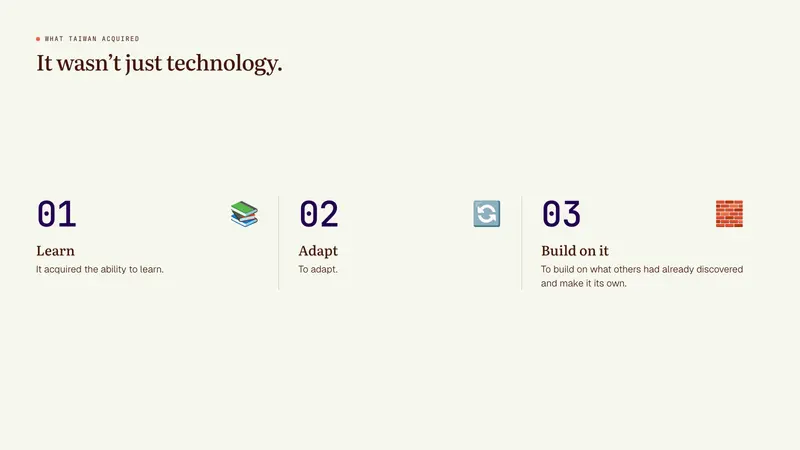
  • Citations Inline source badge, source-detail carousel and complete reference list.
Citations reference

AI Elements Inline Citation Open live preview
Additional composition references: AI Elements Inline Citation — https://elements.ai-sdk.dev/components/inline-citation
Labelled beats adapted layout previewPreview layout

Labelled beats

S18

Which voice or argumentative beat am I reading now?
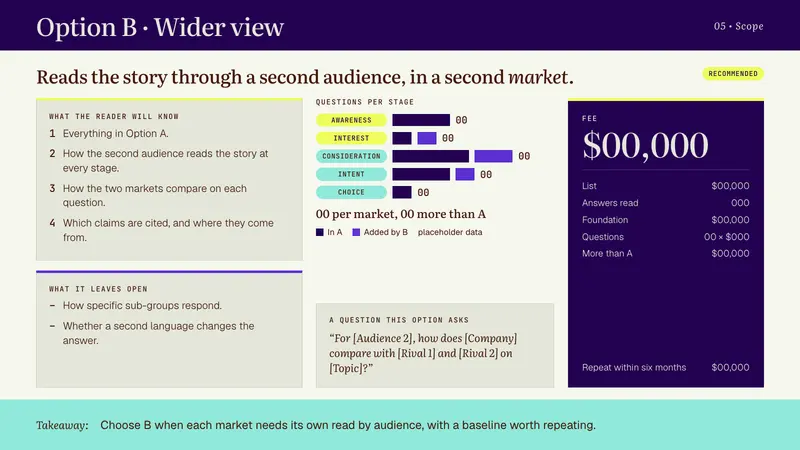
Colour & variationsPaper · Default
Use with AI

Copy this prompt. Add your content, brand and output format. The public layout files are linked below.

Layout HTML / live preview
Content slots and credits

How to use this prompt
Details & source

Use when
A structured take where the reader should see the parts of the argument.

Meaning & narrative

Reader question
Which voice or argumentative beat am I reading now?

Reasoning relationship
labelled argument beats

Meaning and reuse: reviewed · layout interpretation; author intent unverified.

The point
Different kinds of material are labelled so readers can distinguish event, interpretation and counterpoint.

Communication job
Explain a development while keeping the writer’s view separate from the reported basis.

What the audience gains
Explanation and perspective: helps readers judge which statements are observations, evidence or interpretation.

How to read it
Read each margin label before its paragraphs.
Inspect the chart where its beat introduces the relevant evidence.
Compare the interpretation with any counterpoint or qualification rather than collapsing them into one voice.

How to adapt it

Inputs needed
Two to five named beats with distinct rhetorical jobs.
Evidence for reported claims.
A chart with genuine definitions/source or an explicitly labelled illustrative diagram.

What belongs in each slot
beats: Two to five labelled sections such as observation, interpretation and limitation; each label must describe its actual content.

chart: A relevant chart or diagram with title, units where applicable and source/status line.

What can change
Beat names and their order when argument supports it.
Chart or illustration format without obscuring evidence status.

What must survive
Labels accurately classify the text.
Chart provenance remains attached.
Opinion is not dressed as observed fact.

Before this page
Introduce the event or question and its relevance.

What it prepares next
Develop the implication or competing explanation the beats expose.

Good uses
Reported analysis
A finding with counterpoint
An explainer separating fact and view

Poor fits
A transcript needing speaker-level attribution
An undifferentiated essay with decorative labels

Fictional worked example

Fictional worked example
Fictional repair cooperative proposal; all events, people and evidence are invented teaching material.

Example slot fills
beats: Proposal: The cooperative will record why each enquiry cannot proceed.
Working view: Distinguishing parts delays from diagnosis delays could improve booking decisions.
Qualification: A readiness check may add work without reducing delay; the pilot must measure that burden.

chart: Proposed enquiry categories: parts unavailable, diagnosis pending, access unconfirmed; illustrative taxonomy, no measured counts.

Why the example works
The labels stop a proposed process, a hypothesis and its limitation from being mistaken for one established finding.

Example qualification
Fictional teaching example only. Proposed benefits and results are not verified; replace with authorised material for a real use.

Evidence and review limits

Observed in the inspected material
Viewed source: prose with an embedded chart, visible source line and qualifying discussion; source capture is cropped and partially obscured by a cookie notice, so full beat labelling is supported by current markup rather than that crop.
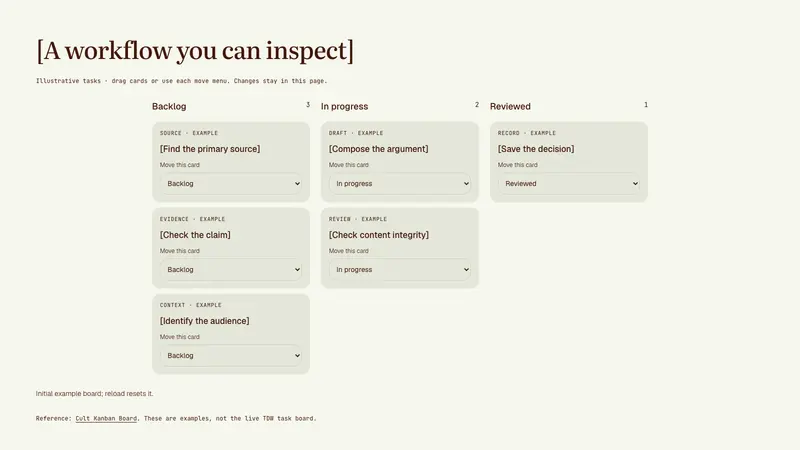
Current HTML and active slot contract were inspected.

Interpretation for reuse
The guidance interprets the layout’s communication affordances; it does not assert source-author intent.

Not verified
Original author intent, surrounding source sequence, sample factual claims and persuasion effects are not independently verified.

References inspected
02_product/spreads/S18-labelled-beats/source.webp
dist/S18-labelled-beats/spread.html
dist/S18-labelled-beats/spread.json
https://www.semafor.com/article/10/07/2026/china-is-coming-slowly-for-the-dollar

Review basis
reviewed: Viewed retained source capture and inspected current markup/slot contract; reviewed reasoning and example mapping. This is layout-contract review, not source-intent confirmation.

Relationship to the default
base

Read the semantic guide · Review coverage

labelled-beats · standard · 2 columns · deck / page

Original reference · Semafor

Semafor article, Semaform body
Visit original source

Slot reference · all variations

beats
2-5 x (beat label + paragraphs) in one reading columnlabel 1-4 words
chart
chart with title, source line and the TDW bandone per beat at most
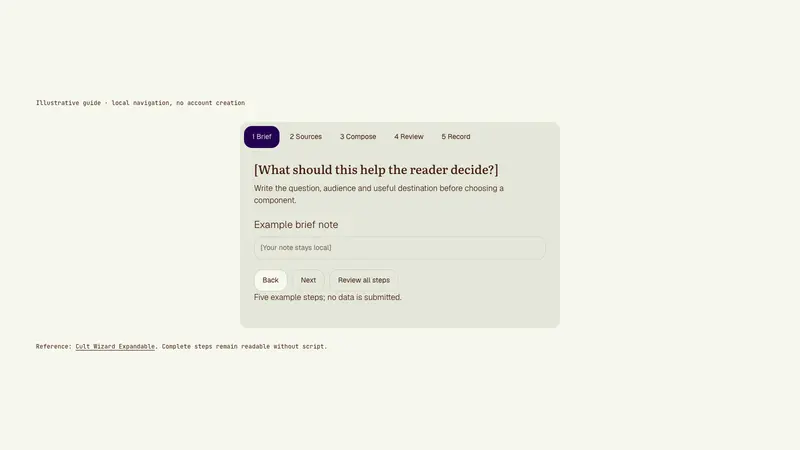
transcript
opt-transcript: title, standfirst, intro, then speaker turns (label, question or answer), one hanging quote, one video figureany length

Variations

  • Transcript Interview transcript: speaker names as right-aligned margin labels, questions bold and answers regular, a hanging-quote-mark quote and an inline video figure
Open live preview
Scroll dial adapted layout previewPreview layout

Scroll dial

S80

Where am I in this unfolding argument or process?

Colour & variationsPaper · Default
Use with AI

Copy this prompt. Add your content, brand and output format. The public layout files are linked below.

Layout HTML / live preview
Content slots and credits

How to use this prompt
Details & source

Use when
Inside a long read, when the order of events is the point. Any number of steps.

Meaning & narrative

Reader question
Where am I in this unfolding argument or process?

Reasoning relationship
sequential reading and position awareness

Meaning and reuse: reviewed · layout interpretation; author intent unverified.

The point
A sequence of decisions becomes understandable as the reader moves through it, while a persistent cue locates the current passage.

Communication job
Guide the reader through an unfolding argument without losing their place.

What the audience gains
Offers explanation and orientation: what changed at this point, and how does it prepare the next? Position tracking does not turn chronology into proof of causation.

How to read it
Read the section framing, then the first complete passage.
Follow passages in their authored order; each should change the reader’s understanding.
Use the dial’s caption and active rail entry as position cues; they summarise the current passage, not a second argument.

How to adapt it

Inputs needed
Two to eight complete passages with a short rail label, optional numeric value and accurate caption for each.
A generated position cue derived from the same passage labels and values; do not author contradictory independent copy.

What belongs in each slot
steps: Two to eight complete passages with a short rail label, optional numeric value and accurate caption for each.

dial: A generated position cue derived from the same passage labels and values; do not author contradictory independent copy.

What can change
Replace the fictional subject and its supported content while retaining the roles and relationship described here.

What must survive
Keep every passage readable in static and reduced-motion states.
Labels, captions and numeric values must refer to the same step.
Retain a defensible bridge between beats; sequence alone does not establish cause.

Before this page
Establish the problem that made the old approach insufficient.

What it prepares next
State the common lesson across the decisions and qualify what remains inference.

Good uses
Long-form process explanation.
A dated argument whose milestones need prose.

Poor fits
An unordered feature list.
A timeline whose scroll position is mistaken for elapsed time.

Fictional worked example

Fictional worked example
Fictional Cedar moves from an overwhelmed repair day to a repeatable workshop method.

Example slot fills
steps: The failed format | January | Cedar ran an open repair day; visitors waited for help because only two volunteers knew the intake process. The visible queue exposed a capability gap, not simply a lack of tables.
A shared intake method | February | Volunteers wrote and rehearsed a safety-first intake checklist. This established a repeatable starting point before adding more sessions.
A learning loop | March | Each session ended with a short review of the hardest intake questions. The team revised the checklist after the review rather than treating the first version as finished.
A larger service | April | Cedar could then try a second venue with trained volunteers and a common checklist. The earlier investments made expansion plausible; this fictional sequence alone does not prove they caused success.

dial: Derive January → February → March → April and the four passage captions from the same authored steps.

Why the example works
Each beat explains a capability that the next beat uses, preserving the source adaptation’s retrospective capability-building reading rather than a list of unrelated dates.

Example qualification
Fictional teaching example. Replace invented details with authorised content and keep any source, scope, status or uncertainty that affects interpretation.

Evidence and review limits

Observed in the inspected material
Viewed base source: running prose is accompanied by a year/caption and a small sequence rail.
Current HTML contains four .step passages with data-label/data-value/data-cap and a derived .dial; the conceptual steps/dial names are not data-slot attributes.
The corrected matching contract explicitly maps steps to .steps .step and dial to .dial for dial states; section-rail instead uses its active story wrapper.

Interpretation for reuse
A sequence of decisions becomes understandable as the reader moves through it, while a persistent cue locates the current passage. This is an interpretation of the inspected composition, not a verified claim of author intent.

Not verified
Original author intent, historical claims, persuasion and archive-wide frequency have not been independently verified.

References inspected
02_product/spreads/S80-scroll-dial/source.webp
02_product/spreads-semantics-2026-10-13/dist/S80-scroll-dial/spread.html
02_product/spreads-semantics-2026-10-13/dist/S80-scroll-dial/spread.json

Review basis
reviewed: Viewed the retained base source capture and inspected current HTML and matching slots; reviewed the fictional adaptation at layout-contract level. Rechecked integrated matching on 2026-10-13: required roles, example fills and repeated-item counts agree. Previously provisional because conceptual steps/dial roles lacked explicit markup mapping. The integrated contract now maps the four authored passages and derived dial explicitly; section-rail retains only its active story role. Historical issue details remain in contract-issues-reading.json. This review does not establish original author intent or verify playback.

Relationship to the default
base

Read the semantic guide · Review coverage

scroll-steps · standard · 2 columns · page

Original reference · TDW

Private deck reference; original evidence retained in the private Spreads library.

Slot reference · all variations

steps
ordered prose blocks, each with data-label (rail), optional data-value (rolling number) and data-cap (one-line caption)2-8 steps
dial
empty <aside class="dial">, built by dial.js; optional data-titlefixed

Variations

  • Dial left Dial on the left
  • No odo No rolling number, caption and rail only
  • No rail No rail
  • Section rail Plain sticky section list left, authored panels right; links jump to each passage and active state follows scroll. No dial or rolling number in this option; mobile list flows above the text.

Section rail reference

Cult Feature Sticky Section Open live preview

Additional composition references: ObsidianUI Scroll Stack (https://www.obsidianui.dev/docs/scroll-stack, read 2026-09-23; removed in the 2026-09-23 site reset, no archive copy) · Rare UI Animated counter (https://www.rareui.com/components/animatedcounter; MIT + Commons Clause + Attribution since 2026-09-22: a shipped page using this odometer must link rareui.com visibly) · Cult Feature Sticky Section (https://www.cult-ui.com/docs/components/feature-sticky-section; captured 2026-10-10; private reference capture; independent native implementation) · Nexvyn Table of Contents (https://ui.nexvyn.dev/components/table-of-contents; documentation reference only, no code copied; MIT + Commons Clause licence flag retained)

Two-column essay adapted layout previewPreview layout

Two-column essay

S82

What developed argument needs two reading columns?

Colour & variationsPaper · Default
Use with AI

Copy this prompt. Add your content, brand and output format. The public layout files are linked below.

Layout HTML / live preview
Content slots and credits

How to use this prompt
Details & source

Use when
When a passage of continuous reading should fill a slide or a wide page section without becoming one long measure. For one column of prose use S02 Reading; for labelled beats use S18.

Meaning & narrative

Reader question
What developed argument needs two reading columns?

Reasoning relationship
long-form exposition with column hierarchy

Meaning and reuse: reviewed · layout interpretation; author intent unverified.

The point
A developed argument moves from an observation to its interpretation and implications across two reading columns.

Communication job
Give enough prose to explain why the conclusion follows, rather than compressing a nuanced argument into labels.

What the audience gains
Offers explanation and perspective. It addresses “What is the reasoning behind that claim?” while leaving qualifications in the reading path.

How to read it
Read the title and kicker for the argument’s frame.
Read the first column to establish the observation or premise.
Continue into the second column for the turn, explanation and qualification.
Use the credit row to identify authorship and context, not as evidence for the claim.

How to adapt it

Inputs needed
The governing conclusion that both columns develop.
A short topic or section identifier.
Two prose passages, normally 60–120 words each, connected as one argument.
Names the turn or supporting idea within the second passage.
Three compact authorship/context items; use accurate identifiers, not fabricated authority.

What belongs in each slot
headline: The governing conclusion that both columns develop.

kicker: A short topic or section identifier.

columns: Two prose passages, normally 60–120 words each, connected as one argument.

subhead: Names the turn or supporting idea within the second passage.

credits: Three compact authorship/context items; use accurate identifiers, not fabricated authority.

What can change
Replace the fictional subject and its supported content while retaining the roles and relationship described here.

What must survive
Preserve the connection between premise, interpretation and implication.
Do not split qualifiers away from the claim they limit.
Maintain continuous reading when columns stack on mobile.

Before this page
Describe the symptom and why a decision is needed.

What it prepares next
Show the proposed test or operational change.

Good uses
An editorial explanation with a meaningful reasoning turn.

Poor fits
A comparison that needs aligned criteria.
Dense legal or technical detail that cannot be read at the chosen size.

Fictional worked example

Fictional worked example
Fictional Cedar investigates why workshop visitors wait.

Example slot fills
headline: Fix the handoff before adding tables

kicker: Service design · example

columns: A crowded repair day can look like a successful event while exposing a weak service. In Cedar’s fictional pilot, visitors reached a table quickly but waited while volunteers repeated the same intake questions. Adding tables would have created more places to wait. The team therefore treated the queue as a signal to inspect the handoff between arrival and repair, rather than as evidence that the event simply needed to become larger.

The proposed response was to make that handoff teachable. A short safety checklist would give every volunteer the same opening questions, while a daily review would capture cases the checklist missed. This is a hypothesis about the service, not a measured result. Cedar should test whether first-time volunteers can apply the checklist, then observe whether waiting changes. Expansion earns its place only after the team understands which part of the new method actually helps.

subhead: Make the handoff teachable

credits: Cedar example team | Fictional pilot | Discussion draft

Why the example works
The first column challenges an easy diagnosis; the second proposes a testable mechanism while retaining uncertainty. Equal columns are successive reading, not automatically opposing opinions.

Example qualification
Fictional teaching example. Replace invented details with authorised content and keep any source, scope, status or uncertainty that affects interpretation.

Evidence and review limits

Observed in the inspected material
Viewed base source: a title/kicker, drop-cap first column, second prose column and three credits.
Current markup uses one columns wrapper with two visible prose regions; optional side headings and third column are separately controlled.

Interpretation for reuse
A developed argument moves from an observation to its interpretation and implications across two reading columns. This is an interpretation of the inspected composition, not a verified claim of author intent.

Not verified
Original author intent, historical claims, persuasion and archive-wide frequency have not been independently verified.

References inspected
02_product/spreads/S82-two-column-essay/source.webp
02_product/spreads-semantics-2026-10-13/dist/S82-two-column-essay/spread.html
02_product/spreads-semantics-2026-10-13/dist/S82-two-column-essay/spread.json
https://webslides.tv/demos/landings#slide=26

Review basis
reviewed: Viewed the retained base source capture and inspected current HTML and matching slots; reviewed the fictional adaptation at layout-contract level.

Relationship to the default
base

Read the semantic guide · Review coverage

prose · dense · 2 columns · deck / page

Original reference · WebSlides

WebSlides landings 26
Visit original source

Slot reference · all variations

headline
small title, top leftunder 9 words
kicker
a mono line under the title: part, series or section2-5 words
columns
running prose in two columns; column one opens with a drop cap; one or two phrases may be set bold60-120 words per column
subhead
a short heading that breaks the second columnunder 6 words
credits
three small items centred under the text: byline, part, reading time or a contact2-5 words each
gloss
gloss option: a lead-in sentence in the narrow left columnunder 20 words
column-heading
side-note options: a small heading over each column1-3 words
foot-band
foot option: a takeaway or source in a band across both columnsunder 18 words

Variations

  • Five seven Columns split 5 to 7 instead of evenly
  • Gloss A narrow lead-in or gloss column (3 to 9) beside one wide reading column
  • Foot A full-width band under both columns for a takeaway or source, instead of the credit row
  • Side left Side notes: a narrow notes column then the main text (1 to 2), each with a small heading
  • Side right Side notes: the main text then a narrow notes column (2 to 1), each with a small heading
  • Three Side notes either side of the main text (1 to 2 to 1), each with a small heading
Open live preview
Q and A grid adapted layout previewPreview layout

Q and A grid

S84

Which common objections can I resolve by scanning short answers?

Colour & variationsPaper · Default
Use with AI

Copy this prompt. Add your content, brand and output format. The public layout files are linked below.

Layout HTML / live preview
Content slots and credits

How to use this prompt
Details & source

Use when
A Q and A slide at the end of a talk, or an article's questions section, when every answer is short enough to show open and the reader should scan them side by side.

Meaning & narrative

Reader question
Which common objections can I resolve by scanning short answers?

Reasoning relationship
parallel questions and answers

Meaning and reuse: reviewed · layout interpretation; author intent unverified.

The point
A small set of practical objections can be resolved independently with complete short answers.

Communication job
Help the reader find the question that would otherwise prevent a decision.

What the audience gains
Offers explanation and reassurance. It addresses concrete uncertainties without claiming these are proven frequent questions.

How to read it
Read the title and introduction to identify the scope.
Scan question headings for the objection that matters.
Read each complete answer, including its limit.
Use the foot link when the listed answers do not resolve the issue.

How to adapt it

Inputs needed
Names the decision or topic these questions support.
Explains who the answers are for and their scope.
Four to six distinct question–answer pairs; answers must directly address the question and retain conditions.
A real route for an unanswered question, not a dummy destination.

What belongs in each slot
title: Names the decision or topic these questions support.

dek: Explains who the answers are for and their scope.

questions: Four to six distinct question–answer pairs; answers must directly address the question and retain conditions.

foot: A real route for an unanswered question, not a dummy destination.

What can change
Replace the fictional subject and its supported content while retaining the roles and relationship described here.

What must survive
Questions and answers remain paired.
Keep disqualifying conditions visible.
Do not assert question frequency without evidence.

Before this page
Introduce the offer or proposal.

What it prepares next
Invite a decision or give the next action.

Good uses
Participation or service clarification.
A concise objection-handling appendix.

Poor fits
An ordered technical explanation.
Marketing claims disguised as questions nobody has asked.

Fictional worked example

Fictional worked example
Fictional Cedar explains attendance before a workshop.

Example slot fills
title: Before you join

dek: What to expect at Cedar’s fictional repair workshop.

questions: Can beginners attend? Yes. The fictional pilot starts with a guided safety check; participants do not work alone.
Must I bring tools? No. The fictional pilot supplies the listed basic tools; unusual parts need prior agreement.
Will every item be repaired? No. Volunteers may stop when safe repair is outside their capability.
What should I bring? One item and its history, so intake can identify likely faults.
Can I watch without an item? Yes, within the fictional room capacity; reserve a place first.
Where is follow-up help? The fictional guide lists approved next steps and referral contacts.

foot: Unanswered question? Contact the workshop coordinator.

Why the example works
Each answer removes a different uncertainty about participation; the grid is for scanning, not steps in a process.

Example qualification
Fictional teaching example. Replace invented details with authorised content and keep any source, scope, status or uncertainty that affects interpretation.

Evidence and review limits

Observed in the inspected material
Viewed source: six open question-and-answer pairs in two columns under a heading and introduction, plus a contact line.
Current rail option hides the fifth and sixth items.

Interpretation for reuse
A small set of practical objections can be resolved independently with complete short answers. This is an interpretation of the inspected composition, not a verified claim of author intent.

Not verified
Original author intent, historical claims, persuasion and archive-wide frequency have not been independently verified.

References inspected
02_product/spreads/S84-qa-grid/source.webp
02_product/spreads-semantics-2026-10-13/dist/S84-qa-grid/spread.html
02_product/spreads-semantics-2026-10-13/dist/S84-qa-grid/spread.json
https://oss.tailark.com/view/veil-faqs-4?theme=light

Review basis
reviewed: Viewed the retained base source capture and inspected current HTML and matching slots; reviewed the fictional adaptation at layout-contract level.

Relationship to the default
base

Read the semantic guide · Review coverage

faq · medium · 2 columns · deck / page

Original reference · Tailark

Tailark veil faqs 4
Visit original source

Slot reference · all variations

title
centred serif title2-4 words
dek
one line under the title; the intro paragraph in the rail optionunder 16 words (rail: under 30)
questions
six items in two columns, each a bold one-line question over a 1-3 line answer; the rail option shows the first four as a 2x2question under 9 words, answer under 30 words
foot
a 'more questions' pointer with one linkunder 10 words

Variations

  • Rail Title, intro and contact line in a hairline-topped left rail; a 2x2 grid of questions on the right with a small ornament between the rows
Open live preview
Question list adapted layout previewPreview layout

Question list

S85

Which detailed questions should I resolve in reading order?

Colour & variationsBone · Default
Use with AI

Copy this prompt. Add your content, brand and output format. The public layout files are linked below.

Layout HTML / live preview
Content slots and credits

How to use this prompt
Details & source

Use when
Questions whose answers run longer than a line or two, read one after another: the explainer's 'what readers ask' section, or a Q and A slide where the answers must be read in order.

Meaning & narrative

Reader question
Which detailed questions should I resolve in reading order?

Reasoning relationship
ordered questions and disclosed answers

Meaning and reuse: reviewed · layout interpretation; author intent unverified.

The point
A sequence of reader questions unpacks a topic, with each answer adding context for what follows.

Communication job
Resolve questions in a readable order while making each answer directly discoverable.

What the audience gains
Offers explanation and reassurance. It addresses conceptual and practical uncertainty through full answers, not question labels alone.

How to read it
Read the introduction to establish what this question set covers.
Read or scan questions from basic scope toward implications.
Use each answer to understand the next question.
Keep fuller method or contact context in the surrounding narrative; the default hides its foot link.

How to adapt it

Inputs needed
Frames the topic and the reason for this question set.
Names the question set.
Three to six complete question–answer pairs, in a deliberate order; grouped mode also needs category labels.

What belongs in each slot
intro: Frames the topic and the reason for this question set.

title: Names the question set.

questions: Three to six complete question–answer pairs, in a deliberate order; grouped mode also needs category labels.

What can change
Replace the fictional subject and its supported content while retaining the roles and relationship described here.

What must survive
Every question needs an accessible complete answer.
Category labels should organise actual reader needs.
Do not use closed rows to conceal material conditions.

Before this page
Explain the pilot’s purpose.

What it prepares next
Move to participation, implementation or the full method.

Good uses
A narrative FAQ or methodology explanation.

Poor fits
A multi-criterion comparison.
Essential answers hidden behind nonfunctional controls.

Fictional worked example

Fictional worked example
Fictional Cedar explains its repair pilot’s limits.

Example slot fills
intro: Cedar’s fictional pilot tests a repeatable repair intake method before expanding.

title: About the pilot

questions: Can beginners attend? Yes. The fictional pilot starts with a guided safety check; participants do not work alone.
Will every item be repaired? No. Volunteers may stop when safe repair is outside their capability.
What should I bring? One item and its history, so intake can identify likely faults.
Where is follow-up help? The fictional guide lists approved next steps and referral contacts.

Why the example works
Start with eligibility, then limits, preparation and follow-through; the ordering supports understanding while each answer remains usable on its own.

Example qualification
Fictional teaching example. Replace invented details with authorised content and keep any source, scope, status or uncertainty that affects interpretation.

Evidence and review limits

Observed in the inspected material
Viewed source: a narrow column of question rows with disclosure chevrons.
Current default keeps four answers visible; grouped CSS hides .a answers but the HTML has non-button rows and no dedicated disclosure script.
Corrected default matching omits the hidden foot and requires intro, title and question-and-answer pairs.

Interpretation for reuse
A sequence of reader questions unpacks a topic, with each answer adding context for what follows. This is an interpretation of the inspected composition, not a verified claim of author intent.

Not verified
Original author intent, historical claims, persuasion and archive-wide frequency have not been independently verified.

References inspected
02_product/spreads/S85-question-list/source.webp
02_product/spreads-semantics-2026-10-13/dist/S85-question-list/spread.html
02_product/spreads-semantics-2026-10-13/dist/S85-question-list/spread.json
https://reuters-graphics.github.io/graphics-components/iframe.html?id=components-text-elements-faqbox--demo&viewMode=story

Review basis
reviewed: Viewed the retained base source capture and inspected current HTML and matching slots; reviewed the fictional adaptation at layout-contract level. Rechecked integrated matching on 2026-10-13: required roles, example fills and repeated-item counts agree. Previously provisional because the default contract required its hidden foot. The integrated default contract now omits foot; all four visible question-and-answer pairs remain represented. Historical issue details remain in contract-issues-reading.json. This review does not establish original author intent or verify playback.

Relationship to the default
base

Read the semantic guide · Review coverage

faq · medium · 1 column · deck / page

Original reference · Reuters

Reuters FaqBox
Visit original source

Slot reference · all variations

intro
one paragraph of story text before the questions; the dek under the title in the side and groups optionsunder 35 words
title
the section heading2-4 words
questions
question rows between hairlines, each with a chevron and its open answer; four show by default. Groups option: questions sorted into category cards (icon and name), rows closed, up to sixquestion under 9 words, answer under 30 words; 2-4 groups of 2-3
foot
a contact pointer with one link (side and groups options only)under 10 words

Variations

  • Side Title, dek and contact line in a left column; the question list on the right
  • Groups Centred title and dek; questions grouped in stacked category cards with a small icon and name, rows closed
Open live preview
Split lede adapted layout previewPreview layout

Split lede

S86

What governing argument introduces the evidence that follows?

Colour & variationsDeep · Default
Use with AI

Copy this prompt. Add your content, brand and output format. The public layout files are linked below.

Layout HTML / live preview
Content slots and credits

How to use this prompt
Details & source

Use when
The opening section of an article or a talk's framing slide, when the claim needs a paragraph of argument beside it rather than a picture, and a few supporting points or figures underneath.

Meaning & narrative

Reader question
What governing argument introduces the evidence that follows?

Reasoning relationship
governing claim and explanatory setup

Meaning and reuse: reviewed · layout interpretation; author intent unverified.

The point
One governing claim is explained in prose and supported by a few named mechanisms or reasons.

Communication job
Introduce the argument and show why its supporting ideas belong together.

What the audience gains
Offers explanation and perspective. It addresses “What is your point, and what makes it plausible?” without treating labelled benefits as measured proof.

How to read it
Read the headline for the central claim.
Read the adjacent prose for the situation and reasoning.
Scan the support band to distinguish the mechanisms or reasons behind the claim.

How to adapt it

Inputs needed
States the governing claim, with an optional two-part turn.
Explains the situation and the proposed mechanism in one or two short paragraphs.
Three or four distinct supporting reasons; each has a short lead-in and a sentence connecting it to the claim.

What belongs in each slot
headline: States the governing claim, with an optional two-part turn.

body: Explains the situation and the proposed mechanism in one or two short paragraphs.

points: Three or four distinct supporting reasons; each has a short lead-in and a sentence connecting it to the claim.

What can change
Replace the fictional subject and its supported content while retaining the roles and relationship described here.

What must survive
Every support point must explain part of the governing claim.
Keep proposal status explicit until tested.
Numbers, when used, require their own scope and source.

Before this page
Name the current failure or opportunity.

What it prepares next
Show evidence for each mechanism or the plan to test it.

Good uses
An argument opener with concise support.

Poor fits
A complete case study needing methods and results.
Three unrelated features under an overbroad claim.

Fictional worked example

Fictional worked example
Fictional Cedar explains its proposed workshop operating method.

Example slot fills
headline: A workshop becomes repeatable when its handoffs are teachable

body: Cedar’s fictional pilot proposes a common intake method so new volunteers can start safely. The method would preserve what experienced volunteers know, while review sessions would capture exceptions. This is a testable design proposal, not evidence that waiting has already fallen.

points: Shared intake. Every volunteer starts with the same safety questions.
Visible limits. Difficult cases move to an experienced repairer.
Learning loop. End-of-session notes improve the next checklist.

Why the example works
The points are complementary mechanisms of repeatability, not three restatements of the claim.

Example qualification
Fictional teaching example. Replace invented details with authorised content and keep any source, scope, status or uncertainty that affects interpretation.

Evidence and review limits

Observed in the inspected material
Viewed source: a two-tone headline faces explanatory prose and four ruled support points.
Current two/numbers/plain states hide later body paragraphs; numbers replaces points with a three-member group.

Interpretation for reuse
One governing claim is explained in prose and supported by a few named mechanisms or reasons. This is an interpretation of the inspected composition, not a verified claim of author intent.

Not verified
Original author intent, historical claims, persuasion and archive-wide frequency have not been independently verified.

References inspected
02_product/spreads/S86-split-lede/source.webp
02_product/spreads-semantics-2026-10-13/dist/S86-split-lede/spread.html
02_product/spreads-semantics-2026-10-13/dist/S86-split-lede/spread.json
https://oss.tailark.com/view/dusk-content-4?theme=light

Review basis
reviewed: Viewed the retained base source capture and inspected current HTML and matching slots; reviewed the fictional adaptation at layout-contract level.

Relationship to the default
base

Read the semantic guide · Review coverage

lede · medium · 2 columns · deck / page

Original reference · Tailark

Tailark dusk content 4
Visit original source

Slot reference · all variations

headline
two short sentences, first muted and second strong (or one sentence)under 12 words
body
one or two paragraphs at reading measure (one in the two, numbers and plain options)under 70 words in all
points
three or four points between hairlines, each a small line icon, a bold lead-in and one sentence; two side by side in the two optionlead-in 1-3 words, sentence under 18 words
numbers
numbers option: three figures with a short label each, a hairline abovefigure 2-4 characters, label under 4 words

Variations

  • Two One paragraph, then two points side by side with no rules
  • Numbers A row of three small numbers with labels and top rules in place of the points
  • Plain Headline beside one paragraph, both vertically centred, nothing else
Open live preview
Entries list adapted layout previewPreview layout

Entries list

S87

What does each named person or term mean in this context?

Colour & variationsPaper · Default
Use with AI

Copy this prompt. Add your content, brand and output format. The public layout files are linked below.

Layout HTML / live preview
Content slots and credits

How to use this prompt
Details & source

Use when
When the reader needs to look up the cast or the vocabulary of a story without a card per person: two to six entries, each a name, a qualifier and a paragraph that hangs beside a small portrait tile. Between S28 Roster (one line each) and S29 Bio (one person in depth).

Meaning & narrative

Reader question
What does each named person or term mean in this context?

Reasoning relationship
named reference entries

Meaning and reuse: reviewed · layout interpretation; author intent unverified.

The point
Named participants or terms receive enough context for the reader to understand their distinct role in the story.

Communication job
Provide a reference entry that explains why each named subject matters.

What the audience gains
Offers orientation. It addresses “Who is this?” or “What does this term mean here?” without turning a portrait or title into an endorsement.

How to read it
Read the entry heading to find the subject.
Use the qualifier to locate their role or context.
Read the paragraph for the decision, contribution or definition relevant to this story.

How to adapt it

Inputs needed
Names the set of people or terms.
An authorised portrait or clearly fictional illustrative stand-in, paired with its correct entry.
The person or term being identified.
The specific role or context that distinguishes this entry.
Why the subject matters here; give the relevant action, authority or meaning in plain prose.

What belongs in each slot
title: Names the set of people or terms.

portrait: An authorised portrait or clearly fictional illustrative stand-in, paired with its correct entry.

name: The person or term being identified.

qualifier: The specific role or context that distinguishes this entry.

definition: Why the subject matters here; give the relevant action, authority or meaning in plain prose.

What can change
Replace the fictional subject and its supported content while retaining the roles and relationship described here.

What must survive
Keep identity, role and contribution attached to the same entry.
Use verified roles and dates for real subjects.
An illustrated stand-in must not be presented as a real portrait.

Before this page
Introduce the event or decision in which these subjects appear.

What it prepares next
Return to the narrative with roles understood.

Good uses
A cast of participants.
A glossary where each term needs contextual explanation.

Poor fits
A ranking or comparison of performance.
Invented biographies for real people.

Fictional worked example

Fictional worked example
Three fictional people have distinct responsibilities in Cedar’s workshop pilot.

Example slot fills
title: People in the pilot

portrait: Fictional illustrated coordinator portrait.
Fictional illustrated safety-lead portrait.
Fictional illustrated library-host portrait.

name: Mira Chen
Oren Vale
Lina Park

qualifier: Fictional pilot coordinator
Fictional safety lead
Fictional library host

definition: Mira coordinates intake and keeps the issue log. She connects the volunteer rota to the cases expected at the session.
Oren decides when a task exceeds the team’s safe repair capability and records unresolved safety questions. His role differs from coordinating attendance.
Lina manages the venue and access arrangements. Hosting the workshop does not make her the person who certifies repairs.

Why the example works
The entry format separates identity, role and actual contribution so a reader does not infer responsibility from seniority or portrait placement.

Example qualification
Fictional teaching example. Replace invented details with authorised content and keep any source, scope, status or uncertainty that affects interpretation.

Evidence and review limits

Observed in the inspected material
Viewed source: two portrait-led reference entries each combine a name, role and developed contextual paragraph.
Current HTML has three entries but only the first name/qualifier/definition is annotated; the corrected matching now uses explicit selectors and counts of three for each repeated portrait, name, qualifier and definition.

Interpretation for reuse
Named participants or terms receive enough context for the reader to understand their distinct role in the story. This is an interpretation of the inspected composition, not a verified claim of author intent.

Not verified
Original author intent, historical claims, persuasion and archive-wide frequency have not been independently verified.

References inspected
02_product/spreads/S87-entries-list/source.webp
02_product/spreads-semantics-2026-10-13/dist/S87-entries-list/spread.html
02_product/spreads-semantics-2026-10-13/dist/S87-entries-list/spread.json
https://reuters-graphics.github.io/graphics-components/iframe.html?id=components-text-elements-headpile--demo&viewMode=story

Review basis
reviewed: Viewed the retained base source capture and inspected current HTML and matching slots; reviewed the fictional adaptation at layout-contract level. Rechecked integrated matching on 2026-10-13: required roles, example fills and repeated-item counts agree. Previously provisional because only the first entry was fully annotated. Explicit selectors and counts now cover all three portraits, names, qualifiers and definitions; the fictional example supplies three matched records. Historical issue details remain in contract-issues-reading.json. This review does not establish original author intent or verify playback.

Relationship to the default
base

Read the semantic guide · Review coverage

entries · standard · 1 column · deck / page

Original reference · Reuters

Reuters Headpile
Visit original source

Slot reference · all variations

title
page title, top left of the columnunder 4 words
portrait
per entry: a head-and-shoulders cut-out portrait standing on a small tile, head rising above the tile's top edge; omitted for a glossary1:1 cut-out
name
per entry: bold name or term over a hairline (Name Surname unless a real, consenting person)2-5 words
qualifier
per entry: muted one-line role, part of speech or source typeunder 10 words
definition
per entry: the full paragraph, hanging in the text column (never under the tile)under 60 words
notes
notes option: labelled notes (Note, Sources, Edited by), each a bold label over one short line2-4 notes, one line each

Variations

  • Notes Compact end notes with no images: a bold label over one short line, stacked (Reuters EndNotes)
Open live preview
Prose with boxed aside adapted layout previewPreview layout

Prose with boxed aside

S88

What context must I know while following this argument?

Colour & variationsPaper · Default
Use with AI

Copy this prompt. Add your content, brand and output format. The public layout files are linked below.

Layout HTML / live preview
Content slots and credits

How to use this prompt
Details & source

Use when
When the reader needs a short briefing that is not part of the argument (where the data comes from, three things to know) without leaving the page. On a slide, use the side option so the box sits beside the text.

Meaning & narrative

Reader question
What context must I know while following this argument?

Reasoning relationship
main argument and contextual aside

Meaning and reuse: reviewed · layout interpretation; author intent unverified.

The point
A main argument continues around a clearly separated method or context note that the reader needs to interpret it.

Communication job
Supply necessary context at the point of use without confusing the note’s voice with the argument.

What the audience gains
Offers explanation and reassurance about scope. It answers “What must I know before accepting this passage?” and gives a route to fuller detail.

How to read it
Read the first paragraph for the claim or transition.
Pause at the labelled box for method, definition or scope.
Follow the link if greater detail is needed.
Resume the argument with the qualification in mind.

How to adapt it

Inputs needed
The argument that creates a need for clarification.
Names the kind of context, such as method or scope.
One or two short paragraphs of self-contained context.
A real source or fuller-method destination with an informative label.
The next argument beat, written so the box’s qualification still applies.

What belongs in each slot
prose-before: The argument that creates a need for clarification.

label: Names the kind of context, such as method or scope.

box-text: One or two short paragraphs of self-contained context.

link: A real source or fuller-method destination with an informative label.

prose-after: The next argument beat, written so the box’s qualification still applies.

What can change
Replace the fictional subject and its supported content while retaining the roles and relationship described here.

What must survive
The surrounding claim must remain true within the boxed qualification.
Keep the aside self-contained and clearly labelled.
Use an actual link destination when implemented.

Before this page
Establish the question or claim.

What it prepares next
Continue to evidence or a decision using the stated method.

Good uses
A method note within an argument.
A definition needed only at this point in a story.

Poor fits
Essential evidence relegated to an optional link.
A second unrelated argument competing with the first.

Fictional worked example

Fictional worked example
Fictional Cedar proposes a workshop evaluation with defined limits.

Example slot fills
prose-before: Cedar’s fictional pilot will test whether a shared intake checklist helps new volunteers start safely. A shorter queue would be useful, but it would not by itself show why waiting changed.

label: How the pilot is scoped

box-text: This fictional proposal covers one library and six sessions. Record waiting time from arrival at a repair table, not arrival at the building. Compare similar item types and retain cases stopped for safety. No measured improvement is claimed.

link: Read the pilot measurement plan

prose-after: The first review should therefore compare like-for-like cases and explain exceptions before recommending expansion.

Why the example works
The box defines what a waiting-time comparison would mean; the closing prose uses that definition rather than treating a raw average as the conclusion.

Example qualification
Fictional teaching example. Replace invented details with authorised content and keep any source, scope, status or uncertainty that affects interpretation.

Evidence and review limits

Observed in the inspected material
Viewed source: prose appears before and after a bordered context box with a label, explanatory paragraphs and a methodology link.
Current side moves the box beside the second paragraph; list replaces prose inside the box with three bullets.

Interpretation for reuse
A main argument continues around a clearly separated method or context note that the reader needs to interpret it. This is an interpretation of the inspected composition, not a verified claim of author intent.

Not verified
Original author intent, historical claims, persuasion and archive-wide frequency have not been independently verified.

References inspected
02_product/spreads/S88-boxed-aside/source.webp
02_product/spreads-semantics-2026-10-13/dist/S88-boxed-aside/spread.html
02_product/spreads-semantics-2026-10-13/dist/S88-boxed-aside/spread.json
https://reuters-graphics.github.io/graphics-components/iframe.html?id=components-text-elements-infobox--demo&viewMode=story

Review basis
reviewed: Viewed the retained base source capture and inspected current HTML and matching slots; reviewed the fictional adaptation at layout-contract level.

Relationship to the default
base

Read the semantic guide · Review coverage

prose-aside · standard · 1 column · deck / page

Original reference · Reuters

Reuters InfoBox
Visit original source

Slot reference · all variations

prose-before
one or two paragraphs of body copy in the text measure, set in serifunder 60 words
label
small-caps label at the top of the box (About this data, What you need to know)2-6 words
box-text
one or two short paragraphs inside the tinted, hairline-bordered boxunder 70 words in all
box-list
list option: three or four bullets, each opening with a bold lead-in phraseunder 20 words each
link
optional underlined link at the foot of the boxunder 7 words
prose-after
the prose resumes below the box (beside it in the side option)under 60 words

Variations

  • Side Slide form: prose about 60% on the left, the box about 35% on the right, level with the second paragraph
  • List The box holds three or four bullets with bold lead-ins instead of paragraphs (Reuters InfoBox lists story)
Open live preview
Flanking columns adapted layout previewPreview layout

Flanking columns

S92

How do the two explanations relate to the object between them?

Colour & variationsPaper · Default
Use with AI

Copy this prompt. Add your content, brand and output format. The public layout files are linked below.

Layout HTML / live preview
Content slots and credits

How to use this prompt
Details & source

Use when
When two parallel ideas each need a paragraph and one shared thing sits between them; or, with the links option, as a quiet where-to-go-next slide.

Meaning & narrative

Reader question
How do the two explanations relate to the object between them?

Reasoning relationship
paired explanation around a referent

Meaning and reuse: reviewed · layout interpretation; author intent unverified.

The point
Two complementary explanations orient the reader to a shared central referent.

Communication job
Explain two different aspects of one object or story without making them look like opposing choices.

What the audience gains
Offers perspective and navigation. It answers “What is this, and how do these two explanations help me understand it?”; symmetry does not establish equivalence.

How to read it
Read the title and subline to identify the shared subject.
Read one flanking explanation and inspect the central referent it describes.
Read the other flank as a complementary lens.

How to adapt it

Inputs needed
Names the common point linking both flanks.
Explains the two-lens relationship.
One aspect of the shared subject, with a short heading and explanation.
A contents tree or bounded diagram identifying the shared referent.
A distinct but complementary aspect of the same subject.

What belongs in each slot
title: Names the common point linking both flanks.

subline: Explains the two-lens relationship.

left: One aspect of the shared subject, with a short heading and explanation.

panel: A contents tree or bounded diagram identifying the shared referent.

right: A distinct but complementary aspect of the same subject.

What can change
Replace the fictional subject and its supported content while retaining the roles and relationship described here.

What must survive
Keep one shared referent across both flanks.
Do not infer quantitative meaning from left/right position.
Use actual destinations for links.

Before this page
Establish why the guide is being introduced.

What it prepares next
Open a section or demonstrate the method.

Good uses
Two-lens explanation around a shared object.
A contents-led orientation.

Poor fits
A comparison requiring consistent decision criteria.
Flanking copy unrelated to the central object.

Fictional worked example

Fictional worked example
Fictional Cedar introduces one repair guide through its purpose and use.

Example slot fills
title: A repair guide needs context and a method

subline: The purpose explains why; the steps explain how.

left: Why this guide exists | New volunteers need a safe starting point rather than a collection of isolated repair tips.

panel: Guide contents: 1 Safety scope; 2 Intake questions; 3 Stop conditions; 4 Referral routes; 5 Review notes.

right: How to use it | Start with the safety scope, follow intake questions, and stop when a case falls outside your training.

Why the example works
Both passages refer to the same guide; one gives motivation and the other use, rather than two alternatives to choose between.

Example qualification
Fictional teaching example. Replace invented details with authorised content and keep any source, scope, status or uncertainty that affects interpretation.

Evidence and review limits

Observed in the inspected material
Viewed source: explanatory passages flank a central folder tree.
Current HTML’s central illustration is hidden outside picture mode; links mode hides the title row and adds three reference rows on each flank.
Corrected matching no longer requests illustration outside picture mode; it retains only the selected state’s active roles.

Interpretation for reuse
Two complementary explanations orient the reader to a shared central referent. This is an interpretation of the inspected composition, not a verified claim of author intent.

Not verified
Original author intent, historical claims, persuasion and archive-wide frequency have not been independently verified.

References inspected
02_product/spreads/S92-flanking-columns/source.webp
02_product/spreads-semantics-2026-10-13/dist/S92-flanking-columns/spread.html
02_product/spreads-semantics-2026-10-13/dist/S92-flanking-columns/spread.json
https://webslides.tv/demos/classes#slide=18

Review basis
reviewed: Viewed the retained base source capture and inspected current HTML and matching slots; reviewed the fictional adaptation at layout-contract level. Rechecked integrated matching on 2026-10-13: required roles, example fills and repeated-item counts agree. Previously provisional because inherited matching required the hidden illustration. The integrated selected-state contract now omits illustration in default, middle and links while retaining each state’s visible explanation roles. Historical issue details remain in contract-issues-reading.json. This review does not establish original author intent or verify playback.

Relationship to the default
base

Read the semantic guide · Review coverage

flanking-columns · medium · 3 columns · deck / page

Original reference · WebSlides

WebSlides classes 18
Visit original source

Slot reference · all variations

title
centred title over the three columnsunder 9 words
subline
one centred line under the titleunder 12 words
left
left column: bold heading, paragraph, three-star ornamentheading under 7 words + under 40 words
panel
centre panel about a quarter of the slide width: a contents tree on a raised cardeyebrow + up to 10 short rows
right
right column mirroring the leftheading under 7 words + under 40 words
left-links
links option: three hairline-ruled rows, bold label then links3 rows, under 6 words each
right-links
links option: three hairline-ruled rows mirroring the left3 rows, under 6 words each
illustration
picture option: one square scene in place of the contents panel1:1

Variations

  • Middle The side columns sit level with the middle of the panel
  • Links No centred title: left-aligned columns with a large heading, a paragraph and hairline-ruled link rows
  • Picture One square illustration in place of the contents panel
Open live preview

Inputs and interaction

5 layouts
Halo dropzone adapted layout previewPreview layout

Halo dropzone

S107

What files can I select here, and where will they go?

Colour & variationsPaper · Default
Use with AI

Copy this prompt. Add your content, brand and output format. The public layout files are linked below.

Layout HTML / live preview
Content slots and credits

How to use this prompt
Details & source

Use when
A file attachment or intake surface deserves a calm, tactile invitation. This preview selects files locally; a production uploader requires a separately specified backend.

Meaning & narrative

Reader question
What files can I select here, and where will they go?

Reasoning relationship
file input and truthful local state

Meaning and reuse: reviewed · layout interpretation; author intent unverified.

The point
A file-input surface explains what can be selected and reports the actual local selection state.

Communication job
Help a person choose files and understand where those files have, and have not, gone.

What the audience gains
Offers operational reassurance. It answers “Can I select this file?” and “Has it been uploaded?”; selection is explicitly local and provides no transfer result.

How to read it
Read title and instruction for purpose and handling.
Use the drop target or native picker to select supported files.
Inspect the actual queue and validation feedback.
Remove incorrect selections; do not infer an upload from a selected state.

How to adapt it

Inputs needed
Names the local file-selection task.
States accepted material and the fact that selection stays local.
Zero or more actual selected file rows, derived from selection; never fabricate upload progress or successful transfer.

What belongs in each slot
title: Names the local file-selection task.

instruction: States accepted material and the fact that selection stays local.

files: Zero or more actual selected file rows, derived from selection; never fabricate upload progress or successful transfer.

What can change
Replace the fictional subject and its supported content while retaining the roles and relationship described here.

What must survive
Keep local-selection and upload states distinct.
Preserve type/size validation and truthful errors.
Queue rows must identify actual selections or explicitly labelled examples.
No network destination exists in this composition; production behaviour must be implemented and disclosed.

Before this page
Explain the intended preparation task and supported file types.

What it prepares next
Connect a real upload destination only through a separately implemented workflow.

Good uses
A local selection preview.
A file-intake UI demonstration.

Poor fits
A working upload promise with no destination.
Sensitive-data handling inferred from visual reassurance alone.

Fictional worked example

Fictional worked example
Fictional Cedar previews two materials before choosing a real sharing workflow.

Example slot fills
title: Select workshop materials

instruction: Choose images or documents for a local preview. Nothing uploads from this example; keep each file within 10 MiB.

files: Fictional selected row: intake-checklist.pdf — selected locally, not uploaded.
Fictional selected row: room-layout.png — selected locally, not uploaded.

Why the example works
The row confirms a local browser state, not receipt by a server. Sample rows must be labelled examples until actual user selection creates them.

Example qualification
Fictional teaching example. Replace invented details with authorised content and keep any source, scope, status or uncertainty that affects interpretation.

Evidence and review limits

Observed in the inspected material
Viewed source and source-focus captures: a title/instruction and broad file drop target with an active border.
Current HTML says files stay in the browser and contains separate actual and sample queues; accepted formats and 10 MiB limit are visible.

Interpretation for reuse
A file-input surface explains what can be selected and reports the actual local selection state. This is an interpretation of the inspected composition, not a verified claim of author intent.

Not verified
Original author intent, historical claims, persuasion and archive-wide frequency have not been independently verified.

References inspected
02_product/spreads/S107-halo-dropzone/source.webp
02_product/spreads-semantics-2026-10-13/dist/S107-halo-dropzone/spread.html
02_product/spreads-semantics-2026-10-13/dist/S107-halo-dropzone/spread.json
https://www.cult-ui.com/docs/components/halo-dropzone

Review basis
reviewed: Viewed the retained base source capture and inspected current HTML and matching slots; reviewed the fictional adaptation at layout-contract level.

Relationship to the default
base

Read the semantic guide · Review coverage

file-intake · compact · 1 column · page / deck

Original reference · Cult UI

Cult UI Halo Dropzone
Visit original source

Slot reference · all variations

title
short action headingunder 5 words
instruction
what to select and where it goesunder 25 words
files
actual filenames, byte sizes and removal controls; read halo.js and motion-native.json; selection stays local until a separately specified uploader is connectedone row per file

Variations

  • Queue Clearly labelled sample rows demonstrate selection layout; no fake upload progress.
  • Thumbnails Source-supported image preview inside the target; local object URLs only. Example file is explicitly labelled.

Native interaction & motion

No file transmission; no upload endpoint. Static halo and complete selection content; no moving trail, bob, blur or crossfade.

Native motion recipe Open live preview
Terminal walkthrough adapted layout previewPreview layout

Terminal walkthrough

S108

What command is being demonstrated, and what output supports it?

Colour & variationsPlum · Default
Use with AI

Copy this prompt. Add your content, brand and output format. The public layout files are linked below.

Layout HTML / live preview
Content slots and credits

How to use this prompt
Details & source

Use when
What does this command or technical step actually show?

Meaning & narrative

Reader question
What happens when I install, build, deploy or test this project?

Reasoning relationship
command and ordered response within related CLI scenarios

Meaning and reuse: reviewed · layout interpretation; author intent unverified.

The point
Show what a developer can expect when running the project’s install, build, deploy and test commands.

Communication job
Demonstrate a CLI workflow through command typing, staged output and a waiting prompt. Four tabs offer related operations in the same project.

What the audience gains
Makes an unfamiliar developer workflow concrete: which command starts each operation, what its output looks like and how completion is reported. A simulation demonstrates the experience; it does not prove an actual run succeeded.

How to read it
Choose the operation: install, build, deploy or test.
Watch the command type, then read the output in its authored order as each line arrives.
Distinguish ordinary progress, notable output and completion through wording and colour.
The waiting prompt closes the demonstration. Replay or show all four complete panels when close reading matters.

How to adapt it

Inputs needed
Four related operations in one real or clearly fictional project.
One exact command for each operation and the corresponding output, including progress and a clear end state.
Identify simulated examples versus captured output; keep actual versions, values and results grounded when claiming a real run.

What belongs in each slot
command: Four commands, each initiating the operation named by its tab. Avoid generic evidence placeholders.

output: Four matching transcripts. Preserve line order, the distinction between progress and completion, and each line’s reveal delay and colour role.

tabs: Install, build, deploy and test name the four operations in this example. Other related CLI operations can replace them.

What can change
Project, command syntax and corresponding output.
Operation labels when they still describe related CLI scenarios.
TDW surface and status colours through tokens, while retaining a distinct dark terminal and compact scenario selector.

What must survive
Command → paced output → waiting prompt, with automatic playback when the selected scenario changes.
Every output belongs to the selected command; colour reinforces textual meaning.
The source-like terminal silhouette, textured setting, monospace hierarchy and bottom scenario rail.
Reduced motion shows the complete active scenario immediately; Show all exposes all four transcripts.
Clearly label simulated output. Neither playback nor copying executes a command.

Before this page
Establish the developer task, the project and any prerequisites.

What it prepares next
Offer the real setup instructions or explain the next decision using actual project evidence.

Good uses
Developer-tool landing-page demonstrations.
CLI documentation and guided setup examples.
An explained replay of real command output when its source and context are supplied.

Poor fits
A general-purpose evidence or decision ledger.
A live terminal or deployment control.
Invented successful output presented as a measured result.

Fictional worked example

Fictional worked example
A fictional UI project demonstrates its four development operations. Package totals, times, routes and test outcomes are invented demo output; no commands were run.

Example slot fills
command: install: npm install

build: npm run build

deploy: npm run deploy

test: npm test

output: install:

added 146 packages in 4s

38 packages are looking for funding
run `npm fund` for details

Dependencies ready.

build:

Building the example project...

✓ Compiled application
✓ Checked types
✓ Generated pages (12/12)

Route Size
/ 42 kB
/guide 18 kB

✓ Build completed in 2.4s

deploy:

Preparing a preview deployment...

✓ Building
✓ Uploading assets
✓ Finalizing preview

Preview: https://example.invalid

Example deployment complete.

test:

PASS components/Button.test.ts
✓ renders its label
✓ responds to activation
PASS utils/format.test.ts
✓ formats the date
✓ preserves empty values

Test suites: 2 passed, 2 total
Tests: 4 passed, 4 total
Time: 1.2s

tabs: install
build
deploy
test

Why the example works
The operations belong to one development workflow. Each command produces a different ordered transcript and ends in a waiting prompt. The timing reveals how the workflow unfolds instead of decorating unrelated facts.

Example qualification
Fictional simulated session; example.invalid is intentionally non-resolving. Project scripts would need actual implementations. None of these results establish that a real package installed, project built, deployment happened or test passed.

Evidence and review limits

Observed in the inspected material
Retained Cult demo source has install/build/deploy/test tabs, a dark terminal over a textured backdrop, typed commands, per-line output delays and a trailing cursor.
Source implementation starts after300ms, types at25–60ms per character, pauses250ms, then reveals each authored output line.
The prior adaptation removed automatic scenario playback and line-by-line output, replaced the operations with inspect/compare/verify/record, and flattened the backdrop. Nic flagged the loss of essence.
The local restoration uses deterministic40ms typing, source-style sequencing, token-drawn texture and explicitly fictional CLI examples; it does not reproduce the source image pixel-for-pixel.

Interpretation for reuse
The staged transcript explains an operation as it unfolds. The terminal setting and waiting prompt identify it as a developer workflow; generic evidence labels change that communication job.

Not verified
Original author intent, historical claims, persuasion and archive-wide frequency have not been independently verified.

References inspected
02_product/spreads/S108-terminal-walkthrough/source.webp
02_product/spreads-semantics-2026-10-13/dist/S108-terminal-walkthrough/spread.html
02_product/spreads-semantics-2026-10-13/dist/S108-terminal-walkthrough/spread.json
https://www.cult-ui.com/docs/components/terminal-animation
02_product/spreads-intake-cult-ui-2026-10-10/items/terminal-animation-demo/files/001-terminal-animation-demo.tsx
02_product/spreads-intake-cult-ui-2026-10-10/items/terminal-animation/files/001-terminal-animation.tsx

Review basis
reviewed: Source code/capture and current repair compared after Nic’s fidelity feedback. The prior static-contract review missed the motion/content drift. Targeted native playback, controls and responsive checks are recorded separately; original author intent and measured persuasion remain unverified.

Relationship to the default
base

Read the semantic guide · Review coverage

terminal-walkthrough · standard · 1 column · page / deck

Original reference · Cult UI

Cult UI Terminal Animation
Visit original source

Slot reference · all variations

command
Actual command or explicitly labelled illustrative instructionone line
output
Verified output with source/date, or visibly bracketed placeholders3–8 lines per panel
tabs
A finite set of distinct scenarios4 panels

Variations

  • Code tabs Compact source-supported code window with tabs and copy feedback; no command playback.

Native interaction & motion

Local preview only. No submission, command execution or file transmission. Complete readable content, local controls retained; optional terminal typing skipped.

Native motion recipe

Code tabs reference

Cult UI Code Block Open live preview
Local choice adapted layout previewPreview layout

Local choice

S109

Which one of these four choices best answers this question?

Colour & variationsPaper · Default
Use with AI

Copy this prompt. Add your content, brand and output format. The public layout files are linked below.

Layout HTML / live preview
Content slots and credits

How to use this prompt
Details & source

Use when
Which option should I choose or prioritize?

Meaning & narrative

Reader question
Which one of these four choices best answers this question?

Reasoning relationship
choice and local confirmation

Meaning and reuse: reviewed · layout interpretation; author intent unverified.

The point
One local selection records which of four alternatives best answers a clearly posed question.

Communication job
Let a reader express a single preference and see the state they selected.

What the audience gains
Offers reflection and clarification. It answers “Which option fits my need?” without inventing a poll result, consensus or recommendation.

How to read it
Read the question and its selection criterion.
Compare the four labelled choices under that criterion.
Select one and confirm locally.
Read the confirmation as this browser’s state, not a submitted audience vote.

How to adapt it

Inputs needed
One unambiguous question with a clear choice criterion.
Four meaningful alternatives at the same level; use distinct labels and values.
Truthful local status before and after confirmation, derived from the selected choice.

What belongs in each slot
question: One unambiguous question with a clear choice criterion.

choices: Four meaningful alternatives at the same level; use distinct labels and values.

selection: Truthful local status before and after confirmation, derived from the selected choice.

What can change
Replace the fictional subject and its supported content while retaining the roles and relationship described here.

What must survive
Keep options comparable and the criterion explicit.
Local confirmation is not transmission or durable storage.
No aggregate percentages, votes or popularity claims should appear.

Before this page
Explain the objective and constraints for the choice.

What it prepares next
Discuss the reason for the selected option or record it through a real workflow.

Good uses
A local preference exercise.
A prototype of a one-choice interaction.

Poor fits
An audience vote without collection infrastructure.
A multi-select or ranked decision presented as one choice.

Fictional worked example

Fictional worked example
Fictional Cedar uses a workshop discussion to elicit one person’s immediate priority.

Example slot fills
question: Which workshop preparation issue should Cedar address first?

choices: Clarify the safety checklist
Label the tool storage
Rehearse volunteer intake
Improve referral information

selection: No choice confirmed; after selection: “Confirmed locally: Rehearse volunteer intake”.

Why the example works
The question asks for one first priority. The local answer is a preference under that question, not evidence about all participants.

Example qualification
Fictional teaching example. Replace invented details with authorised content and keep any source, scope, status or uncertainty that affects interpretation.

Evidence and review limits

Observed in the inspected material
Viewed source: one question, four radio choices and a submit-vote action.
Current adaptation confirms only local choice and explicitly states no aggregate results are shown or sent.

Interpretation for reuse
One local selection records which of four alternatives best answers a clearly posed question. This is an interpretation of the inspected composition, not a verified claim of author intent.

Not verified
Original author intent, historical claims, persuasion and archive-wide frequency have not been independently verified.

References inspected
02_product/spreads/S109-local-choice/source.webp
02_product/spreads-semantics-2026-10-13/dist/S109-local-choice/spread.html
02_product/spreads-semantics-2026-10-13/dist/S109-local-choice/spread.json
https://www.cult-ui.com/docs/components/choice-poll

Review basis
reviewed: Viewed the retained base source capture and inspected current HTML and matching slots; reviewed the fictional adaptation at layout-contract level.

Relationship to the default
base

Read the semantic guide · Review coverage

local-choice · standard · 1 column · page / deck

Original reference · Cult UI

Cult UI Choice Poll
Visit original source

Slot reference · all variations

question
A real question with a finite valid answer setone sentence
choices
Distinct options with accurate labels; optional explanations4 choices
selection
Only the current user selection or priority orderlocal state

Variations

  • Ranked list Source-supported tally row arrangement adapted to local priority ordering with drag and explicit Up/Down controls; no vote counts.

Native interaction & motion

Local preview only. No submission, command execution or file transmission. Complete readable content, local controls retained; optional terminal typing skipped.

Native motion recipe

Ranked list reference

Cult UI Vote Tally Open live preview
Workflow board adapted layout previewPreview layout

Workflow board

S110

Which lane currently contains each work item?

Colour & variationsPaper · Default
Use with AI

Copy this prompt. Add your content, brand and output format. The public layout files are linked below.

Layout HTML / live preview
Content slots and credits

How to use this prompt
Details & source

Use when
Where is each work item in the process?

Meaning & narrative

Reader question
Which lane currently contains each work item?

Reasoning relationship
work item and workflow state

Meaning and reuse: reviewed · layout interpretation; author intent unverified.

The point
Each work item belongs to one clearly defined state, so the audience can see what is pending, underway and reviewed.

Communication job
Make the current state of a small workflow inspectable and let a reader rehearse moving an item between states.

What the audience gains
Provides orientation and operational reassurance about where work stands. It answers “What still needs attention?” without claiming that a card movement proves work was done or saved.

How to read it
Read the title and handling note to learn whether this is a live system or a temporary example.
Read the lane names left to right as state definitions, not a calendar or priority ranking.
Inspect the six cards within their current lanes; labels identify the work, while lane membership identifies status.
Move a card only when its state changes; counts summarize membership and do not measure effort or completion quality.

How to adapt it

Inputs needed
A finite workflow with three unambiguous states and a rule for entering each.
Six bounded work items with current state; categories may describe work type.
A title naming the workflow and a truthful storage/reset disclosure.

What belongs in each slot
title: Names whose work is being tracked and the handling limit of this example.

lanes: Three mutually exclusive states of one workflow, ordered by progress. Each lane label must match every move-menu option.

cards: Six actual tasks or clearly labelled fictional examples. Each must be in the lane that describes its current state; a category is not a status.

What can change
Task wording, category labels and state names when the workflow remains finite and consistent.
The initial distribution of cards, with matching counts and move-menu selections.

What must survive
One card belongs to exactly one lane; counts reflect actual membership.
The move menu remains usable alongside dragging.
This implementation stores changes only in the page and resets on reload; never imply a shared or persistent task service.
State transitions need human or system criteria; moving a card is not completion evidence.

Before this page
Define the workshop and who decides that a task is reviewed.

What it prepares next
Discuss the blocked tasks, next owners or a real tool for persistent coordination.

Good uses
A small workflow demonstration.
A workshop conversation about current state and handoffs.

Poor fits
A dated roadmap or dependency diagram.
A production task tracker requiring durable history, permissions or shared updates.

Fictional worked example

Fictional worked example
Fictional Cedar is preparing a repair workshop. This is a disposable planning demonstration, not the cooperative’s real task system.

Example slot fills
title: Cedar workshop preparation — temporary example

lanes: Backlog
In progress
Reviewed

cards: Venue · example: Confirm the library room — Backlog
Materials · example: Count spare plugs — Backlog
Access · example: Check step-free entry — Backlog
Guide · example: Draft the safety checklist — In progress
Training · example: Review volunteer briefing — In progress
Record · example: Save the agreed workshop date — Reviewed

Why the example works
Room confirmation, stock count and access inspection are discrete tasks; their lane tells the reader whether work has started or passed review. None becomes a chronological milestone merely because it sits farther right.

Example qualification
Cards and status are fictional. This browser example resets on reload and has no team synchronisation, durable history or backend completion checks.

Evidence and review limits

Observed in the inspected material
Viewed source.webp: three status lanes hold six cards in a 3/2/1 distribution, with category and task labels.
Current HTML has three lanes, six cards, a move selector per card, lane counts and an explicit reload-reset message.

Interpretation for reuse
Lane membership represents current state; it does not by itself express task priority, duration or causal dependency.

Not verified
The source author’s intent, effectiveness with an audience and historical claims have not been independently verified.
No proposal archive or corpus validation was performed.

References inspected
02_product/spreads/S110-workflow-board/source.webp
02_product/spreads-semantics-2026-10-13/dist/S110-workflow-board/spread.html
02_product/spreads-semantics-2026-10-13/dist/S110-workflow-board/spread.json
https://www.cult-ui.com/docs/components/kanban-board

Review basis
reviewed: Inspected retained source capture, current HTML and selected matching contract; reviewed semantic roles and fictional adaptation, not persuasion or source facts.

Relationship to the default
base

Read the semantic guide · Review coverage

workflow-board · standard · 3 columns · page / deck

Original reference · Cult UI

Cult UI Kanban Board
Visit original source

Slot reference · all variations

lanes
An actual finite workflow with unambiguous state labels3 lanes
cards
Real work items and current states, or labelled examples6 example cards
title
Purpose and storage/handling limitsunder 12 words

Native interaction & motion

Local preview only. No submission, command execution or file transmission. Complete readable content, local controls retained; optional terminal typing skipped.

Native motion recipe Open live preview
Guided steps adapted layout previewPreview layout

Guided steps

S111

What instruction belongs to each of these five steps?

Colour & variationsPaper · Default
Use with AI

Copy this prompt. Add your content, brand and output format. The public layout files are linked below.

Layout HTML / live preview
Content slots and credits

How to use this prompt
Details & source

Use when
What should I do next, and why?

Meaning & narrative

Reader question
What instruction belongs to each of these five steps?

Reasoning relationship
ordered instruction and local progression

Meaning and reuse: reviewed · layout interpretation; author intent unverified.

The point
A five-step guide connects each stage of a task with the instruction needed at that moment.

Communication job
Help a reader move through a defined procedure while keeping the complete set of instructions available.

What the audience gains
Offers orientation and reassurance about what comes next. It answers “What do I do now?” without confusing navigation with task completion or validation.

How to read it
Read the numbered rail for the route through the task.
Open the current step and read its instruction and expected output.
Use Back/Next to move locally, or Review all steps to inspect the full method.
Treat completion as an external work state, not as reaching the final panel.

How to adapt it

Inputs needed
Five ordered labels that name meaningful stages.
Five corresponding instructional panels, each with a concrete output and relevant limit, under 60 words per panel.
Truthful local Back/Next/Review all controls; no submission or account creation.

What belongs in each slot
steps: Five ordered labels that name meaningful stages.

content: Five corresponding instructional panels, each with a concrete output and relevant limit, under 60 words per panel.

navigation: Truthful local Back/Next/Review all controls; no submission or account creation.

What can change
Replace the fictional subject and its supported content while retaining the roles and relationship described here.

What must survive
Step labels and panels must correspond one-to-one.
Keep prerequisites and outputs explicit.
Navigation does not validate completion, save records or submit data.
Complete steps must remain available without script.

Before this page
State the task, user and prerequisites.

What it prepares next
Use the real output or assign its next owner outside the preview.

Good uses
A bounded procedural guide.
An interactive walkthrough with a complete static view.

Poor fits
A production onboarding flow requiring validation or account creation.
An unordered set of tips.

Fictional worked example

Fictional worked example
Fictional Cedar uses a five-step guide to prepare and learn from a workshop.

Example slot fills
steps: Scope
Prepare
Run
Review
Record

content: 1 Scope: Name the workshop, audience and the safety boundary. Output: a one-sentence purpose and stop rule.

2 Prepare: Check the venue, tools and volunteer briefing. Output: a readiness record with unresolved gaps visible.

3 Run: Follow the intake checklist and refer cases outside the team’s capability. Output: an item-level record, not a claim that every item was repaired.

4 Review: Compare observed issues with the expected process. Output: a list of supported changes and unanswered questions.

5 Record: Save the agreed revisions, owner and next review date in a real system. Output: a versioned method; this local guide does not save or submit it.

navigation: Back | Next | Review all steps — local navigation only; no submission.

Why the example works
Each instruction produces the input the next stage needs. Navigating to Record does not prove the real records exist.

Example qualification
Fictional teaching example. Replace invented details with authorised content and keep any source, scope, status or uncertainty that affects interpretation.

Evidence and review limits

Observed in the inspected material
Viewed source: a five-step validated wizard has a step rail, current form panel and Back/Next controls.
Current adaptation is an illustrative composition guide with local input/navigation and a complete review state; it does not reproduce account creation.

Interpretation for reuse
A five-step guide connects each stage of a task with the instruction needed at that moment. This is an interpretation of the inspected composition, not a verified claim of author intent.

Not verified
Original author intent, historical claims, persuasion and archive-wide frequency have not been independently verified.

References inspected
02_product/spreads/S111-guided-steps/source.webp
02_product/spreads-semantics-2026-10-13/dist/S111-guided-steps/spread.html
02_product/spreads-semantics-2026-10-13/dist/S111-guided-steps/spread.json
https://www.cult-ui.com/docs/components/wizard-expandable

Review basis
reviewed: Viewed the retained base source capture and inspected current HTML and matching slots; reviewed the fictional adaptation at layout-contract level.

Relationship to the default
base

Read the semantic guide · Review coverage

guided-steps · standard · 1 column · page / deck

Original reference · Cult UI

Cult UI Wizard Expandable
Visit original source

Slot reference · all variations

steps
A real ordered process with meaningful step labels5 steps
content
Complete instructions for each step; label examplesunder 60 words per step
navigation
Back, next, direct tab selection and complete reviewlocal only
plan-title
opt-plan: Name the intended outcome.one bounded example; preserve readable static content
plan-summary
opt-plan: Bound the scope of the proposal.one bounded example; preserve readable static content
plan-content
opt-plan: State meaningful ordered steps and concrete outputs.one bounded example; preserve readable static content
plan-action
opt-plan: Provide a local copy, without implying approval or execution.one bounded example; preserve readable static content

Variations

  • Plan Expandable plan card with summary, overview, ordered steps and local download.

Native interaction & motion

Local preview only. No submission, command execution or file transmission. Complete readable content, local controls retained; optional terminal typing skipped.

Native motion recipe

Plan reference

AI Elements Plan Open live preview

Additional composition references: AI Elements Plan — https://elements.ai-sdk.dev/components/plan